Introduction
In regulated industries, documents are not administrative overhead — they are the audit. When a registrar arrives, they ask for procedures, revision histories, approval logs, and training records. What they find in those records determines the outcome.
Most teams already have some form of document storage. Shared drives, email chains, folder hierarchies on SharePoint — they exist in nearly every quality operation. But storing documents and controlling them are two different problems. A shared drive holds files. An integrated document management system controls them: who can see what version, who approved it, when it changed, and whether the team acknowledged the update.
This article explains what an integrated DMS actually changes — in audit readiness, compliance evidence, and daily quality operations — and why the gap between the two approaches costs teams citations they could have avoided.
Key Takeaways
- An integrated DMS connects documents directly to the workflows and standards they support, making every procedure findable, current, and traceable.
- Version control removes the most common nonconformity source: teams working from superseded procedures.
- Continuous audit trails mean evidence is already compiled before an auditor walks in — no last-minute scramble.
- Institutional knowledge is captured in the system, so critical procedures survive turnover.
- For regulated industries, a controlled DMS is operational infrastructure that your QMS depends on to function under audit pressure.
What Is an Integrated Document Management System?
An integrated document management system (IDMS) is a platform that captures, organizes, controls, and connects documents to the workflows, approvals, and standards they support — so records stay accurate wherever they are used.
AIIM defines document management as the use of computer systems and software to store, manage, and track electronic documents. An IDMS goes further: it makes documents functional inside live compliance processes, not just retrievable from a folder.
Where It Applies
Regulated industries are the primary context: aerospace, manufacturing, medical devices, EHS, and defense — anywhere auditors require traceable, version-controlled documentation tied to a specific standard or clause. Both AS9100D clause 7.5 and ISO 9001:2015 clause 7.5 require documented information to be controlled across distribution, access, retrieval, storage, and changes — meaning the system holding your documents must demonstrate that control, not just store the files.
What Separates It from Basic Storage
| Capability | Shared Drive / SharePoint | Integrated DMS |
|---|---|---|
| Version enforcement | None — any file can be overwritten | Single live revision; superseded versions archived |
| Approval workflow | Manual, via email | Built-in routing with segregation of duties |
| Audit trail | None | Append-only, tamper-evident log |
| Standards mapping | None | Documents linked to specific clauses |
| Evidence export | Manual assembly | One-click indexed PDF |
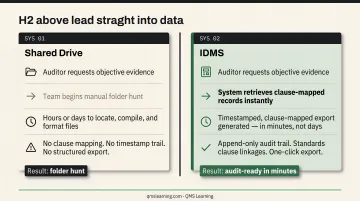
When an auditor asks for objective evidence, a shared drive produces a folder hunt. An IDMS produces a timestamped, clause-mapped export — in minutes, not days.
Key Advantages of an Integrated Document Management System
The advantages below focus on outcomes quality and compliance teams track directly: audit findings, evidence compilation time, nonconformity rates, and institutional knowledge stability.
Version Control That Prevents Nonconformities at the Source
The most common source of process nonconformities in regulated industries is not deliberate deviation. It is a team acting on a procedure that was superseded months ago — often without realizing it.
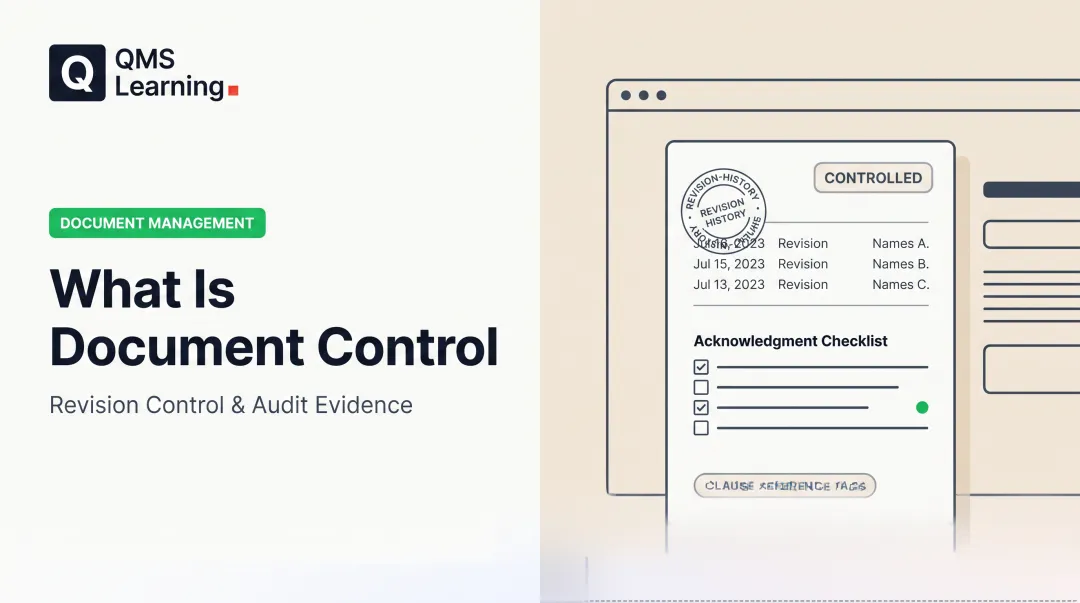
An integrated DMS eliminates this failure mode structurally. The system enforces one current version of every controlled document. Previous revisions are archived in an append-only history, visible for reference, but not accessible as active working documents. Approval routing ensures no revision goes live without the required sign-offs — with segregation of duties preventing the document author from approving their own revision.
Teams cannot pull an outdated SOP from a shared drive and act on it in good faith — the current version is the only version at the point of use.
KPIs this directly affects:
- Nonconformity rate
- CAPA volume
- Audit findings related to document control
- Rework on process-driven defects
When this matters most: Multi-site operations, high-document-volume quality systems, or environments where procedures change frequently due to engineering revisions or regulatory updates.
QMS Learning's DMS enforces this directly. When a new revision is approved, the prior revision transitions to superseded status and is retained in the append-only audit trail — permanently on the record, but clearly separated from the active document workspace. One live revision. Never a wrong copy.
Audit-Ready Evidence Without the Last-Minute Scramble
ISO 9001's Auditing Practices Group defines audit evidence as records, statements of fact, or other verifiable information relevant to audit criteria. The key word is verifiable. Assertions do not satisfy auditors — records do.
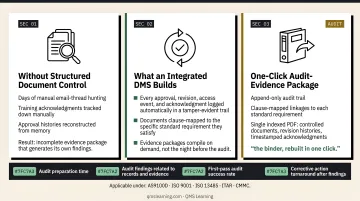
Audit preparation in organizations without structured document control typically means days of manual work: pulling email threads, tracking down training acknowledgments, reconstructing approval histories from memory. The result is often an incomplete evidence package that itself generates findings — not on process problems, but on document control.
An integrated DMS builds the audit evidence record continuously:
- Every approval, revision, access event, and acknowledgment is logged automatically in a tamper-evident trail
- Documents are clause-mapped to the specific standard requirements they satisfy — making compliance coverage visible before an auditor looks for gaps
- Evidence packages compile on demand, not the night before the audit
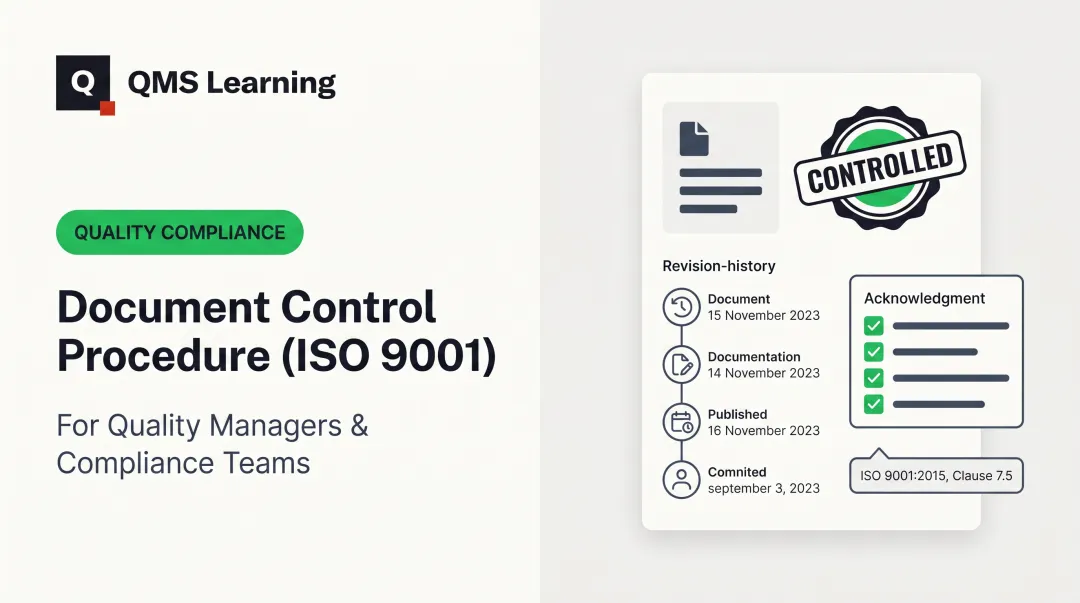
QMS Learning's DMS includes an append-only audit trail, clause-mapped linkages connecting each document to the standard clause it satisfies, and a one-click Audit-Evidence Package export — a single indexed PDF containing controlled documents, revision histories, and timestamped read-and-understand acknowledgments. QMS Learning describes it as "the binder, rebuilt in one click."
KPIs this directly affects:
- Audit preparation time
- Audit findings related to records and evidence
- First-pass audit success rate
- Corrective action turnaround after findings
When this matters most: Any team operating under AS9100D, ISO 9001, ISO 13485, ITAR, or CMMC — standards where objective evidence of document control is a specific audit requirement.
Institutional Knowledge That Stays in the System, Not in People's Heads
ISO 9001's guidance on documented information identifies knowledge sharing as one of three core purposes for maintaining documentation. In regulated industries, that purpose is overlooked until a key person leaves.
When the team member who "knows how the system works" departs, the next audit often exposes the gap. Auditors ask questions that should have straightforward answers — why this procedure looks the way it does, when it was last updated, who approved the change — and the team cannot answer without that individual in the room.
An integrated DMS removes that vulnerability. Every revision carries:
- A written summary of what changed and why
- The identity of the author and approver (separately, due to segregation of duties)
- Timestamps for each stage from draft through release
- Linkages to related records, training, and compliance artifacts
A new team member browsing a controlled document sees not just the current revision, but the complete history of how it evolved — who approved each change, what changed, and when. The rationale is in the record, not in someone's memory.
For growing organizations, this matters beyond continuity. Junior quality engineers become productive faster because the context is already documented. Senior staff are no longer the only ones who can navigate the QMS. When someone leaves unexpectedly, the compliance record doesn't leave with them.
KPIs this directly affects:
- Onboarding time for quality roles
- Senior quality staff dependency ratio
- Compliance continuity through personnel transitions
What Happens When an Integrated DMS Is Missing
The absence of an integrated DMS does not create a visible gap — until an auditor arrives or a nonconformity escapes. At that point, the gap becomes the finding.
These are the consequences that build quietly over time:
- Outdated procedures in circulation. Teams work from whatever version they saved locally or received by email. There is no mechanism to know if it is current.
- Evidence arrives incomplete. Manual compilation takes days and still misses records — triggering findings on document control, not on actual process performance.
- Knowledge concentrates in individuals. When those people leave or are unavailable, the system cannot answer basic auditor questions.
- CAPAs close but documents do not update. The root cause fix never propagates to the controlled procedure, so the same finding recurs at the next cycle.
- Administrative burden scales with growth. The harder it is to control documents manually, the more quality team time goes to document administration instead of compliance work.
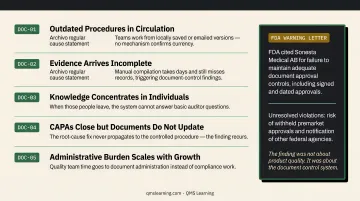
These consequences are not hypothetical. The FDA's warning letter to Sonesta Medical AB illustrates the regulatory cost directly: FDA cited the company for failure to maintain adequate document approval controls, including signed and dated approvals — and warned that unresolved violations could lead to withheld premarket approvals and notification of other federal agencies. The finding was not about product quality. It was about the document control system.
How to Get the Most Value from Your Integrated DMS
An integrated DMS delivers maximum value when it functions as the operating record of the QMS, not a storage archive consulted at audit time.
The conditions that determine actual value:
- Every controlled document lives in the system. SOPs, work instructions, forms, quality plans, and training acknowledgments belong in the DMS. Shared drives and email attachments sit outside the audit trail.
- Revision cycles run through the approval workflow. Every change is captured in the audit trail automatically. Email approvals and verbal sign-offs leave no record an auditor can verify.
- The DMS connects to training. When a procedure updates, assigned team members are notified and their acknowledgment is captured per revision, creating a closed loop between document control and workforce competence.
- Gaps surface before the audit. Because documents are clause-mapped, any standard clause with no document linked to it is visible in the system, not discovered by a registrar.
QMS Learning's platform handles item 3 automatically: a revised document triggers the change impact analysis, flags linked training, and records acknowledgment with a timestamp when team members confirm they have reviewed the new version.
QMS Learning's platform combines controlled document management, an AI compliance workbench, and practitioner-built training in a single bundle. The DMS is embedded in how the team does compliance work, which is why the evidence it produces is registrar-accepted rather than reconstructed.
Conclusion
An integrated DMS turns audit readiness from a last-minute scramble into a built-in system behavior — one that compounds in value the longer it runs.
The advantages build on each other: version control prevents nonconformities, audit trails reduce finding risk, and institutional knowledge stops walking out the door when key personnel leave. Each benefit reinforces the next.
The return shows up in every revision cycle, every approval logged, and every acknowledgment on record when an auditor asks for evidence. QMS Learning's controlled DMS is built to capture exactly that — with revision history, clause-mapped documents, and one-click audit-evidence export included from day one.
Frequently Asked Questions
What is an integrated document management system?
An integrated document management system is a platform that manages, controls, and connects documents to the workflows, approvals, and standards they support. Unlike basic file storage, it enforces version control, routes documents through approval workflows, logs every action in an audit trail, and links documents to the specific compliance clauses they satisfy.
What is the difference between DMS and ECM?
A DMS focuses on controlling the lifecycle of business and compliance documents — storage, version history, access, and retrieval. An ECM (Enterprise Content Management) system covers a broader scope including media, web content, and large-scale business process integration, and typically requires significantly more infrastructure than quality-focused teams need.
What is the difference between CMS and DMS?
A CMS (Content Management System) is designed for creating and publishing content — typically web pages or marketing materials. A DMS is designed for controlling the lifecycle of compliance documents, including revision history, approval workflows, and audit trail requirements that a CMS is not built to handle.
What are the main types of electronic document management systems?
The three main types are document imaging systems (converting paper to digital), document control systems (managing version, approval, and access), and integrated DMS platforms (connecting document control to QMS, ERP, or training systems). Regulated industries require the third type.
Does an integrated document management system help with ISO or AS9100 audits?
Yes. A properly configured integrated DMS directly supports audit readiness by maintaining version-controlled procedures, recording approval histories, and generating objective evidence on demand — which are the specific records auditors require under ISO 9001, ISO 13485, AS9100D, and related standards.
How is an integrated DMS different from a shared drive or SharePoint?
Shared drives and SharePoint store files but do not enforce control — anyone can overwrite a document or skip approval steps with no record. An integrated DMS enforces approval workflows, maintains an append-only revision history, and generates audit-acceptable evidence that a shared drive structurally cannot produce.