Many teams write objectives to check a box: "improve customer satisfaction," "reduce defects," "build a culture of excellence." These read fine in a manual. They fall apart the moment an auditor asks how progress gets measured, or interviews a floor supervisor who has never heard the objective mentioned.
This guide explains what Clause 6.2 actually requires, gives categorized examples you can adapt, and shows how to plan, document, and track objectives so they hold up under audit scrutiny instead of generating a finding.
Key Takeaways
- Set SMART objectives aligned to the Quality Policy, then measure, monitor, communicate, and document them
- Group objectives into five buckets: product, process, customer, supplier, and resource
- Document a Clause 6.2.2 plan: what, resources, who, when, and how you evaluate results
- Expect auditors to interview staff at multiple levels for real understanding, not paperwork alone
What Are ISO 9001 Quality Objectives?
Quality objectives under Clause 6.2 are measurable targets that convert your Quality Policy's broad commitments into something a team can actually chase. If your policy promises "customer-focused, defect-free delivery," an objective turns that into a number with a deadline attached.
The standard doesn't leave much room for interpretation. According to NQA's breakdown of Clause 6.2, objectives must be:
- Consistent with the quality policy
- Measurable, with a defined method of tracking
- Account for applicable requirements (regulatory, contractual, customer)
- Relevant to product/service conformity and customer satisfaction
- Monitored on a defined cadence
- Communicated to the people expected to achieve them
- Updated as circumstances change
You must also keep documented information on each objective. A stated goal with no record behind it doesn't satisfy Clause 6.2.
Quality Objectives vs. Quality Policy, KPIs, and Targets
Teams often use these four terms interchangeably. Auditors don't, and neither should you.
| Term | Role | Example |
|---|---|---|
| Quality Policy | Top-level commitment | "We are committed to on-time delivery" |
| Quality Objective | Measurable goal from the policy | "Improve on-time delivery from 82% to 95% within 12 months" |
| KPI/Indicator | The measure used to track it | On-time delivery percentage, calculated monthly |
| Target | The specific value and deadline | 95% by December 31 |
Strategy sets direction. The Quality Policy turns strategy into a commitment. The objective makes that commitment measurable. The KPI tracks it, and the target tells you when you've arrived. Skip a link in that chain, and you end up with a policy nobody can prove is working.
The SMART Criteria Explained
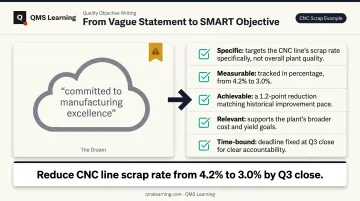
ISO 9001 doesn't use the SMART acronym itself, but it's the most practical way to satisfy the "measurable" requirement in Clause 6.2.1. Here's how it plays out for a CNC machining line trying to cut scrap:
- Specific — Target scrap on the CNC line specifically, not "reduce waste" company-wide
- Measurable — Track scrap as a percentage of units produced, pulled weekly from the ERP
- Achievable — Aim for a 15% reduction against the current baseline, not an 80% swing
- Relevant — Ties directly to the policy's material-cost and conformity commitments
- Time-bound — Complete within two fiscal quarters
Compare that to what Quality Magazine calls a "quality dream": a statement like "we are committed to manufacturing excellence." It sounds good on a policy poster. It's unauditable.
The SMART rewrite is concrete: "Reduce CNC line scrap rate from 4.2% to 3.0% by Q3 close." That's the difference between a dream and an objective.
Examples of ISO 9001 Quality Objectives by Category
Objectives can be set organization-wide, by site, or by process. The strongest programs cascade top-level QMS goals down to team and individual targets, so a machine operator can explain how their shift's numbers connect to the plant's annual goal.
Product-Related Objectives
- Reduce nonconforming parts (PPM) from 850 to 400 within 12 months
- Cut scrap rate from 4% to 2.5% by fiscal year-end
- Improve first-pass yield from 88% to 95% within two quarters
Process-Related Objectives
- Reduce average cycle time on the assembly line by 20% within six months
- Cut changeover time from 45 minutes to 25 minutes per setup
- Raise Overall Equipment Effectiveness (OEE) from 65% to 80% within 12 months
Customer-Related Objectives
- Reduce customer complaints from 12 per month to 5 per month within two quarters
- Improve on-time delivery from 82% to 95% within 12 months
- Raise customer satisfaction scores from 3.8 to 4.5 out of 5 within one year
Supplier-Related Objectives
- Reduce supplier-caused nonconformances from 18 to under 8 per quarter
- Improve supplier on-time delivery rate from 76% to 92% within 12 months
- Cut incoming inspection reject rate from 5% to 2% within nine months
Resource-Related Objectives
- Raise training and competency completion rates from 70% to 98% within six months
- Reduce absenteeism from 6% to 3% within 12 months
- Improve equipment uptime from 89% to 96% within one year
How to Set and Plan to Achieve Quality Objectives (Clauses 6.2.1 & 6.2.2)
Establishing the Objectives (6.2.1)
Don't hand this to one person in the quality department. Form a small cross-functional team: the quality manager, a member of top management, and the process owners closest to the work.
- Tie objectives to your risk register. If late deliveries are your top-rated risk, an objective should address it directly.
- Start with 3 to 5 objectives. A short list you actually manage beats a long one nobody tracks.
- Secure top management sign-off before rollout, then cascade so each function knows its piece.
If a machine operator can't tell an auditor how their daily work connects to a stated objective, that's a gap top management needs to close before the next audit, not during it.
Building the Action Plan (6.2.2)
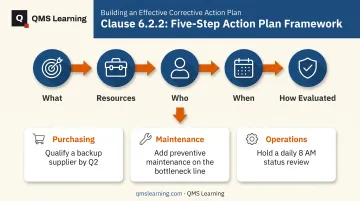
Every objective needs a plan covering five things:
- What will be done to achieve it
- What resources are required (people, budget, equipment, time)
- Who is responsible for each action item
- When it will be completed
- How results will be evaluated
Take an on-time-delivery objective as an example. One goal, three departments, three action items:
- Purchasing renegotiates delivery schedules with the two suppliers causing the most delays.
- Maintenance revises the preventive maintenance schedule to cut unplanned downtime.
- Operations cross-trains staff on the bottleneck station to prevent stoppages.
A documented plan like this, paired with a running register of objectives and their KPIs, is what auditors expect as objective evidence. A stated target with nothing behind it isn't enough. Generating that plan and register by hand for every objective is slow work—QMS Learning's AI Workbench is built to produce those artifacts faster.
Monitoring Progress and Avoiding Common Mistakes
An objective without monitoring is just a wish with a deadline. Track it through dashboards, tracking matrices, or a standing agenda item at management review. Use whatever method fits your operation, as long as it's consistent.
Split your measures into two types:
- Leading indicators — proactive and predictive, such as training completion rates or internal audit frequency
- Lagging indicators — reactive, such as nonconformance rates or lost-time incidents
Leading indicators tell you where you're headed before the result lands. Lagging indicators confirm whether you got there. Use both; relying only on lagging data means you find out about a problem after it's already cost you.
Watch for these recurring Clause 6.2 findings:
- Objectives that aren't actually measurable, just stated as intentions
- Missing or incomplete action plans under 6.2.2
- Objectives siloed to one department with no cross-functional connection
- Staff who can't explain their objective when an auditor asks directly
- Objectives disconnected from the risk register or the Quality Policy
This isn't a minor category of finding. DNV's 2025 audit-data analysis, drawn from more than 25,000 companies and 250,000 audit results, found that quality objectives and planning accounted for 28.8% of all Chapter 6 planning-related nonconformities, second only to risk and opportunity management.
More than half of organizations audited between 2023 and 2025 received a Chapter 6 finding of some kind. Clause 6.2 is a well-documented weak point, not an edge case.
How QMS Learning Helps Teams Build Audit-Ready Quality Objectives
Most quality managers know SMART theory cold. The gap shows up when an auditor asks for the action plan, the KPI trail, and the evidence behind it — on the spot, mid-audit.
QMS Learning's General Manufacturing Quality pathway is built around ISO 9001 and includes a 16-hour Internal Auditor course covering every clause, including 6.2, through 27 interactive scenarios rather than passive video watching.
Training is only one piece. The pathway pairs with tools that turn objectives into documented, auditable work:
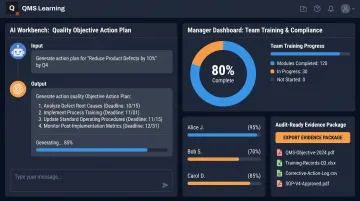
- AI Workbench: Describe a problem in plain language (for example, a process gap behind a missed delivery objective). It diagnoses the issue, routes you to the right method—5-Why, FMEA, CAPA, or gap analysis—and drafts the supporting document instead of a blank template.
- Manager Dashboard: Track team training progress, standards fluency, and capability gaps, then export results in an indexed, audit-ready evidence package.
That export is the KPI and action-plan trail auditors expect under Clause 6.2—and the one nonconformities so often expose as missing.
Frequently Asked Questions
What are examples of ISO 9001 quality objectives?
Common examples span five categories: product (reducing defect rate), process (cutting cycle time), customer (improving on-time delivery), supplier (raising supplier delivery performance), and resource (improving training completion). See the detailed breakdown above for specific targets.
What is the difference between a quality objective and a quality policy?
The Quality Policy is the organization's broad, aspirational commitment: for example, a promise to customer satisfaction. Quality objectives are the specific, measurable targets that turn that commitment into something you can track and prove.
How many quality objectives should a company set?
Start with 3 to 5 objectives tied to your top risks and opportunities. A short, well-managed list beats a long one that nobody actively tracks or reviews.
Do ISO 9001 quality objectives have to be numeric?
They must be measurable and verifiable, but not always numeric. A qualitative yes/no result can work if it's properly documented and supported with evidence, though numeric targets are easier to defend in an audit.
Who is responsible for setting quality objectives under ISO 9001?
Top management is responsible for setting and approving objectives, but a cross-functional team of process owners should be involved for realistic targets and genuine buy-in across departments.
How often should quality objectives be reviewed?
Monitor objectives continuously through your chosen KPIs and review them formally at every management review meeting. Update them whenever circumstances or priorities shift.