Introduction
Aerospace doesn't get second chances. A single supplier-quality failure can ground a fleet, delay a satellite launch, or worse.
A 2008 GAO review of seven weapon systems found supplier-quality problems severe enough to stall major programs. On one program alone, the fallout included:
- A 15-month schedule slip
- An 18-month delay to initial operating capability
- Roughly $10 million in corrective costs
- A seven-month supplier shutdown
Delivery of about 100 missiles was delayed as a result.
That's the environment AS9100 was built for. But between AS9100, AS9100D, and ISO 9001, the terminology confuses even experienced quality professionals.
This article defines AS9100, breaks down what it actually requires, and clarifies how it relates to ISO 9001. Whether you're chasing a Tier 1 aerospace contract or prepping for a registrar audit, this is the foundation you need.
Key Takeaways
- AS9100 is the aerospace, space, and defense QMS standard, built entirely on top of ISO 9001
- The current version is AS9100 Revision D, released in 2016 and aligned with ISO 9001:2015
- Certification isn't legally required, but it's a de facto condition for working with major primes and defense agencies
- Getting certified requires a documented QMS, internal audits, and a two-stage third-party registrar audit
What Is AS9100?
AS9100 is the international quality management system (QMS) standard for organizations that design, develop, or provide aviation, space, and defense products and services. It was developed by the International Aerospace Quality Group (IAQG) (formed in 1998) and is published through SAE International.
The standard was first released on November 1, 1999, replacing an earlier patchwork of aerospace-specific requirements. Before AS9100, ISO 9001 alone left gaps aerospace organizations still needed to fill. SAE, ASD-Europe, and Asian standards bodies combined ISO 9001:1994 with 55 aerospace-specific requirements into one unified standard.
Who AS9100 Applies To
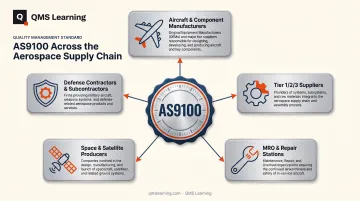
AS9100 applies across the aerospace and defense supply chain, including:
- Aircraft and component manufacturers
- Tier 1, Tier 2, and Tier 3 suppliers
- MRO and repair stations
- Space and satellite systems producers
- Defense contractors and subcontractors
AS9100 isn't a law. No government agency mandates it. It's a customer- and contract-driven standard. "AS9100 Certified" means an organization passed an independent third-party registrar audit against the current revision, not that it self-declared compliance.
AS9100 Revisions Explained: What Does AS9100D Stand For?
The "D" simply marks the fourth major revision. Here's how the standard evolved:
| Revision | Release Date | What Changed |
|---|---|---|
| Original | Nov 1, 1999 | ISO 9001:1994 plus 55 aerospace requirements |
| Rev A | Aug 1, 2001 | Incorporated ISO 9001:2000 updates |
| Rev B | Jan 6, 2004 | Minor revision; retitled to reflect aerospace scope |
| Rev C | Jan 15, 2009 | Added nearly 100 requirements after supplier delivery failures; introduced evidence-based auditing |
| Rev D | Sep 20, 2016 | Full ISO 9001:2015 alignment plus new clauses |
Rev C emerged largely from repeated supplier delivery and nonconforming-product problems across the industry. It tightened accountability and pushed auditors toward evidence-based verification rather than paperwork checks.
Rev D went further. It restructured the standard around ISO 9001:2015's format and strengthened requirements in four areas:
- Product safety
- Counterfeit parts prevention
- Data and configuration management
- Human factors
AS9100D is the active version today. Any organization called "AS9100 Certified" is audited against Revision D. There is no Rev E in circulation.
Key Requirements of AS9100D
AS9100D inherits ISO 9001:2015's 10-clause structure. Clauses 0 through 3 are informative: introduction, scope, references, definitions. The auditable requirements start at Clause 4 (Context of the Organization) and run through Clause 10 (Improvement).
Layered on top of that ISO 9001 foundation, AS9100D adds aerospace-specific requirements:
- Risk Management: identifying and mitigating risks across product and process
- Configuration Management: controlling product identity and change throughout its lifecycle
- Product Safety: protecting personnel and end users from hazards
- Counterfeit Parts Prevention: detection and avoidance of unauthorized components
- Human Factors: accounting for human error in safety-critical operations
- Special Requirements/Key Characteristics: flagging critical dimensions and processes for extra control
Clause 8 Carries the Heaviest Load
Clause 8, Operation, absorbs most of the aerospace-specific expansion. It covers design and development controls, production process validation, First Article Inspection (governed by AS9102), control of external providers, and control of nonconforming outputs.
Traceability sits at the center of this clause. Organizations must trace materials and components from raw input through final delivery. That control matters when a single mistraced fastener could end up in a flight-critical assembly.
Counterfeit parts prevention is built into this operational scope for good reason. A GAO investigation found that 12 of 16 military-grade electronic parts purchased from online platforms were suspect counterfeit (a 75% rate in that specific test sample). While not a generalizable industry-wide figure, it shows why AS9100D treats supplier and component verification as a standing requirement, not a one-time check.
Documentation Isn't the Same as Proof
Registrars evaluate two things: whether procedures and records exist, and whether evidence shows they're actually followed. This is where teams get tripped up. Having a document isn't the same as proving it's used correctly under audit pressure.
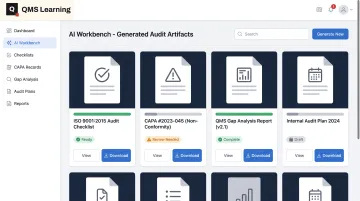
That evidence-first bar is also why QMS Learning's AI Workbench generates audit-ready artifacts (checklists, CAPA records, gap analyses) rather than stopping at theory. Teams leave with a paper trail that holds up when the registrar asks for proof.
AS9100 vs ISO 9001: Key Differences
AS9100D contains 100% of the ISO 9001:2015 requirements plus aerospace-specific additions. It's a superset, not a competing or alternative standard.
| Point | ISO 9001:2015 | AS9100D |
|---|---|---|
| Scope | Any industry, worldwide | Aviation, space, and defense only |
| Additional clauses | None | Operational risk, configuration management, product safety, counterfeit parts, human factors |
| Certification body oversight | External certification body | Certification body plus IAQG-owned AQMS scheme |
| Public registry | Verified via IAF CertSearch or the cert body | Listed on the OASIS database managed by IAQG |
| Audit rigor | Standard ISO/IEC 17021-1 audit | Same audit rules plus standardized aerospace-specific requirements |
The practical takeaway for suppliers: an organization can hold ISO 9001 without AS9100, but not the reverse. AS9100 certification is impossible without satisfying every ISO 9001 clause at the same time.
Some suppliers pursue ISO 9001 first as a stepping stone, then add aerospace-specific requirements. Others go straight to AS9100D when aerospace contracts are the immediate goal.
Who Needs AS9100 Certification & Its Benefits
Organizations across the aerospace and defense supply chain pursue certification, including:
- Aircraft and component manufacturers
- Tier 1 through Tier 3 suppliers
- MRO and repair stations
- Space and satellite producers
- Defense contractors
Major OEMs and primes don't ask nicely. Boeing lists AS9100 among its contractual QMS requirements for suppliers, and Lockheed Martin Aeronautics explicitly requires AS9100 for external providers performing design, development, or manufacturing work. Certification isn't optional if you want the contract.
Once certified, organizations get listed on OASIS, IAQG's aerospace supplier database. That listing acts as a supply-chain credibility signal, so buyers can verify status without chasing paperwork.
The business case follows directly from those requirements:
- Access to more RFPs — many aerospace contracts simply exclude non-certified bidders
- Fewer redundant audits — one accredited certification can satisfy multiple customer requirements
- Stronger risk management — built-in configuration and counterfeit-parts controls reduce costly failures
Those controls only hold if teams can run disciplined root-cause and CAPA work under audit pressure. QMS Learning customers such as S3 AeroDefense and COMAV use structured CAPA training to build the process discipline aerospace buyers look for during supplier audits.
AS9100 Certification Process and Cost
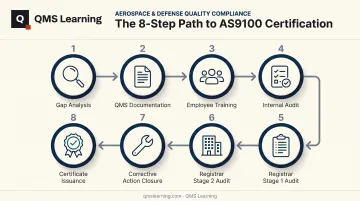
Getting certified follows a consistent path, regardless of company size:
- Gap analysis — compare current practices against AS9100D requirements
- QMS documentation development — build procedures, work instructions, and records
- Employee training — get staff fluent in the requirements relevant to their roles
- Internal audit — test the system before an outsider does
- Registrar Stage 1 audit — documentation review and readiness check
- Registrar Stage 2 audit — on-site evaluation of actual implementation
- Corrective action closure — resolve any findings from Stage 2
- Certificate issuance — followed by annual surveillance audits over a three-year cycle
What Certification Actually Costs
Total cost depends on a few variables:
- Company size and number of sites
- Existing QMS maturity
- Registrar fees and how complex the organization is
There's no single universal figure. Training costs offer a useful reference point: published aerospace courses run from roughly $1,150 for a two-day requirements course up to $2,420 for a five-day lead-auditor course.
Consulting and registrar fees add substantially on top of that. A single-site machine shop pays far less than a multi-site Tier 1 supplier.
That spread is why many teams look for ways to handle documentation and auditor prep in-house instead of staffing a long consulting engagement. QMS Learning's Aerospace & Defense pathway, built by a 20-year aerospace auditor who has written over 1,000 audit findings, bundles a 7-module AS9100D Internal Auditor course with ITAR and Counterfeit Parts Avoidance training, an AI Workbench, and audit-evidence exports.
The Workbench generates artifacts consultants often bill to produce: audit checklists, gap-analysis reports, corrective-action records with 5-Why analysis, and a single Audit-Evidence Package PDF registrars can review directly. Teams using this approach target audit-ready status within 30 days of rollout, compressing a timeline that often stretches for months when handled ad hoc.
Frequently Asked Questions
What is the difference between AS9100 and AS9100D?
AS9100D is the current, fourth revision of the AS9100 standard, released in 2016. When people say "AS9100" today, they're referring to Rev D unless otherwise specified.
What are the key differences between ISO 9001 and AS9100D?
AS9100D includes every ISO 9001:2015 requirement plus aerospace-specific additions like risk management, configuration management, product safety, and counterfeit parts prevention. ISO 9001 applies to any industry; AS9100D is aerospace and defense-specific.
What does AS9100D stand for?
AS9100D refers to Revision D of "Quality Management Systems — Requirements for Aviation, Space, and Defense Organizations," published by SAE International and IAQG in 2016.
How much does AS9100 certification cost?
Cost depends on company size, number of sites, QMS maturity, and registrar audit fees. Training and any outside support add to that total; published courses often run roughly $1,150–$2,420, while consulting and multi-day audits scale with complexity.
Is AS9100 certification legally required?
No. AS9100 isn't a government or legal mandate, but it's a contractual requirement imposed by most major OEMs, primes, and defense agencies as a condition of doing business.
How long does it take to get AS9100 certified?
Timelines vary widely based on QMS maturity and organizational readiness. Structured, role-specific training, such as QMS Learning's pathway aimed at audit readiness within 30 days, can help teams get certified faster than building prep ad hoc.