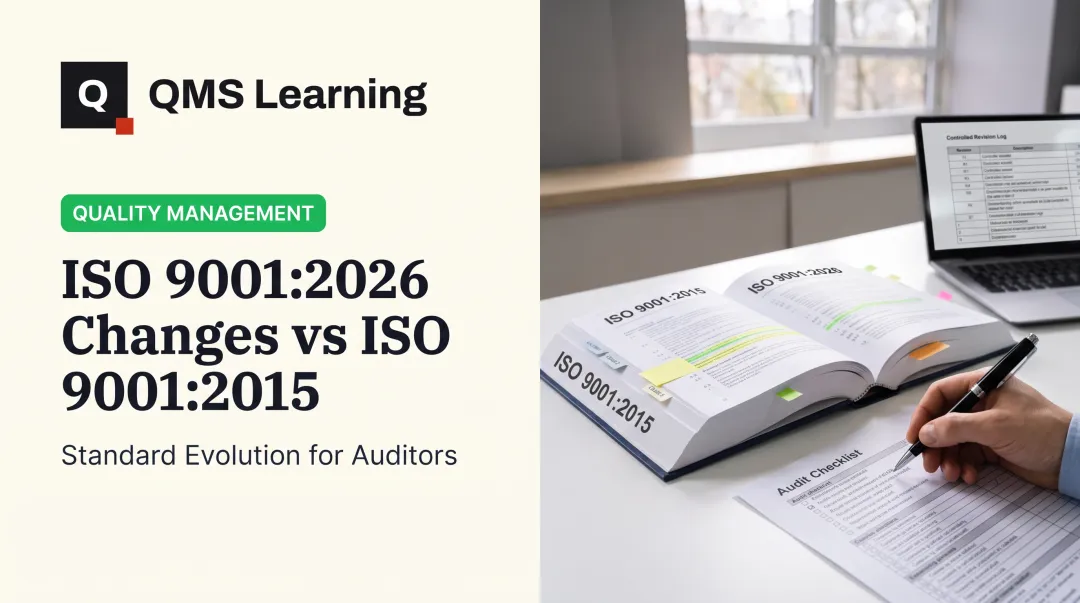
This is an evolutionary update, not a revolutionary one. The core principles that define ISO 9001—customer focus, process-based management, continual improvement, evidence-based decisions, and risk-based thinking—remain intact. What's changing are requirements that make implicit expectations explicit. Leadership must now explicitly promote quality culture and ethical behavior. Risk and opportunity management has been restructured for clarity. The climate change amendment from February 2024 is now formally integrated. And awareness requirements now extend to quality culture, not just quality policy.
For quality managers, QMS directors, and audit teams, the message is clear: start planning your transition in 2026, but don't delay implementing ISO 9001:2015 if you need a QMS today. Everything you build on the 2015 edition carries forward to 2026.
Key Takeaways
- ISO 9001:2026 is planned for September 2026, with a roughly three-year transition through about September 2029
- Leadership clauses now explicitly require promoting quality culture and ethical behavior, not only implying them
- Climate change considerations from the 2024 amendment are formally integrated into organizational context requirements
- Risk and opportunity management (Clause 6.1) has been reorganized into separate sub-clauses for better clarity
- ISO 9001:2015-certified organizations should start gap analysis in 2026; the transition is an update, not a rebuild
ISO 9001:2026 Publication Timeline & Key Milestones
ISO 9001 has followed an unusual revision path. In 2021, ISO/TC 176 completed a systematic review and confirmed that ISO 9001:2015 would remain unchanged. No revision was planned.
In August 2023, the committee reversed course and voted to revise the standard after all. That decision restarted development and set the current timeline in motion.
Here are the confirmed and expected milestones:
- August 27, 2025 — Draft International Standard (DIS) officially published
- May 2026 — Final Draft International Standard (FDIS) submitted to ISO member bodies for yes/no approval vote
- September 2026 — ISO 9001:2026 publication planned
- September 2029 — Expected transition deadline (three years after publication, subject to formal IAF confirmation)
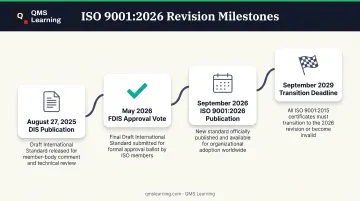
ISO has not published the standard yet, so September 2026 is still a planned date. The three-year transition window is normal for ISO management system revisions, but it stays provisional until the International Accreditation Forum (IAF) issues formal transition rules.
When will the first ISO 9001:2026 certificates be available?
Certification bodies need time after publication to update audit programs, train auditors, and gain accreditation for the new edition. No official accreditation schedule is out yet, so plan on first certificates arriving in 2027—likely in the second half of the year.
Key Changes in ISO 9001:2026: What's Different from ISO 9001:2015
ISO 9001:2026 refines and clarifies existing requirements rather than introducing entirely new frameworks. Most changes address areas where auditors and organizations struggled with interpretation under the 2015 edition. Below are the most significant updates based on the FDIS and certification body guidance.
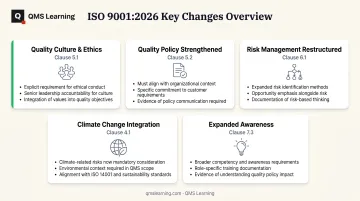
Quality Culture & Ethical Behavior Now Explicit (Clause 5.1)
Under ISO 9001:2015, quality culture was implied through leadership and engagement requirements. ISO 9001:2026 makes it explicit: top management must now actively promote and demonstrate quality culture and ethical behavior as part of their leadership responsibilities.
What auditors will look for:
- Leadership communication that consistently emphasizes quality and ethics
- Recognition programs that reward quality behavior
- Training programs that integrate quality culture expectations
- Leadership actions that model ethical decision-making
- Visible consequences when ethical or quality standards are violated
This doesn't require a separate "quality culture policy." It does require evidence that leadership promotes these values through visible actions and organizational systems, not words alone.
Strengthened Quality Policy Requirements (Clause 5.2)
Certification body summaries indicate the quality policy must now explicitly tie to organizational context and strategic direction, not leave that link implied as many 2015 policies did.
After the final standard is published, review your policy for:
- Explicit reference to organizational context
- Clear connection to strategic direction
- Documented alignment with quality objectives
Risk & Opportunity Management Restructured (Clause 6.1)
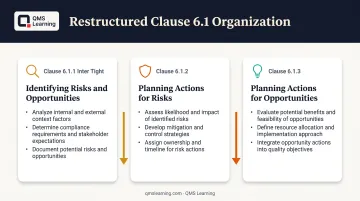
Clause 6.1 is reorganized into separate sub-clauses (6.1.1, 6.1.2, and 6.1.3) that distinguish actions to address risks from actions to address opportunities. Under ISO 9001:2015, risks and opportunities were bundled together, which sometimes confused audits.
The new structure provides clearer guidance on:
- Identifying risks and opportunities separately
- Planning distinct actions for each
- Documenting how those actions are integrated into QMS processes
Annex A has also been expanded with guidance for organizations that struggled with risk-based thinking under the 2015 edition. Annex A provides clarification, not additional auditable requirements.
Climate Change Formally Integrated (Clause 4.1)
In February 2024, ISO published an amendment requiring organizations to determine whether climate change is relevant to their QMS context. ISO 9001:2026 now folds that amendment into the base standard.
What this means in practice:
- Organizations must assess whether climate change is relevant to their operations, products, or services
- If relevant, it must be addressed in the context of the QMS (Clause 4.1)
- Interested parties with climate-related requirements must be identified (Clause 4.2)
This is not a blanket requirement that every organization treat climate change as relevant. It's a requirement to make a documented determination and, if relevant, address it appropriately.
Expanded Awareness Requirements (Clause 7.3)
Under ISO 9001:2015, employees needed to be aware of the quality policy, their contribution to QMS effectiveness, and the implications of not conforming. ISO 9001:2026 expands this to include awareness of quality culture and ethical behavior.
Organizations should update:
- Induction training to include quality culture and ethics expectations
- Ongoing training programs and communications
- Manager training on modeling and reinforcing these behaviors
- Internal audit checklists to verify awareness during audits
Most other changes are clarifications, terminology updates, and structural improvements for readability. The Annex SL high-level structure remains intact, so ISO 9001:2026 will continue to integrate smoothly with ISO 14001, ISO 45001, and other management system standards.
What's NOT Changing in ISO 9001:2026
Organizations with a compliant ISO 9001:2015 system will not need to learn a new framework or abandon existing processes. ISO 9001:2026 builds on those foundations rather than replacing them.
What stays the same:
- Process approach, PDCA cycle, and risk-based thinking remain the foundation of ISO 9001
- No new requirements for AI, digital transformation, or emerging technologies; ISO/TC 176 chose not to add technology-specific mandates despite survey requests
- Annex SL high-level structure stays intact, preserving compatibility with ISO 14001:2026 (published April 15, 2026), ISO 45001, and other integrated systems
Organizations running multiple ISO standards can plan coordinated transitions without structural conflicts. Teams may still use AI or digital tools to support the QMS; the standard does not require them.
Should You Wait for ISO 9001:2026 or Implement ISO 9001:2015 Now?
If you need a QMS, implement ISO 9001:2015 now. Everything you build on the 2015 edition carries forward to 2026. Waiting for publication delays certification benefits by one to two years:
- Customer requirements and bid eligibility
- Competitive advantage in supplier selection
- Operational improvements from a working QMS
The transition from ISO 9001:2015 to ISO 9001:2026 will be an update during regular surveillance audits, not a complete system rebuild. Organizations that achieve ISO 9001:2015 certification in 2025 or early 2026 will already have a compliant system when the new edition publishes. They'll then have three years to make the relatively minor adjustments required for transition.
Certification bodies like NQA explicitly recommend obtaining ISO 9001:2015 certification now. The revision builds on existing requirements, and changes can be implemented during the transition period.
How to Prepare for ISO 9001:2026 Transition
Start planning your transition in 2026 once the FDIS or final standard is published. Don’t wait until 2029 to begin. Early preparation reduces audit findings and shortens the path to a clean transition audit.
Work through these steps as the draft firms up:
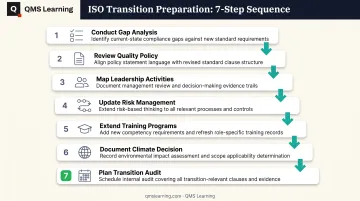
Conduct a structured gap analysis comparing your ISO 9001:2015 QMS to ISO 9001:2026. Use a checklist, review documentation, and run internal self-audits so you find gaps before your certification body does.
Review your quality policy so it explicitly ties to organizational context and strategic direction. If that link is only implied, rewrite the policy language to make it clear.
Map existing leadership activities to quality culture and ethical behavior. Document how leaders set expectations, recognize quality behavior, and model ethical decisions.
Update risk and opportunity management to match the new sub-clause structure. Show separate determination and actions for risks and for opportunities—you need process evidence, not necessarily a formal risk register.
Extend induction and ongoing training to cover quality culture and ethical behavior. Update internal audit checklists to confirm employees understand these concepts, not only the quality policy.
Document your Clause 4.1 decision on whether climate change is relevant to your QMS. If it is, identify interested parties with climate-related requirements and address them under Clause 4.2.
Contact your certification body to plan transition audit timing inside the three-year window. Ask about availability, added audit time, and whether the transition can ride along with a routine surveillance audit.
ISO 9001:2026 Transition Support & Training Resources
Organizations preparing for the transition need training that reflects the new requirements and helps teams revise documentation efficiently. QMS Learning's General Manufacturing Quality pathway, currently based on ISO 9001:2015, will cover ISO 9001:2026 when the standard publishes. Active subscribers receive a transition module at no additional cost.
The pathway includes:
- ISO 9001 Internal Auditor: 16-hour self-paced course on every clause, risk-based thinking, ISO 19011 audit principles, and 27 interactive scenarios
- Root Cause Analysis & CAPA: 5-Why, fishbone, fault-tree analysis, containment, corrective action, and effectiveness verification
- Internal Audit Program Management: Auditor competence, audit scheduling, program effectiveness, and management reporting
- Management Review: Review inputs, action tracking, and management review as the QMS operating system
The AI Workbench is trained on ISO 9001:2015, ISO 19011, and 20 years of internal audit experience. It generates gap analyses, audit checklists, CAPA documentation, and nonconformity reports tailored to your facility. When ISO 9001:2026 publishes, the Workbench will support transition findings and corrective actions against the new requirements.
The Manager Dashboard tracks training completion, competency gaps, and audit readiness. All records compile into a single Audit-Evidence Package PDF that certification bodies accept on first submission.
Frequently Asked Questions
What is the current status of ISO 9001:2026?
The Final Draft International Standard (FDIS) was submitted to ISO member bodies for a yes/no approval vote in May 2026. Publication is planned for September 2026, with an expected three-year transition period ending approximately September 2029.
What are the key differences between ISO 9001:2015 and ISO 9001:2026?
Main changes include quality culture and ethical behavior in leadership, restructured risk and opportunity management (Clause 6.1), stronger quality policy requirements, climate change in organizational context, and expanded awareness that covers quality culture. Most other updates are clarifications and editorial fixes.
Where can I download the draft version of ISO 9001:2026?
Purchase the FDIS through ISO member bodies such as ANSI in the US (ANSI Webstore). The final standard will be available through the same channels in September 2026. Do not treat the FDIS as final; requirements may still change before publication.
How long do I have to transition from ISO 9001:2015 to ISO 9001:2026?
Expect a three-year transition, roughly September 2026 to September 2029. That window is provisional until the IAF publishes formal transition rules. Confirm timing with your certification body; some offer earlier transition audits.
Will I need to completely rebuild my quality management system for ISO 9001:2026?
No. Compliant ISO 9001:2015 systems need updates, not a full rebuild. The process approach, PDCA cycle, and risk-based thinking stay in place. Most changes are refinements you can cover with documentation updates and minor process adjustments.
Does ISO 9001:2026 affect integrated management systems with ISO 14001 or ISO 45001?
Annex SL compatibility is maintained, so ISO 9001:2026 still aligns with ISO 14001, ISO 45001, and other management system standards. ISO 14001:2026 was published April 15, 2026, which supports coordinated transitions. Review shared-structure changes in your integrated change-control process.