The confusion runs both directions. Some manufacturers assume their ISO 9001 certificate is a stepping stone to medical device work. Others assume ISO 13485 is just "ISO 9001 with extra paperwork." Neither assumption survives contact with a notified body auditor or an FDA inspector.
The distinction isn't academic. It determines whether you can affix a CE mark, whether your quality system satisfies FDA's evolving Quality Management System Regulation (QMSR), and whether you pass the next supplier audit a medical device customer runs on your facility.
This article breaks down what each standard actually covers, where they diverge in practice, and how to figure out which one applies to your business — or whether you need both.
TL;DR
- ISO 9001 is a generic QMS for any organization; ISO 13485 is built for medical device design, manufacture, and servicing.
- ISO 13485 has been stand-alone since 2016, while still using ISO 9001’s process-model foundation.
- Regulated medical device companies need ISO 13485, not ISO 9001, for market access such as CE marking.
- Expect deeper documentation, stricter risk management, and full regulatory traceability under ISO 13485.
ISO 13485 vs ISO 9001: Quick Comparison
Here’s how the two standards compare across the dimensions that matter most:
| Dimension | ISO 9001:2015 | ISO 13485:2016 |
|---|---|---|
| Scope | Any industry, any organization size | Exclusive to medical device design, manufacture, installation, and servicing |
| Regulatory focus | No built-in regulatory mandate; centers on customer satisfaction | Requires documented evidence of compliance with applicable device regulations (FDA, EU MDR) |
| Risk management | Risk-based thinking embedded across general business processes | Formal, documented risk management required throughout the entire product lifecycle |
| Documentation | Moderate, tied to processes and outcomes the organization defines | Extensive: device master records, batch records, full component traceability |
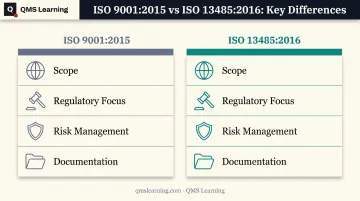
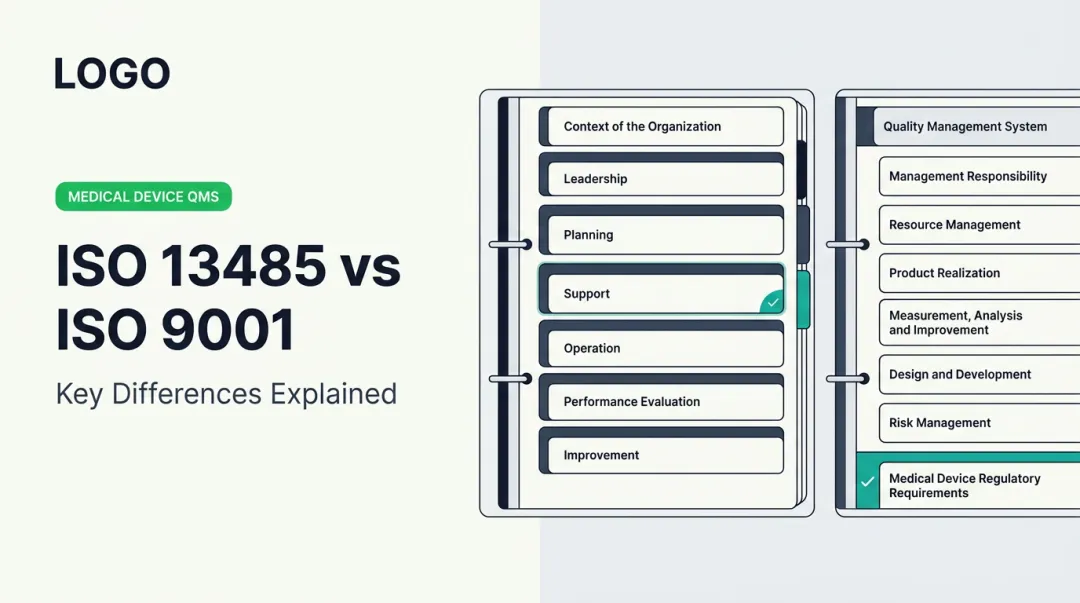
The pattern is consistent: ISO 13485 takes ISO 9001's structure and adds prescriptive, patient-safety-driven requirements on top of it.
What Is ISO 9001?
ISO 9001:2015 is the world's most widely adopted quality management standard. Manufacturers across virtually every sector use it as a baseline for consistent operations, from automotive suppliers to consumer packaged goods companies.
Its core mechanics translate directly into shop-floor impact:
- Customer focus keeps requirements traceable from order to delivery
- Process approach (PDCA) turns quality into a repeatable cycle, not a one-off inspection event
- Risk-based thinking flags problems before they become nonconformities
- Evidence-based decision-making replaces gut calls with data
ISO 9001 has no formal "subtypes." What it does have are sector-specific standards layered on top of it: AS9100 for aerospace, IATF 16949 for automotive, and ISO 13485 for medical devices all build additional requirements onto the ISO 9001 foundation.
Use Cases of ISO 9001
ISO 9001 shows up everywhere in a general manufacturer's operations: supplier qualification, incoming inspection, production control, nonconformance handling, and customer feedback loops. It's the connective tissue between departments that otherwise operate in silos.
Industries where ISO 9001 dominates include:
- Injection molding and machining
- Fabrication and assembly
- Packaging operations
- Consumer goods manufacturing
The gap most ISO 9001-certified teams hit is translating the standard into daily practice. Internal audits check paperwork instead of testing real processes. CAPAs close without verified effectiveness. Management reviews produce slides instead of decisions.
QMS Learning's General Manufacturing Quality pathway was built around these recurring audit gaps. It covers ISO 9001 internal auditing, root cause analysis and CAPA, and management review so teams close findings for good instead of re-explaining the same nonconformity every surveillance audit.
What Is ISO 13485?
ISO 13485:2016 exists to manage one thing above all else: patient safety and regulatory risk across the entire medical device lifecycle. Where ISO 9001 asks "did we satisfy the customer," ISO 13485 asks "could this device harm someone, and can we prove we controlled that risk."
That shift changes the operational math:
- Design controls catch safety issues before they reach production
- Formal risk management (tied to ISO 14971) runs from concept through post-market surveillance
- Traceability requirements mean a single component can be tracked to every device it shipped in
A common misconception is that ISO 13485 "cut ties" with ISO 9001 entirely after 2016. That's not quite accurate. According to BSI's comparison of the two standards, ISO 13485 is a stand-alone standard, but it's still based on ISO 9001's process-model concepts. It simply layers stricter, medical-device-specific documentation and regulatory requirements on top.
The regulatory backdrop is shifting too. FDA's Quality Management System Regulation (QMSR), which incorporates ISO 13485:2016 directly into 21 CFR Part 820, became effective February 2, 2026.
Adoption of the standard itself is substantial. NSF reports more than 33,000 valid ISO 13485 certificates currently issued by accredited certification bodies worldwide.
Use Cases of ISO 13485
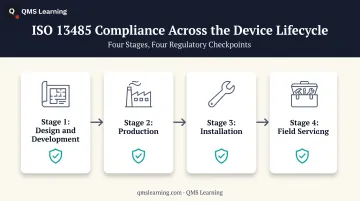
ISO 13485 governs the full device lifecycle: design and development, production, installation, and field servicing. For companies in this space, it is the framework regulators and customers expect to see.
Organizations that typically hold ISO 13485 include:
- Device OEMs selling into the EU market
- Contract manufacturers producing finished devices or subassemblies
- Sterilization, calibration, and distribution providers supporting device supply chains
- Companies aligning with FDA's QMSR transition
Documentation and risk-management depth here is significantly heavier than ISO 9001. That is why teams moving into medical device work often underestimate the lift.
QMS Learning's Medical Device & Life Sciences QMS pathway bundles ISO 13485, FDA 21 CFR Part 820, and ISO 14971 for this transition, with pilot cohorts opening in Q3 2026. The platform's AI Workbench is already trained on ISO 13485 and Part 820 content so teams can generate audit-ready design history files, risk management plans, and CAPA records.
ISO 13485 vs ISO 9001: Which Standard Do You Need?
The decision comes down to four questions:
- What product are you making? Regulated medical device, or something else?
- Which markets are you selling into? EU MDR and FDA-regulated markets both expect ISO 13485-aligned quality systems.
- Who's the regulatory authority? FDA, notified bodies under EU MDR, or no device-specific regulator at all?
- What do your contracts require? Many device OEMs mandate ISO 13485 from suppliers as a condition of doing business.
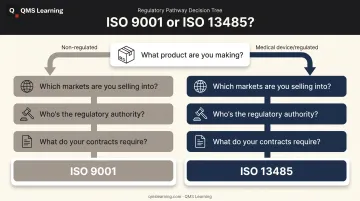
The situational answer is straightforward: choose ISO 9001 if you're manufacturing non-regulated products and want a broad quality baseline. Choose ISO 13485 if you're designing, manufacturing, or servicing medical devices bound for regulated markets.
Do you need both? Usually not. ISO 13485 already covers ISO 9001's core quality principles and adds medical-device-specific rigor, so most device companies certify to ISO 13485 alone. Mixed product lines sometimes keep both, but that's the exception.
Real-world scenario: A machining shop certified to ISO 9001 lands its first contract manufacturing surgical instrument components. The trigger is a new customer requirement, not a strategic pivot. What changes operationally:
- Design controls get added for any component-level design input
- A formal risk management file gets built and maintained
- Complaint handling becomes a documented, traceable process
- Batch records and device-specific traceability replace general production logs
That transition is where training pathways matter. If you're still on general manufacturing under ISO 9001, QMS Learning's General Manufacturing Quality pathway is available now.
If device work is next, the Medical Device & Life Sciences QMS pathway pilot cohort opens Q3 2026. Explore it before that first device contract lands on your desk.
Conclusion
Pick ISO 9001 or ISO 13485 based on what you manufacture and who regulates it. ISO 13485 inherits ISO 9001's foundation, then layers on the documentation, risk management, and regulatory traceability that medical device safety demands.
Get the match right, and the payoff is practical: faster market access, fewer audit findings, and stronger customer trust. A certificate on the wall does not keep you audit-ready. Your team's ability to apply the standard under pressure does.
Frequently Asked Questions
Is ISO 13485 equivalent to ISO 9001?
No. ISO 13485 originated from ISO 9001's process-model concepts but has been a stand-alone standard since 2016, adding medical-device-specific and regulatory requirements not found in ISO 9001.
Do medical device companies need both ISO 9001 and ISO 13485?
Generally no. ISO 13485 covers the quality principles medical device companies need on its own, so most don't separately pursue ISO 9001. Some maintain both if they also produce non-device product lines.
Can a company get ISO 13485 certified without holding ISO 9001 certification?
Yes. ISO 13485 is a stand-alone standard and doesn't require prior or concurrent ISO 9001 certification to pursue or maintain.
Which is more difficult to implement, ISO 9001 or ISO 13485?
ISO 13485 generally demands more extensive documentation, formal risk management, and regulatory tracking, making it more resource-intensive to implement than ISO 9001.
Does ISO 13485 certification satisfy FDA requirements for medical devices?
It aligns closely with FDA's QMSR, effective February 2026, but a certificate alone isn't equivalent to full compliance. FDA doesn't issue or require ISO 13485 certificates and can still inspect regardless of certification status.
How long does it typically take to get certified in each standard?
ISO 13485 typically takes 6–12 months depending on organization size and device risk class. ISO 9001 is usually faster, often 3–6 months, once you have three months of operating evidence and a completed internal audit cycle.