Introduction
ISO 13485 is the backbone quality standard for anyone in the medical device lifecycle—from raw material suppliers to contract manufacturers to finished-device companies.
Starting February 2, 2026, that standard gets much harder to ignore for US companies. FDA's new Quality Management System Regulation (QMSR) folds ISO 13485:2016 directly into federal law.
Here's the common pain point: quality teams can recite clause numbers but freeze when an auditor asks for objective evidence tied to Clause 7.5.6 or 8.2.2. Memorization isn't the same as readiness.
This guide breaks down all eight clauses of ISO 13485 and clarifies how the QMSR changes US applicability. You'll see what separates a company certified on paper from one that's genuinely audit-ready.
Key Takeaways
- ISO 13485:2016 organizes requirements into 8 clauses; Clauses 4-8 hold the mandatory operational content auditors assess.
- FDA's QMSR incorporates ISO 13485:2016 by reference into 21 CFR Part 820, effective February 2, 2026.
- The standard applies to any organization touching the device lifecycle, not just the company on the label.
- Certification proves compliance at one moment; sustaining evidence continuously is where most teams struggle.
What Is ISO 13485?
ISO 13485 is the internationally recognized quality management system (QMS) standard for organizations involved in designing, developing, producing, installing, or servicing medical devices. It covers the full device lifecycle, and it's the standard regulators, notified bodies, and customers point to when they ask, "How do you control quality?"
The current edition, ISO 13485:2016, is built on the ISO 9001:2008 framework rather than the newer Annex SL structure used in ISO 9001:2015. ISO/TC 210 confirmed this structural choice in its official practical guide. ISO 13485 kept its own clause architecture instead of aligning with ISO 9001's 2015 overhaul, prioritizing stability for a heavily regulated industry over structural alignment.
ISO reconfirmed the 2016 edition as current in 2025. Medical device manufacturers, suppliers, and service providers worldwide still use it as their baseline QMS framework, with certificates tracked through IAF CertSearch.
Who Actually Needs to Comply
A common misconception is that ISO 13485 only applies to the company whose logo appears on the finished device. It doesn't. The standard's scope extends to:
- Finished-device manufacturers
- Contract manufacturers and component suppliers
- Sterilization and packaging service providers
- Distributors and installers who provide QMS-related services
- Any organization supporting one or more stages of the device lifecycle
If your business touches a medical device before it reaches a patient, ISO 13485 likely applies to some portion of your operations.
The 8 Clauses of ISO 13485: Complete Requirements Breakdown
ISO 13485 is structured into eight clauses. Clauses 1 through 3 (Scope, Normative References, and Terms and Definitions) are introductory. They set context but don't generate auditable evidence.
Clauses 4 through 8 are where the real work happens. These contain the mandatory QMS requirements auditors evaluate directly.
Some requirements within Clauses 6, 7, and 8 can be marked non-applicable if properly justified and documented within your defined scope.
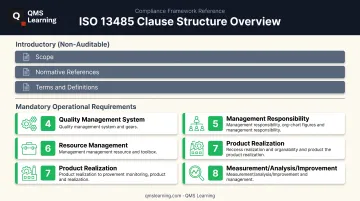
Clause 4: Quality Management System
This clause is the foundation everything else sits on. It requires:
- A risk-based process approach to identifying, controlling, and monitoring QMS processes
- Documented control over outsourced processes, even when performed by a supplier outside your walls
- A quality manual describing your QMS scope and process interactions
- A document control procedure governing approval, review, and revision of QMS documents
- A record control procedure ensuring records remain legible, retrievable, and protected
Auditors typically start here because weak document control cascades into every other clause.
Clause 5: Management Responsibility
Top management can't delegate this clause away. It requires leadership to:
- Establish a documented quality policy aligned with regulatory and organizational goals
- Set measurable quality objectives at relevant functions and levels
- Appoint a management representative with defined authority over QMS performance
- Conduct management reviews at planned intervals, with documented inputs and outputs
Auditors look for evidence that management reviews actually drive decisions, not just check a box once a year.
Clause 6: Resource Management
Resource management covers the people and environment behind the QMS. Requirements include:
- Documented competency, training, and awareness records for personnel affecting product quality
- Infrastructure adequate for conformity, including buildings, equipment, and supporting utilities
- Work environment controls, particularly where contamination poses a risk to product or personnel
- Specific contamination control measures for sterile or clean-room device production
Auditors often flag incomplete training records and vague work-environment controls under this clause.
Clause 7: Product Realization
This is the largest and most detailed clause in the standard, and it's where most nonconformities originate. It spans:
- Planning for product realization, including risk management activities
- Customer-related processes, such as reviewing requirements before accepting orders
- Design and development controls, including design inputs, outputs, verification, validation, and design history files
- Purchasing and supplier management, with supplier evaluation and re-evaluation criteria
- Production and service provision, covering process validation and sterile device requirements
- Identification and traceability, ensuring devices can be tracked through distribution and, when needed, recalled
Given its size, Clause 7 deserves the most internal audit attention, not the least.
Clause 8: Measurement, Analysis and Improvement
Clause 8 governs what happens after product ships. Key requirements include:
- Complaint handling procedures with defined timelines for investigation
- Internal audit programs covering the full QMS on a planned schedule
- Control of nonconforming product, including rework and disposition decisions
- Data analysis to identify trends in quality performance
- Corrective and preventive action (CAPA) processes to eliminate root causes, not just symptoms
Is ISO 13485 Required in the US? Understanding the FDA QMSR
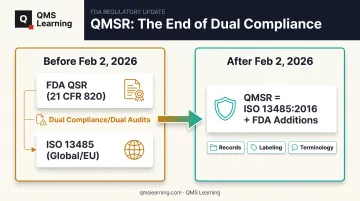
For years, US manufacturers lived a dual-compliance life: FDA's Quality System Regulation (QSR) governed domestic sales, while ISO 13485 governed access to the EU and most other global markets. Two frameworks, two sets of documentation, often two audits.
That split is closing. FDA published its final QMSR rule in the Federal Register on February 2, 2024, with an effective date of February 2, 2026. The QMSR amends 21 CFR Part 820 to incorporate ISO 13485:2016 by reference. It also pulls in a clause from ISO 9000:2015 for terminology.
What "Incorporation by Reference" Actually Means
FDA didn't rewrite ISO 13485 into new regulatory language. Instead, the agency:
- Points directly to ISO 13485:2016 as the technical backbone of Part 820
- Layers FDA-specific additions on top, particularly around records (21 CFR 820.35), labeling and packaging integrity (21 CFR 820.45), and terminology clarifications (21 CFR 820.3)
- Retains authority to enforce the FD&C Act wherever it conflicts with ISO terminology
In practice, ISO 13485 clauses now form the technical spine of FDA inspections, with FDA-specific requirements bolted on—including complaint recordkeeping and UDI documentation.
Certification Still Isn't a Legal Mandate
Here's the nuance many teams miss: FDA will not issue or require ISO 13485 certificates. Compliance with the QMSR is the legal requirement, not possession of a certificate. A QMS aligned to ISO 13485's clauses is still what FDA inspections will expect—certified or not.
The same standard anchors the EU path. ISO 13485:2016 sits on the EU's harmonized standards list for the Medical Device Regulation (MDR) and underpins CE marking. Between the QMSR and EU harmonization, one ISO 13485-aligned QMS now covers the technical spine of both major device markets.
ISO 13485 vs. ISO 9001: Key Differences
Both standards share a risk-based, Plan-Do-Check-Act foundation, and their clause numbering looks familiar at first glance. That similarity ends quickly in the requirements themselves.
| Aspect | ISO 9001:2015 | ISO 13485:2016 |
|---|---|---|
| Structure | Annex SL high-level structure | Retains ISO 9001:2008-era format |
| Improvement focus | Continual improvement and customer satisfaction | QMS suitability, adequacy, and device safety |
| Design controls | General requirements | Detailed design history file and verification/validation requirements |
| Traceability | Not emphasized | Mandatory for device identification and recall readiness |
| Regulatory focus | Secondary consideration | Central to nearly every clause |
ISO 13485 adds device-specific requirements that ISO 9001 doesn't touch:
- Device master records and design history files
- Sterile device provisions and contamination control
- Formal complaint handling and advisory notice procedures
- Post-market feedback and vigilance linked to risk management
If your company manufactures both industrial and medical products, you'll likely need to maintain both frameworks in parallel.
The practical move is clear scoping: define which product lines fall under which QMS, and avoid forcing one document set to satisfy both standards' distinct priorities.
Building Audit-Ready ISO 13485 Compliance
Certification captures a single point in time. What happens on audit day six months later is a different question entirely, and it's where most internal quality teams actually struggle.
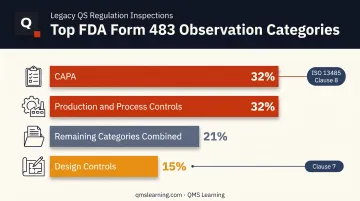
FDA's own inspection data makes the pattern clear. In a review of Form 483 observations against the legacy QS Regulation, CAPA deficiencies accounted for 32% of all cited observations, tied with production and process controls as the most frequent finding category. Design controls followed at 15%. These categories map almost directly onto ISO 13485 Clauses 7 and 8 — the same clauses most teams underinvest in day to day.
The common failure pattern looks like this:
- CAPA records live in one shared drive, complaint logs in another
- Design history files get updated inconsistently across engineering and quality
- When an unannounced audit or QMSR inspection happens, evidence retrieval takes days instead of minutes
- Junior staff can't produce documentation without pulling a senior quality manager off other work
That gap is what QMS Learning's Medical Device & Life Sciences QMS pathway is built to close. A pilot cohort opens in Q3 2026, led by founder Will Trikha, a 20-year quality and operations practitioner.
The pathway covers:
- ISO 13485, FDA 21 CFR Part 820, and ISO 14971
- An AI Workbench that routes teams to the right method (CAPA, FMEA, 5-Why, and others)
- Automatic generation of audit-evidence documentation mapped to the relevant clauses
The aim is lasting capability: clause-mapped evidence on demand, long after the initial audit ends.
Frequently Asked Questions
What are the ISO 13485 requirements?
ISO 13485 organizes requirements into 8 clauses. Clauses 4–8 cover QMS documentation, management responsibility, resource management, product realization, and measurement, analysis, and improvement. Clauses 1–3 are introductory and do not generate auditable evidence.
Is ISO 13485 required in the US?
Certification itself is not automatically mandatory, but FDA’s QMSR incorporates ISO 13485:2016 by reference into 21 CFR Part 820. Alignment with the standard is essential for US market access as of February 2026.
Is ISO 13485 only for medical devices?
No. It applies to any organization in the device lifecycle—suppliers, contract manufacturers, sterilization providers, and service organizations—not only finished-device brand owners.
Is ISO 13485 certification mandatory?
Certification is not legally mandated in every market, but regulators, notified bodies, and customers expect it in most. It is also the standard referenced for EU MDR harmonization and CE marking support.
How is ISO 13485 different from ISO 9001?
ISO 13485 is device-specific. It adds requirements such as design controls, traceability, and complaint handling, and prioritizes regulatory compliance and QMS effectiveness over ISO 9001’s broader continual-improvement focus.
How long does ISO 13485 certification take?
Timelines vary by company size, QMS maturity, and product complexity. Organizations with an existing QMS often certify in months, while early-stage companies building a QMS from scratch typically need a year or longer.