They do not solve the same problem.
Choosing the wrong standard to pursue first wastes implementation effort. Misunderstanding what each requires creates audit gaps. The core distinction — quality management versus information security management — determines who owns the system, what evidence auditors will demand, and which certification delivers the most immediate contract value for your organization.
This article breaks down both standards precisely, with no conflated requirements.
Key Takeaways
- ISO 9001 is a Quality Management System standard focused on consistent product and service delivery
- ISO 27001 is an Information Security Management System standard focused on protecting information assets
- Both share the same Annex SL clause structure (Clauses 4–10), so they integrate within a single management system
- ISO 27001 requires a risk-assessed control set (Annex A, 93 controls) with no ISO 9001 equivalent
- A functioning QMS already covers much of the management infrastructure ISO 27001 demands
ISO 9001 vs ISO 27001: Quick Comparison
| Dimension | ISO 9001 | ISO 27001 |
|---|---|---|
| Core purpose | Quality of products and services | Security of information assets |
| Management system type | QMS | ISMS |
| Current version | ISO 9001:2015 | ISO/IEC 27001:2022 |
| Primary internal owner | Quality manager / operations | CISO / IT director / compliance officer |
| Scope flexibility | Non-applicable clauses permitted if justified | Exclusions from defined ISMS scope are not permitted |
| Mandatory control set | Organization-defined process controls | Annex A — 93 controls; documented in Statement of Applicability |
| Shared foundation | Annex SL: Clauses 4–10, PDCA, internal audits, management reviews, nonconformity management, continual improvement | ← Same for both standards |
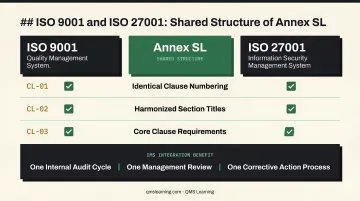
Both standards share the Annex SL harmonized structure — the same clause numbering, titles, and core requirements. ISO designed this intentionally, so organizations running an integrated management system (IMS) can satisfy both standards through one set of internal audits, one management review cycle, and one corrective action process rather than building two parallel programs.
What Is ISO 9001?
ISO 9001 is the international standard for Quality Management Systems. First published in 1987 and currently in its ISO 9001:2015 revision, it provides a framework for consistently delivering products and services that meet customer requirements and relevant regulatory obligations. It applies to any organization regardless of size, sector, or geography.
The standard is built on seven quality management principles:
- Customer focus
- Leadership
- Engagement of people
- Process approach
- Improvement
- Evidence-based decision making
- Relationship management
In practice, these principles translate into fewer nonconformities, tighter supplier control, and audit evidence that holds up under scrutiny.
What Auditors Focus On
DNV's analysis covering over 25,000 companies and 250,000 audit results found that more than half of organizations audited during 2023–2025 received findings related to Clause 6, with Clause 6.1 (risk and opportunity management) ranking as the second-most common nonconformity. Clause 8 (Operations) carries significant audit weight because it covers where the QMS meets execution — production and service provision, control of externally provided processes, nonconforming output control, and design and development where applicable.
According to the ISO Survey 2024, there are currently 1,474,118 valid ISO 9001:2015 certificates worldwide — making it the most widely held management system certification globally.
Scope Flexibility
ISO 9001 permits organizations to identify requirements as non-applicable within their defined QMS scope. Design and development (Clause 8.3) is a commonly cited example — organizations that don't design products may document this as non-applicable. The requirement: the decision must be justified, documented, and must not affect the organization's ability to ensure product and service conformity or customer satisfaction. Undeclared non-applicabilities become audit findings.
Where ISO 9001 Creates Direct Value
- Manufacturers bidding on commercial or government supply chain contracts (machining, fabrication, assembly, injection molding)
- Aerospace Tier 1/2/3 suppliers — ISO 9001 is the embedded foundation of AS9100
- Automotive supply chain participants — IATF 16949 is implemented as a supplement to ISO 9001:2015
- Service organizations that need to demonstrate process consistency to enterprise or government customers
What Is ISO 27001?
ISO 27001 is the international standard for Information Security Management Systems. First published in 2005 and currently at its ISO/IEC 27001:2022 revision, it provides a systematic framework for managing information security risks across three dimensions: confidentiality (preventing unauthorized access), integrity (accuracy and reliability of information), and availability (accessibility to authorized users).
What Structurally Separates ISO 27001 from ISO 9001
The defining structural feature is Annex A — a control reference set containing 93 controls organized across four themes: Organizational, People, Physical, and Technological. (The prior 2013 edition contained 114 controls across 14 areas.)
Organizations must:
- Conduct a formal information security risk assessment
- Select applicable controls from Annex A
- Document their decisions — including exclusions — in a Statement of Applicability (SoA)
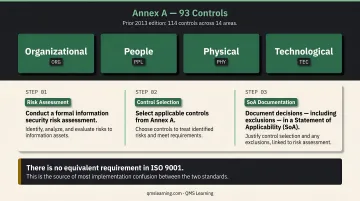
There is no equivalent requirement in ISO 9001. This is the source of most implementation confusion between the two standards.
Risk Assessment Requirements
ISO 27001's risk assessment process is materially more rigorous than ISO 9001's risk-based thinking. ISO 27001 requires a defined, repeatable risk assessment methodology, documented risk treatment plans, and audit-acceptable evidence that selected Annex A controls are operating effectively.
ISO 9001 requires risk-based thinking woven through process management — not a formal, documented methodology with a discrete output artifact.
IBM's 2025 Cost of a Data Breach Report puts the global average breach cost at $4.4 million. Organizations pursuing ISO 27001 are building a defensible, auditable response to that exposure.
That exposure is driving rapid adoption. The ISO Survey 2024 reports 96,709 valid certificates — up from 48,671 in 2023, roughly a doubling in a single year.
Where ISO 27001 Creates Direct Value
- Defense contractors with cybersecurity obligations needing a security posture baseline
- SaaS and technology companies demonstrating security credibility to enterprise buyers
- Healthcare organizations managing patient information under contractual security requirements
- Companies handling client data subject to customer-driven security questionnaires
- Any organization where ISO 27001 certification appears as a vendor qualification requirement — ENISA's procurement guidance for hospital cybersecurity explicitly recommends requiring ISO 27001 certification from security service suppliers
ISO 9001 vs ISO 27001: Key Differences
Difference 1 — Core Audit Question
In an ISO 9001 audit, the auditor asks: do your processes produce consistent, conforming products or services, and does your QMS catch and correct failures effectively?
In an ISO 27001 audit, the auditor asks: have identified information security risks been treated with appropriate controls, and does evidence of control operation exist?
Both standards share the same clause structure — but the starting question, evidence requirement, and audit focus are fundamentally different.
Difference 2 — Controls
- ISO 9001: Organizations define and apply their own process controls. The standard sets principles, not specific control measures.
- ISO 27001: Organizations must assess risks, select controls from the Annex A reference set, and document which apply and which don't in the Statement of Applicability.
This is the single largest structural difference between the two standards.
Difference 3 — Scope Rules
| Standard | Scope Rule | Audit Implication |
|---|---|---|
| ISO 9001 | Non-applicable requirements permitted if justified | Undeclared non-applicabilities become findings |
| ISO 27001 | Exclusions from defined ISMS scope are not permitted | Undefined scope boundaries create systemic findings |
Difference 4 — Leadership Engagement
ISO 9001 explicitly mandates a customer-focused approach from top management: customer satisfaction monitoring, a communicated quality policy, and visible executive accountability.
ISO 27001 requires top management accountability and resource allocation, but gives more flexibility in how that engagement is demonstrated during implementation. For organizations building both systems, ISO 9001 typically demands executive buy-in earlier.
Difference 5 — Organizational Ownership
- ISO 9001 is owned by quality and operations — covering processes that produce or support products and services
- ISO 27001 is owned by IT, security, or compliance — covering systems, data flows, and information handling across the organization
Where the two systems intersect (supplier controls, document management, corrective action), both standards need to reference each other explicitly. Failing to do so is one of the most common sources of audit gaps in dual-certified organizations.
Which Standard Should Your Organization Pursue First?
The answer depends on what your contracts and customers are demanding.
Pursue ISO 9001 first if:
- You're a manufacturer, fabricator, or supply chain participant bidding on commercial or government contracts
- ISO 9001 appears as a formal vendor qualification requirement
- You plan to pursue AS9100 (aerospace) or IATF 16949 (automotive) — both are built on the ISO 9001 foundation
Pursue ISO 27001 first (or simultaneously) if:
- You handle sensitive customer data under contractual security requirements
- You're a defense contractor with cybersecurity obligations
- Enterprise or government buyers are sending security questionnaires that ISO 27001 would answer
The Case for Running Both
Because both standards share the Annex SL structure (Clauses 4–10), an organization with a functioning QMS has already built the management infrastructure ISO 27001 also requires: context analysis, internal audits, management reviews, nonconformity handling, and continual improvement. LRQA confirms that implementing an additional standard after establishing an initial management system requires less time and effort because of this common structure.
The primary additional effort for ISO 27001 is building the formal risk assessment methodology and implementing Annex A controls — not rebuilding the management system from scratch.
QMS Learning has structured training around both paths:
| Pathway | Coverage | Status |
|---|---|---|
| General Manufacturing Quality (ISO 9001) | 16-hour Internal Auditor course, 27 interactive scenarios, AI Workbench trained on ISO 9001:2015 and ISO 19011 across machining, fabrication, packaging, and consumer goods | Available now |
| Defense Cybersecurity Readiness (ISO 27001) | ISMS course covering risk assessment, Annex A controls, Statement of Applicability, and certification audit preparation; AI Workbench supports control gap analysis and SoA documentation | Pilot cohort Q3 2026 |
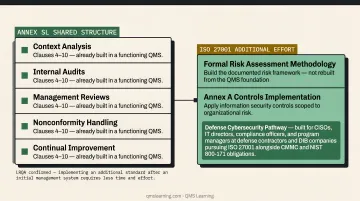
The Defense Cybersecurity pathway is built for CISOs, IT directors, compliance officers, and program managers at defense contractors and DIB companies pursuing ISO 27001 alongside CMMC and NIST 800-171 obligations.
Frequently Asked Questions
Does ISO 9001 certification help with ISO 27001 certification?
Yes. ISO 9001's Annex SL infrastructure — context analysis, internal audits, management reviews, nonconformity processes — maps directly onto ISO 27001's Clauses 4–10, so organizations with a functioning QMS are not starting from scratch. The primary additional work is building the formal risk assessment process and implementing Annex A controls.
Can an organization be certified to both ISO 9001 and ISO 27001 at the same time?
Yes. Many certification bodies offer integrated audits covering both standards in a single visit, and organizations running an Annex SL integrated management system can consolidate documentation, internal audits, and management reviews — cutting duplicated compliance effort across both certifications.
Is ISO 27001 harder to implement than ISO 9001?
For first-time implementers, yes. ISO 27001 adds considerable scope: a formal information security risk assessment, a Statement of Applicability, and operational evidence for each selected Annex A control. ISO 9001 complexity is more variable and depends heavily on the organization's existing process maturity.
Which standard does a quality manager own versus a CISO?
ISO 9001 is typically owned by the quality manager or director; ISO 27001 by the CISO, IT director, or compliance officer. In organizations running both, defined handoff points — supplier security requirements, document control, CAPA — are essential to prevent audit gaps.
What is the main difference between a QMS and an ISMS?
A QMS is a set of business processes built to consistently deliver products and services that meet customer and regulatory requirements — its output is product and service quality. An ISMS is a framework for managing information security risks — its output is the protection of information assets through risk-assessed controls. Same management system structure, entirely different organizational purpose.