It's written for quality, compliance, EHS, and operations professionals working in regulated and manufacturing environments, where a recurring nonconformity doesn't just cost money. It can trigger a reopened audit finding, a safety incident, or a customer escalation that lands on your desk twice.
Here's the uncomfortable truth about RCA: it's one of the most referenced but least consistently executed processes in quality management. Most teams can define it in a training session. Far fewer can apply it correctly when an auditor is standing over their shoulder asking why the same defect showed up again.
This guide covers what RCA is, why regulated industries require it, the step-by-step process, where it applies, and — just as important — when it isn't the right tool for the job.
Key Takeaways
- RCA traces a problem to its originating cause instead of treating the symptom
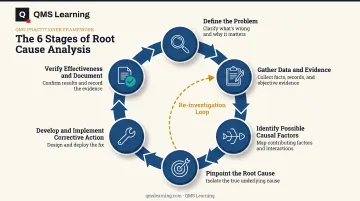
- Six stages drive RCA: define, gather data, analyze causes, find the root cause, correct, and verify
- 85% of executives say their organizations diagnose problems poorly, and 87% say it costs them (HBR)
- 5 Whys, Fishbone, and Fault Tree Analysis support one RCA step—they don't replace the full process
- AS9100D and ISO 9001 require documented root cause evidence, not only a completed fix
What Is Root Cause Analysis and Why It Matters in Quality-Driven Industries
Root cause analysis is a structured process for identifying the underlying cause (or causes) of a problem or nonconformance so it can be permanently eliminated rather than temporarily suppressed. The American Society for Quality describes it as a collective term for the tools and techniques used to uncover the highest-level factor that starts the cause-and-effect chain — not just the most visible link in it.
The outcome RCA is built to produce is a verified cause-effect chain that leads directly to a corrective action capable of preventing recurrence. That's the whole point. If your analysis doesn't end in an action that stops the problem from happening again, it wasn't root cause analysis — it was documentation.
RCA sits between two related activities it's often confused with:
- Containment stops the bleeding right now (quarantine the bad parts, halt the line)
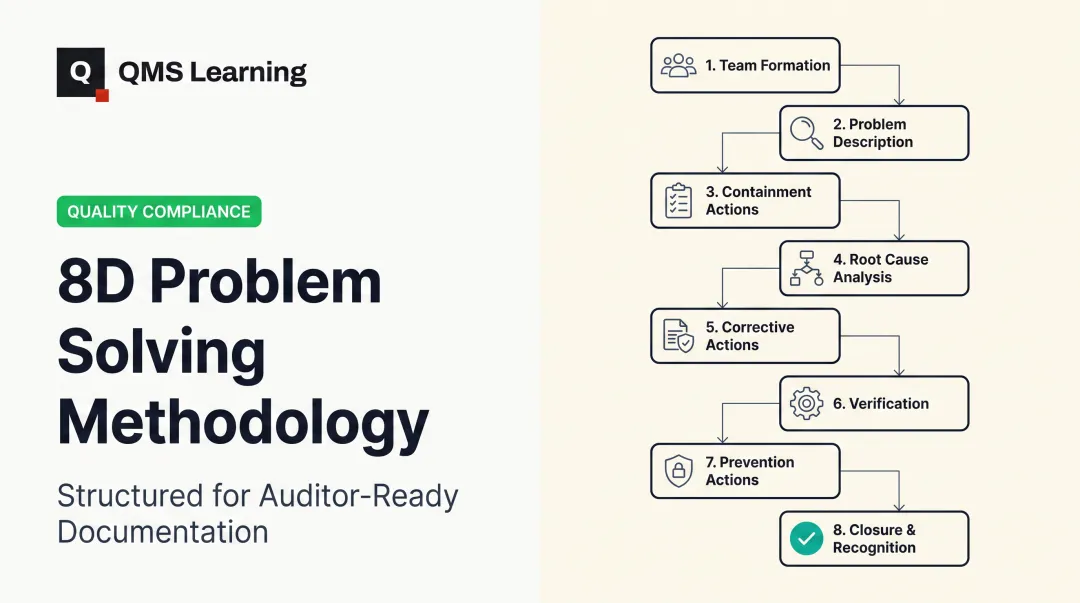
- CAPA (corrective and preventive action) is what you do once you know the cause
- RCA is the investigation that tells you why, which CAPA then acts on
Core Principles of Root Cause Analysis
A handful of principles separate real RCA from a rushed guess dressed up in a template:
- Fix causes, not symptoms — a re-torqued bolt isn't a fix if the torque wrench was never calibrated
- Expect more than one root cause — complex nonconformities rarely trace back to a single condition
- Focus on how and why, not who — blame-driven investigations produce worse data, not better ones
- Require concrete evidence for every cause-effect claim, not assumptions dressed as findings
- Make findings actionable — a root cause that can't be addressed with a specific action isn't finished analysis
One thing that gets overlooked: RCA isn't only for failures. Applying the same rigor to a process that's outperforming expectations can tell you exactly what to replicate elsewhere.
Why RCA Is Required in Regulated and Manufacturing Environments
Quality standards don't leave this optional. ISO 9001's Clause 10.2 requires organizations to determine the cause of a nonconformity before corrective action is taken — official ISO auditor guidance is explicit that correction, cause analysis, and corrective action are three distinct elements, not one step. AS9100D goes further under Clause 10.2.1: auditors are trained to reject "human factor" or "workmanship" as a stopping point and expect causal analysis to go deeper.
Skip that rigor and here's what typically happens:
- The same nonconformity resurfaces within a few audit cycles
- Findings that were "closed" get reopened because the fix didn't survive contact with reality
- Corrective actions treat the first plausible explanation as the answer
In practice, junior quality engineers are usually the ones caught in this trap. They know 5 Whys exists. They don't always know when Fishbone or FMEA is the better fit — or that FMEA is meant for evaluating risk in new processes, not closing out an existing failure.
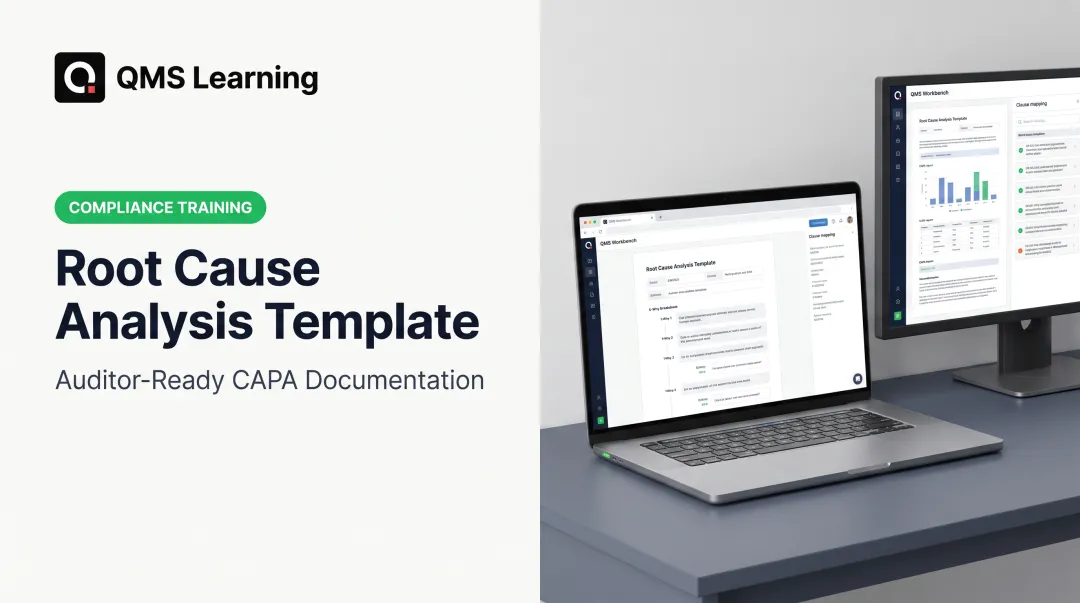
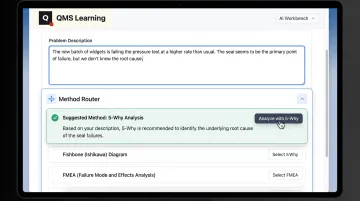
That method-selection gap is what QMS Learning's AI Workbench targets: describe the problem in plain English, and the Method Router recommends 5-Why, Fishbone, FMEA, or another fit before the investigation starts.
RCA in these environments isn't just a box an auditor checks. It's also the difference between paying for the same defect once versus paying for it every quarter.
The Root Cause Analysis Process: Step-by-Step
The process runs in one direction and loops back when evidence demands it. A problem statement and supporting data go in, causal analysis happens, a verified root cause comes out, and a corrective action with a verification loop follows.
That loop matters. Teams frequently discover mid-investigation that a hypothesized cause doesn't hold up to testing, which sends them back to gather more data rather than pushing forward on a weak conclusion.
Step 1: Define the Problem
Write a precise problem statement, not a vague complaint. It should specify:
- What happened, in observable, measurable terms
- Where it occurred (line, station, supplier, site)
- When it started and how often it recurs
- How much impact it's had: units affected, cost, downtime
"The seal fails sometimes" isn't a problem statement. "12 of 340 units from Line 3 failed leak test between March 4–18, all from the same lot" is.
Step 2: Gather Data and Evidence
Before anyone hypothesizes a cause, build the factual picture:
- Construct a timeline of events leading to the nonconformance
- Pull process records, inspection data, and maintenance logs
- Interview operators and technicians who were present
Skipping this step is the single fastest way to end up chasing the wrong cause for two weeks.
Step 3: Identify Possible Causal Factors
With evidence in hand, brainstorm every plausible contributing factor. Common tools here:
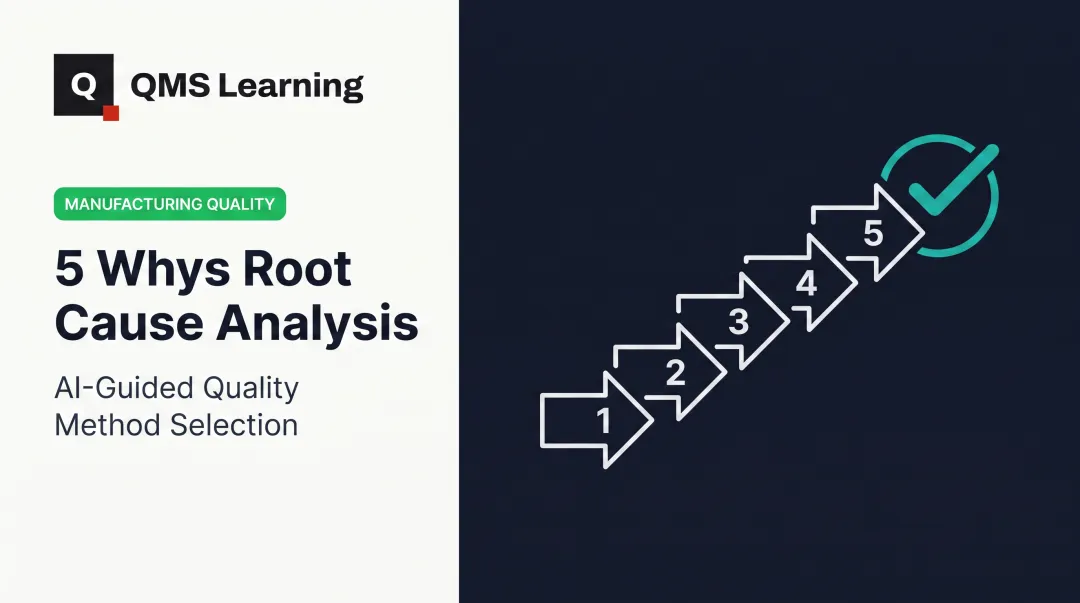
- 5 Whys — repeatedly asking why until you hit a systemic condition
- Fishbone (Ishikawa) diagrams — organizing candidate causes into categories like method, material, machine, and manpower
- Change Analysis — comparing what's different between when the process worked and when it didn't
None of these tools is the RCA process. They're how you populate Step 3.
Step 4: Pinpoint the Root Cause(s)
Test each causal factor against one question: would removing this prevent recurrence? If the answer is no, it's a contributing factor, not the root cause. Keep digging.
Complex problems rarely resolve to one cause. A late shipment might trace back to a supplier capacity issue and a weak escalation trigger in your own purchasing process. Both need to be named.
Step 5: Develop and Implement Corrective Action
Corrective action has to target the verified root cause specifically, not the containment action you already took. Each corrective action needs:
- A named owner
- A defined timeline
- Allocated resources to actually execute it
An action plan with no owner is a wish, not a corrective action.
Step 6: Verify Effectiveness and Document
This is the step teams skip most often, and it's the one auditors check hardest.
After implementation, confirm the fix held and leave a record someone else can follow:
- Verify — monitor long enough to confirm the issue does not recur under normal conditions
- Document — compile findings so an auditor can follow the trail without a verbal walkthrough
Where RCA Is Applied and What Affects Its Effectiveness
RCA gets triggered by a fairly predictable set of events:
- Customer complaints
- Internal nonconformities
- Audit findings
- Supplier deviations
- Safety incidents
- Unexpected process shifts
Sometimes it's a one-time investigation into a single event. Other times, it's built as a recurring practice inside a CAPA system or continuous improvement program.
What actually determines whether an RCA is good or superficial?
- Quality and completeness of the available data
- Cross-functional input, not just the quality department
- Time pressure (rushed investigations stop at the first plausible cause)
- Culture of transparency versus blame
Scale matters too. A one-off defect on a single line warrants a lighter-weight approach than a systemic issue across multiple product families or sites.
A 2024 DOE assessment of nine contractors managing high-hazard facilities found that six of nine hadn't performed a full RCA in five years, despite handling significant issues. One contractor ran only an apparent-cause review after a near-miss, then saw two more similar incidents within three months.
Matching the rigor to the risk isn't a nice-to-have.
Common Issues, Misconceptions, and When RCA May Not Be the Right Approach
The most persistent misconception is that stopping at the first "why" counts as root cause analysis. It doesn't. It's the beginning of one.
Causal factor vs. root cause trips up a lot of teams. A causal factor contributes to the problem. A root cause is the factor whose removal actually prevents recurrence.
Auditors are trained to spot the difference. They also catch teams treating a closed corrective action as proof the root cause was right — two separate claims.
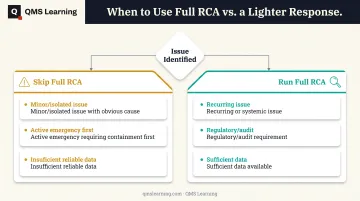
RCA also isn't always the right tool. Skip the full process when:
- The issue is minor, isolated, and low-impact with an obvious, immediately correctable cause
- You're in an active emergency requiring containment first, analysis second
- You lack enough reliable data to trace causes without guessing
A useful warning sign: if your team is running a full Fishbone session for a trivial, non-recurring hiccup, you're using RCA reflexively. Scale the response to the actual risk.
Conclusion
Root cause analysis is a repeatable, evidence-based process. Done properly, it moves a team from firefighting the same symptom every quarter to preventing it from coming back.
That distinction matters most in regulated industries, where auditors are evaluating the rigor behind your root cause evidence, not just whether a corrective action form got filled out. A well-documented CAPA with a shallow root cause is still a finding waiting to reopen.
Building this capability across an entire team, rather than concentrating it in one senior quality manager, closes the gap between passing training and resolving a live compliance problem. QMS Learning is built for that gap: it walks teams through method selection and generates the documentation to back it up.
Frequently Asked Questions
What are the steps of root cause analysis?
Define the problem, gather data, identify causal factors, pinpoint the root cause, implement corrective action, and verify effectiveness. Teams often loop back between steps as new evidence surfaces.
What are the core principles of root cause analysis?
Focus on root causes over symptoms, expect multiple contributing causes, focus on how and why rather than who, and require concrete evidence before accepting any cause-effect claim.
What is the difference between a root cause and a symptom?
A symptom is the visible effect of a problem: the defect, the delay, the failed test. The root cause is the underlying condition that, if removed, stops that symptom from recurring.
What is the 5 Whys method and how does it fit into RCA?
5 Whys is one causal-analysis tool used inside Step 3 of the broader RCA process. It helps identify causal factors, but pinpointing and verifying the true root cause still requires the steps that follow.
Can a problem have more than one root cause?
Yes. Complex or recurring problems frequently trace back to multiple contributing root causes, and RCA shouldn't stop the moment the first one is found.
How long does a root cause analysis typically take?
It depends entirely on complexity. A minor, isolated issue might resolve in a short team session, while a systemic, cross-functional problem can take several weeks of data gathering and testing.