That confusion is not free. NASA/JPL's systems engineering research found that correcting an error found during operations can cost anywhere from 29 to over 1,600 times more than catching it at the requirements stage, though the authors caution this range comes from limited, project-specific data rather than a universal formula (NASA/JPL, 2004). Skip the right FMEA at the right time, and that escalation curve becomes your problem.
This article breaks down exactly where DFMEA ends and PFMEA begins, and how to know which one your situation actually calls for.
Key Takeaways
- DFMEA finds design function failures; PFMEA finds process failures that prevent building the design correctly.
- Both use Severity × Occurrence × Detection (RPN), but differ in timing, scope, and team makeup.
- Aerospace, automotive, and medical device programs typically require both, linked sequentially through APQP.
- Choosing DFMEA vs. PFMEA is a diagnostic skill junior engineers can learn with AI-guided method selection—not only senior review.
DFMEA vs PFMEA: Quick Comparison
Before the definitions, here's the side-by-side view most quality teams keep pinned to the wall.
| Factor | DFMEA | PFMEA |
|---|---|---|
| Primary focus | Risks built into the product/component design | Risks introduced by manufacturing or assembly |
| Timing | During design/development, before tooling investment | Before production ramp-up, during process changes, or after incidents |
| Team composition | Design engineers, reliability engineers, product managers | Process engineers, operators, quality technicians |
| Failure sources | Material selection, geometry, tolerances, component interaction | The 6M's: Man, Machine, Method, Material, Measurement, Mother Nature |
| Documentation link | Feeds design reviews and the DVP&R | Feeds the Control Plan, work instructions, and PPAP |
The industry standard governing both, SAE J1739, treats them as distinct objects of analysis with a defined information flow between them. DFMEA output feeds validation planning. PFMEA output feeds control planning. Neither substitutes for the other.
What Is Design FMEA (DFMEA)?
DFMEA is a structured method for finding potential failure modes in a product or component's design before it ever reaches the shop floor. It answers one question: could this thing fail to do its job, regardless of who builds it?
That "regardless of who builds it" part matters. A DFMEA assumes a perfect manufacturing process and asks whether the design itself still holds up under real-world stress, temperature swings, vibration, and repeated use.
The value here is timing. Changes made on a drawing cost far less than changes made after tooling is cut or parts are in the field. That's the entire logic behind the NASA cost-escalation data cited earlier: fixing a flaw at the design stage stays cheap; fixing it after release does not.
What DFMEA Actually Asks
A DFMEA session typically works through questions like:
- Could this bracket crack under cyclic load?
- Could this polymer degrade at temperature extremes the part will actually see?
- Could tolerance stack-up create an interference fit that binds moving components?
- Could this material choice introduce galvanic corrosion next to a dissimilar metal?
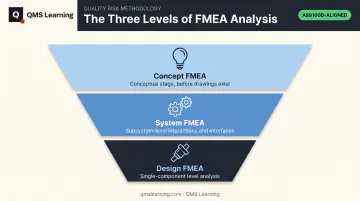
Two earlier-stage variants sit alongside DFMEA:
- Concept FMEA examines risk at the conceptual stage, before detailed drawings exist
- System FMEA looks at how subsystems interact, above the single-component level
Severity ratings in all three focus on design effects: loss of function, safety consequences, or regulatory exposure — not production disruptions.
Use Cases of DFMEA
DFMEA belongs early in APQP or New Product Introduction, before drawings and specs are released to manufacturing. Teams rely on it heavily in:
- Aerospace structural components, where fatigue and fracture risk must be ruled out before tooling
- Automotive powertrain parts, where thermal and mechanical loads compound over a vehicle's life
- Medical device enclosures, where a design flaw can trigger a Class I recall
Catching a design weakness on paper beats discovering it after a field recall. A bracket redesign on a CAD model costs an afternoon. A recall on 10,000 shipped units can sink a program.
What Is Process FMEA (PFMEA)?
PFMEA starts from a different assumption: the design is sound. The question now is whether the process building it can fail to produce a conforming part, step by step.
Where DFMEA lives on a drawing, PFMEA lives on the shop floor. It examines every operation, from raw material receipt to final packout, and asks what could go wrong at each one.
Results show up in operations. A well-built PFMEA tightens the Control Plan, reduces scrap and rework, and cuts warranty claims tied to process variation rather than design defects.
The 6M Framework
At each process step, PFMEA teams evaluate failure sources across six categories:
- Man – operator error, training gaps, fatigue
- Machine – tooling wear, calibration drift, equipment failure
- Method – unclear work instructions, missing sequence controls
- Material – incoming material variation, handling damage
- Measurement – gauge error, inconsistent inspection criteria
- Mother Nature – temperature, humidity, contamination
The 7 Steps of PFMEA
The current AIAG-VDA methodology defines PFMEA as a seven-step sequence (VDA, 2019):
- Map the process from raw material input through final output, capturing every step.
- Identify potential failure modes at each individual process step.
- Determine effects and business impact of each failure mode if it reaches the customer.
- Assign Severity, Occurrence, and Detection rankings based on current controls.
- Calculate the Risk Priority Number to prioritize which risks need attention first.
- Develop corrective and preventive action plans for the highest-priority risks.
- Implement improvements and re-evaluate RPN to confirm the risk actually dropped.
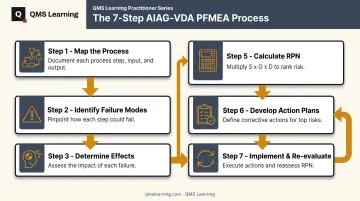
The current AIAG-VDA handbook has largely replaced a raw RPN score with an Action Priority rating (High, Medium, Low) built from the same three inputs. Either framework works, but don't treat an RPN cutoff as the final word on whether action is required.
Use Cases of PFMEA
PFMEA fits at key process milestones:
- Process validation and pre-PPAP submission
- Production transfers to a new facility
- New equipment or automation introductions
It is the dominant tool on automotive stamping and welding lines, aerospace machining and assembly operations, and electronics SMT lines.
A 2023 PCB manufacturing case study recorded rejection rates dropping from 0.906% to 0.142% after structured process controls tied to FMEA analysis (PCB Quality Control Study, 2023. The work also added inspection and functional-test steps, so the gain is not from FMEA alone. Still, the pattern matches what most process engineers see: structured failure analysis paired with real controls drives defect rates down.
DFMEA vs PFMEA: Which One Do You Need?
Two questions settle this almost every time.
First: where are you in the lifecycle? Developing or modifying a component design calls for DFMEA. Qualifying or changing a manufacturing process calls for PFMEA.
Second: what's the nature of the suspected risk? Ask whether the failure would happen regardless of who builds the part (design-inherent) or whether it varies by operator, equipment, or environment (process-induced). The first points to DFMEA. The second points to PFMEA.
Situational Guidance
- Launching a new product design → DFMEA
- Launching a new production line → PFMEA
- Changing equipment or automation → PFMEA
- Investigating a recurring process escape → PFMEA
- Modifying a component's material or geometry → DFMEA
These aren't competing choices. They're sequential, connected steps inside APQP.
Special characteristics flagged in a DFMEA—dimensions, materials, or features tied to safety or fit—become required inputs that the PFMEA and Control Plan must control downstream. Skip that handoff, and you've got two disconnected documents instead of one traceable risk chain.
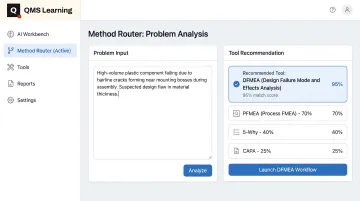
Choosing the right method used to mean waiting on a senior engineer. QMS Learning's AI Workbench includes a Method Router that diagnoses a described problem—process gap, isolated incident, supplier change, or design issue—and points the team to the matching tool, whether DFMEA, PFMEA, 5-Why, or CAPA.
A junior engineer gets a defensible starting point instantly instead of guessing or waiting on someone else's calendar.
You need both. DFMEA and PFMEA are complementary layers of the same risk framework, expected under AS9100D and IATF 16949, and weaker when run in isolation.
Real-World Application: Turning FMEA Knowledge Into Audit-Ready Capability
Picture a Tier 2 aerospace supplier mid-audit. The finding: PFMEA documentation exists, but it wasn't linked to the special characteristics flagged in the DFMEA. Severity and occurrence rankings were assigned by one engineer, without cross-functional input from operators or the design team. The auditor writes it up as a major nonconformity.
This failure pattern is common. It happens when FMEA competency lives in one person's head instead of being distributed across the quality team.
The usual fix is expensive and temporary: bring in a consultant to redo the analysis correctly, close the finding, and move on. Six months later, when the next process change happens, the same gap resurfaces, because the judgment never transferred to the team. Only the paperwork did.
The better fix is building that diagnostic capability in-house. That means:
- Training the full quality team to recognize when a risk is design-inherent versus process-induced
- Standardizing how S-O-D rankings get assigned, with cross-functional sign-off, not just one engineer's opinion
- Keeping a documented trail connecting DFMEA special characteristics to PFMEA controls
This is the specific gap QMS Learning's Aerospace & Defense Audit-Ready pathway targets. Instead of a video library, teams work through AS9100D internal auditor training, ITAR compliance, and counterfeit parts avoidance, backed by an AI Workbench trained on the standard and on real audit-finding patterns.
When a PFMEA question comes up, the Method Router routes it. The platform's Audit-Evidence Package then compiles training records, completed scenarios, and generated documentation into one export an auditor can review.
Teams that build this capability internally close findings faster on the next audit cycle. They also keep that institutional knowledge in-house instead of losing it when a consultant's contract ends.
If your team still routes every FMEA question to one senior engineer, take 30 minutes to see how a practitioner-built pathway can spread that judgment across the department within 30 days.
Frequently Asked Questions
What are the 7 steps of PFMEA?
The AIAG-VDA method uses seven steps: planning and preparation, structure analysis, function analysis, failure analysis, risk analysis, optimization, and results documentation. See the full walkthrough above for how each step works in practice.
What is the difference between DFMEA and PFMEA?
DFMEA addresses failure risks built into a product's design; PFMEA addresses failure risks introduced by the manufacturing process. Both use the same Severity × Occurrence × Detection scoring approach, applied to design versus process.
Do I need both DFMEA and PFMEA for AS9100D or IATF 16949 compliance?
Generally yes. Both are typically required and linked through APQP, with DFMEA's special characteristics feeding directly into the PFMEA and Control Plan as required inputs.
What does RPN mean in FMEA and how is it calculated?
RPN stands for Risk Priority Number, calculated as Severity × Occurrence × Detection. It helps prioritize which failure modes need corrective action first, but a low RPN alone shouldn't be the only reason to skip action on a genuinely severe risk.
When should a PFMEA be updated or revised?
Revisit it after process changes, new equipment, recurring nonconformities, or field failures. Treat it as a living document reviewed periodically, not a one-time form completed before launch and filed away.
Can DFMEA and PFMEA be combined into a single FMEA?
Some smaller organizations combine them informally. Regulated industries generally keep them separate because they involve different teams, different timing, and different audit evidence requirements.