Key Takeaways
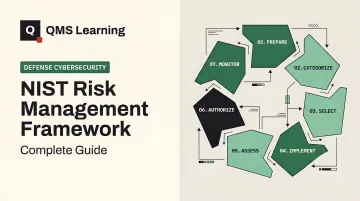
- The NIST RMF is a seven-step iterative process — Prepare, Categorize, Select, Implement, Assess, Authorize, and Monitor — not a one-time compliance checklist
- Security and privacy decisions embed directly into the system development lifecycle — risk management is continuous, not periodic
- FISMA mandates RMF compliance for federal agencies; DFARS carries those requirements to defense contractors handling CUI
- SP 800-37 defines the process; SP 800-53 is the control catalog — two distinct documents that work together but serve different purposes
- The most common failure: treating the ATO as a finish line rather than the start of an ongoing monitoring posture
What Is the NIST Risk Management Framework?
The NIST Risk Management Framework is a structured risk management process published under Special Publication 800-37, Revision 2, issued in December 2018. It replaced earlier, siloed approaches to system security by embedding risk decisions into every phase of a system's lifecycle — not bolting them on after deployment.
The RMF gives senior officials a repeatable, documented process to make risk-informed authorization decisions, and gives organizations an auditable trail of how security controls were selected, implemented, and verified. When auditors arrive, that trail is what separates a defensible authorization package from an incomplete one.
How the RMF Differs from Related Frameworks
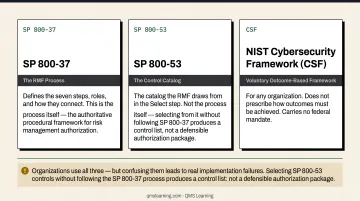
Three NIST documents are frequently confused with each other:
- SP 800-37 — Defines the RMF process: the seven steps, roles, and how they connect
- SP 800-53 — The control catalog the RMF draws from in the Select step; not the process itself
- NIST Cybersecurity Framework (CSF) — A voluntary, outcome-based framework for any organization; it does not prescribe how outcomes must be achieved and carries no federal mandate
Organizations use all three, but confusing them leads to real implementation failures. Selecting SP 800-53 controls without following the SP 800-37 process, for example, produces a control list: not a defensible authorization package.
Why Organizations Use the NIST RMF
The Regulatory Driver
The Federal Information Security Modernization Act (FISMA) — codified at 44 U.S.C. § 3554 — makes each agency head responsible for protecting information systems used or operated by the agency or on its behalf. It requires periodic risk assessments, risk-based policies that address the system lifecycle, and periodic control testing. OMB Circular A-130 operationalizes this by directing agencies to implement the NIST RMF specifically.
For defense contractors, DFARS 252.204-7012 requires adequate security for covered defense information and points to NIST SP 800-171 as the implementation standard. This makes RMF-aligned practices effectively mandatory for a large portion of the defense industrial base — even if the full seven-step federal process isn't contractually required across all contracts.
What Regulated Environments Require
Auditors and authorizing officials don't take your word for it. They expect specific, verifiable artifacts:
- Consistent documentation of security decisions and the rationale behind them
- Evidence of control effectiveness — not just that controls exist
- A named authorizing official who formally accepts residual risk
- Ongoing monitoring posture, not point-in-time compliance snapshots
The RMF produces exactly these artifacts — and without a structured process, organizations consistently struggle to produce them under audit pressure.
The CMMC Connection
Defense contractors pursuing CMMC Level 2 or Level 3 must demonstrate implementation of NIST SP 800-171 Rev. 2 controls. Those controls were derived from the SP 800-53 moderate baseline, meaning contractors who have executed the RMF's Select, Implement, and Assess steps already have the core documentation structure CMMC assessors look for. The frameworks aren't identical, but the overlap is substantial.
That overlap is where DIB teams can get the most leverage. Teams that have worked through the RMF don't start from zero on CMMC — they start with a documentation foundation that covers the hardest parts: SSP structure, control evidence, and POA&M discipline. QMS Learning's Defense Cybersecurity Readiness pathway (pilot cohort opening Q3 2026) is built around this intersection. It covers all 14 NIST SP 800-171 control families, SSP development, POA&M management, and C3PAO assessment preparation — designed for CISOs, IT directors, compliance officers, and program managers working inside the DIB.
The 7 Steps of the NIST Risk Management Framework
The seven steps are designed to be iterative and concurrent, not purely sequential. Organizations cycle back through steps as systems change, new threats emerge, or authorization terms expire. Rev. 2 added Prepare as the first step — a change NIST made specifically to improve effectiveness and cost-efficiency of security and privacy risk management.
Step 1: Prepare
Prepare establishes the organizational groundwork before a single control is selected. This includes:
- Assigning risk management roles and responsibilities
- Defining the organization's risk tolerance
- Identifying common controls that multiple systems can inherit
- Ensuring stakeholders understand the legal and operational context
Without this step, the remaining six steps lack the governance structure needed to produce consistent decisions across systems and teams.
Step 2: Categorize
Categorize uses NIST SP 800-60 and FIPS 199 to assign each information system an impact level — Low, Moderate, or High — across confidentiality, integrity, and availability. The system category uses the high-water mark across all information types.
This is the most consequential upstream decision in the process. The assigned impact level determines which baseline control set is applied in Step 3. An inaccurate categorization cascades through every subsequent decision.
Step 3: Select
Select pulls the appropriate baseline control set from SP 800-53 Rev. 5 and tailors it to the system's specific context:
- Adding controls where the threat environment demands more than the baseline
- Documenting scoping decisions that reduce the baseline — with explicit justification, not silent omission
Tailoring rationale becomes part of the System Security Plan. "We didn't include that control" is not acceptable without documented reasoning.
Step 4: Implement
Implement moves controls from documentation to deployment. Technical controls get configured: encryption, access controls, audit logging. Procedural controls go into practice, incident response procedures, configuration management. The SSP or its attachments capture how each control is operational, not just planned on paper.
Step 5: Assess
An independent or internal evaluator tests whether controls are:
- Implemented correctly
- Operating as intended
- Producing the desired security outcome
Assessment methods include document review, interviews, and technical testing. Findings land in a Security Assessment Report (SAR). Weaknesses that can't be immediately remediated are documented in a Plan of Action and Milestones (POA&M).
Step 6: Authorize
The Authorizing Official (AO) reviews the SSP, SAR, and POA&M and makes a formal risk acceptance decision:
- Authorization to Operate (ATO) — risk is acceptable
- Conditional authorization — operate with specific remediation conditions
- Denial — risk is not acceptable
This step assigns named accountability for residual risk to a specific person — not a committee, not a system, not a policy document. Someone signs their name to it.
Step 7: Monitor
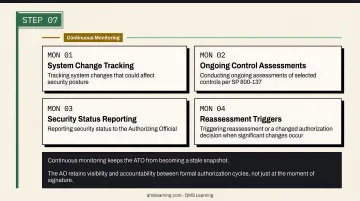
Monitor is ongoing. It includes:
- Tracking system changes that could affect security posture
- Conducting ongoing assessments of selected controls per SP 800-137
- Reporting security status to the AO
- Triggering reassessment or a changed authorization decision when significant changes occur
Continuous monitoring keeps the ATO from becoming a stale snapshot. The AO retains visibility and accountability between formal authorization cycles, not just at the moment of signature.
Common Misconceptions and Pitfalls
The ATO Is Not a Finish Line
The most damaging misconception is treating the ATO as project completion. Many teams cross the authorization threshold, then let controls drift unmonitored until the next assessment cycle. That's exactly the failure mode the Monitor step exists to prevent.
Real audits document this. AmeriCorps' FY 2025 FISMA audit rated its program at Level 3 ("Consistently Implemented") but not effective — the IG found annual security-control and risk assessments were not completed consistently, limiting the AO's decision-making capability. HHS's information-security program was rated not effective for the sixth consecutive year, with recommendations for stronger continuous-monitoring implementation. These aren't edge cases; they're the predictable outcome of treating the RMF as a documentation exercise.
Categorization Shortcuts Have Downstream Costs
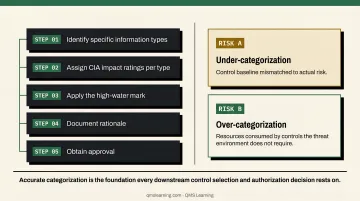
Some teams default every system to Moderate to avoid the work of accurate impact analysis. NIST's FIPS 199 method requires identifying specific information types, assigning CIA impacts, applying the high-water mark, documenting rationale, and obtaining approval — there's no shortcut built into the process.
The consequence of getting it wrong runs in both directions:
- Under-categorization produces a control baseline mismatched to actual risk
- Over-categorization wastes resources on controls the threat environment doesn't require
Accurate categorization is the foundation every downstream control selection and authorization decision rests on. Get it wrong, and the whole package is built on a flawed premise.
Training Completion ≠ Operational Capability
Compliance teams can complete an RMF overview course and still freeze when asked to write a credible POA&M, select controls for an edge-case system, or explain residual risk to an AO. Knowing the seven steps is not the same as being able to execute them under assessment pressure.
The gap shows up at the worst moment — mid-assessment. Teams that can't produce a credible POA&M or walk an AO through residual risk on the spot typically face 6+ months of delay and full reassessment costs. Practitioner-built instruction addresses this directly: QMS Learning's Defense Cybersecurity Readiness pathway names POA&M development and SSP proficiency as explicit outcomes, not implied takeaways.
Applying the RMF Where It Doesn't Belong
Organizations that run only federal compliance programs sometimes put every internal system through a full RMF cycle — regardless of whether it carries a federal nexus, CUI, or FISMA obligation. The process still costs the same time and budget even when the statutory trigger isn't there.
NIST's Cybersecurity Framework (CSF) is the right alternative for organizations without a statutory RMF requirement. Matching the framework to the actual compliance obligation saves resources and produces a more defensible outcome than forcing every system through a process built for federal authorization.
Conclusion
The NIST RMF converts the abstract goal of "managing cybersecurity risk" into a documented, auditable, role-assigned process — one that produces specific artifacts (SSP, SAR, POA&M, ATO) that authorizing officials and auditors can evaluate against concrete criteria.
Knowing the seven steps is table stakes. The organizations that consistently pass FISMA audits and CMMC assessments treat the RMF as an embedded operational capability: controls monitored between authorization cycles, POA&Ms that reflect actual gap closure, and an AO who has current information when the next review arrives.
For DIB teams working toward CMMC Level 2 or Level 3, that capability starts with owning all 14 NIST SP 800-171 control families, maintaining a credible SSP, and arriving at a C3PAO assessment with documentation already assembled and answers already rehearsed. QMS Learning's Defense Cybersecurity pathway covers exactly that preparation — CMMC, NIST 800-171, and the evidence management that keeps your program audit-ready between assessments.
Frequently Asked Questions
What are the 7 steps of the NIST Risk Management Framework?
The seven steps are Prepare, Categorize, Select, Implement, Assess, Authorize, and Monitor. They are iterative rather than strictly sequential — organizations revisit steps as systems evolve, threats change, or authorization terms expire. Rev. 2 added Prepare as a new first step in 2018.
What is NIST risk management?
NIST risk management is the suite of guidance NIST publishes for identifying, assessing, and responding to cybersecurity and privacy risks. SP 800-37 provides the operational RMF process, the CSF provides a voluntary outcomes framework, and SP 800-30 provides the risk assessment methodology that feeds into both.
What are the 4 components of NIST risk management?
Per NIST SP 800-39, the four components are risk framing, risk assessment, risk response, and risk monitoring. These operate across three tiers: organization, mission/business process, and information system.
What is the difference between NIST SP 800-37 and NIST SP 800-53?
SP 800-37 defines the RMF process — the seven steps and how they connect. SP 800-53 is the control catalog used in the Select step to choose specific security and privacy controls. Organizations use both together, but they serve distinct purposes: process framework versus controls library.
Is the NIST Risk Management Framework mandatory?
The RMF is mandatory for U.S. federal agencies under FISMA and for contractors handling federal information under DFARS. It is voluntary for private-sector organizations without a federal nexus, though CMMC requirements effectively extend RMF-aligned practices to a large portion of the defense industrial base.
How does the NIST RMF relate to CMMC compliance?
CMMC Level 2 and Level 3 require implementation of NIST SP 800-171 controls, drawn from the SP 800-53 moderate baseline. Contractors who have completed the RMF's Select, Implement, and Assess steps already hold much of the documentation and evidence that CMMC assessors examine — making prior RMF work a direct head start on certification.