Failure Mode and Effects Analysis directly touches quality control, audit readiness under AS9100D, ISO 9001, and ISO 13485, safety, cost control, and equipment uptime. It's one of the few methodologies that shows up on nearly every auditor's checklist and every engineer's risk register.
The stakes are real. NIST's 2023 Annual Report on the U.S. Manufacturing Economy estimates downtime costs U.S. discrete manufacturers $245 billion and equals 8.3% of planned production time, according to NIST's manufacturing cost modeling. This article breaks down what FMEA is, how it works step by step, and where teams typically get it wrong.
Key Takeaways
- FMEA identifies potential failure modes before they happen, not after
- Teams score Severity, Occurrence, and Detection to calculate a Risk Priority Number (RPN)
- Design FMEA (DFMEA) and Process FMEA (PFMEA) are the two most common types
- Well-run FMEA work means fewer repeat nonconformities and stronger audit evidence
- Treat FMEA as a living document — revisit it whenever risk changes
What Is FMEA?
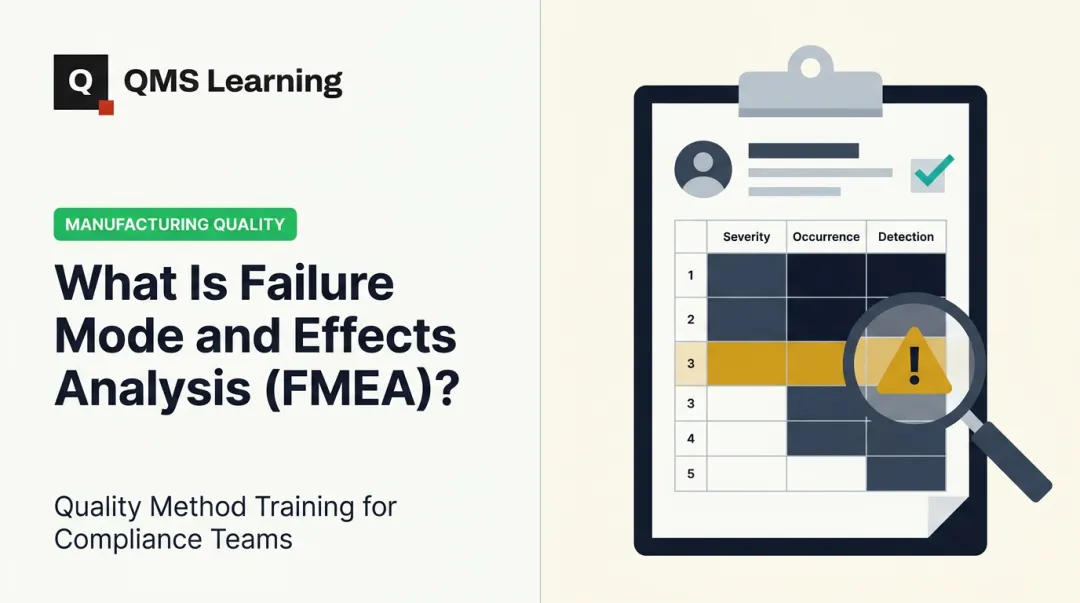
FMEA is a structured, step-by-step methodology for identifying how a product, process, or system could fail, and for assessing the causes and consequences of that failure before it happens.
Three terms anchor every FMEA worksheet, and auditors expect to see them documented clearly:
- Failure mode — the specific way something fails (cracking, leaking, mislabeling, being omitted)
- Failure effect — the downstream consequence for the customer, the system, or safety
- Failure cause — the underlying trigger, such as incorrect material, worn tooling, or a skipped process step
Where FMEA Came From
FMEA isn't a recent invention. ASQ traces its origins to U.S. military reliability engineering in the 1940s, and Quality Magazine dates its first documented appearance to a 1949 U.S. Army procedures protocol.
From there, adoption spread quickly:
- 1960s — NASA used it on Apollo-era programs
- 1970s — Ford brought it into automotive
- Today — standard practice across aerospace, automotive, and medical device design and manufacturing
The Main Types
- Design FMEA (DFMEA) — anticipates failures in a product's design before it's built
- Process FMEA (PFMEA) — anticipates failures in how a product is manufactured or assembled
- System FMEA — scopes the analysis at the system or subsystem level for more complex products
- FMECA — adds a formal criticality analysis on top of standard FMEA, used in safety-critical or mission-critical applications
Why FMEA Is Critical in Manufacturing and Quality Management
FMEA turns failure analysis from a reactive scramble into a discipline built into design and process planning from day one. Instead of discovering a weakness after a customer complaint, teams surface it on paper first.
The measurable benefits stack up:
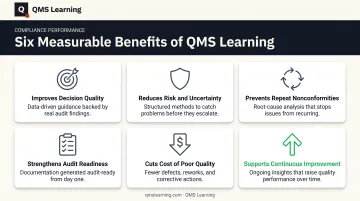
- Improves decision quality by ranking risks objectively instead of relying on gut feel
- Reduces risk and uncertainty by catching design or process weaknesses before launch
- Prevents repeat nonconformities by feeding root cause analysis and CAPA programs
- Strengthens audit readiness with evidence AS9100D, ISO 9001, and ISO 13485 auditors expect
- Cuts cost of poor quality by avoiding rework, warranty claims, and recalls
- Supports continuous improvement as a living record updated with new failure data
The Evidence Behind Proactive Failure Prevention
Organizations that lean into predictive and preventive practices pull ahead of those that don't. A NIST-supported study of manufacturing machinery found facilities that relied more on predictive and preventive maintenance reported 52.7% less unplanned downtime and 78.5% fewer defects than their peers.
The same NIST research estimates $222 billion in annual maintenance-related costs and losses across the sector. That study measured maintenance strategy broadly, not FMEA alone — but it shows the pattern FMEA is built for: catching a problem before downtime is far cheaper than fixing it after.
How FMEA Works – Step by Step
FMEA runs as a practical sequence of stages. Before walking through them, watch for three mistakes that show up constantly:
- Rushing the brainstorming stage and missing failure modes entirely
- Treating RPN as the only decision criterion instead of also flagging high-severity items regardless of score
- Forgetting to re-score RPN after corrective actions go live
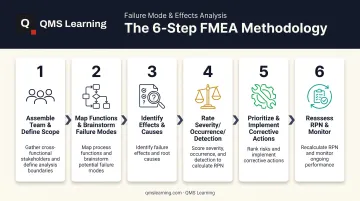
Step 1 – Assemble the Team and Define the Scope
A cross-functional team (design, manufacturing, quality, maintenance) defines system boundaries and objectives together. Skip this step and you usually get coverage gaps or fights over ownership later.
Step 2 – Map Functions and Brainstorm Failure Modes
Define each process step or component's intended function first. Then brainstorm every way it could fail that function. Process flowcharts or Ishikawa diagrams keep the discussion structured.
Step 3 – Identify Effects and Causes
For each failure mode, list the downstream effects (safety, compliance, customer impact) and the root causes (design, process, environmental). This is where depth matters more than speed.
Step 4 – Rate Severity, Occurrence, and Detection
Each factor gets a 1–10 rating. RPN equals Severity × Occurrence × Detection, for a possible range of 1 to 1,000.
SAE J1739-2021 and the AIAG-VDA handbook also support an alternative: the Action Priority (AP) method, which assigns High, Medium, or Low from the S/O/D combination instead of one multiplied score.
A Severity rating of 9 or 10 does not automatically mean High AP. The AIAG-VDA matrix can still assign Medium priority to some Severity 9–10 combinations. High severity earns special review, but it is not an automatic override.
Step 5 – Prioritize and Implement Corrective Actions
Target whichever factor offers the most leverage:
- Error-proofing (poka-yoke) to reduce Occurrence
- Added inspection or automated checks to improve Detection
- Design changes to reduce Severity at the source
Step 6 – Reassess RPN and Monitor Continuously
Recalculate RPN after actions go live, and treat the FMEA as a living document. Revisit it whenever the design, process, or failure data changes. A worksheet untouched for two years is a red flag to any auditor.
FMEA Example Walkthrough
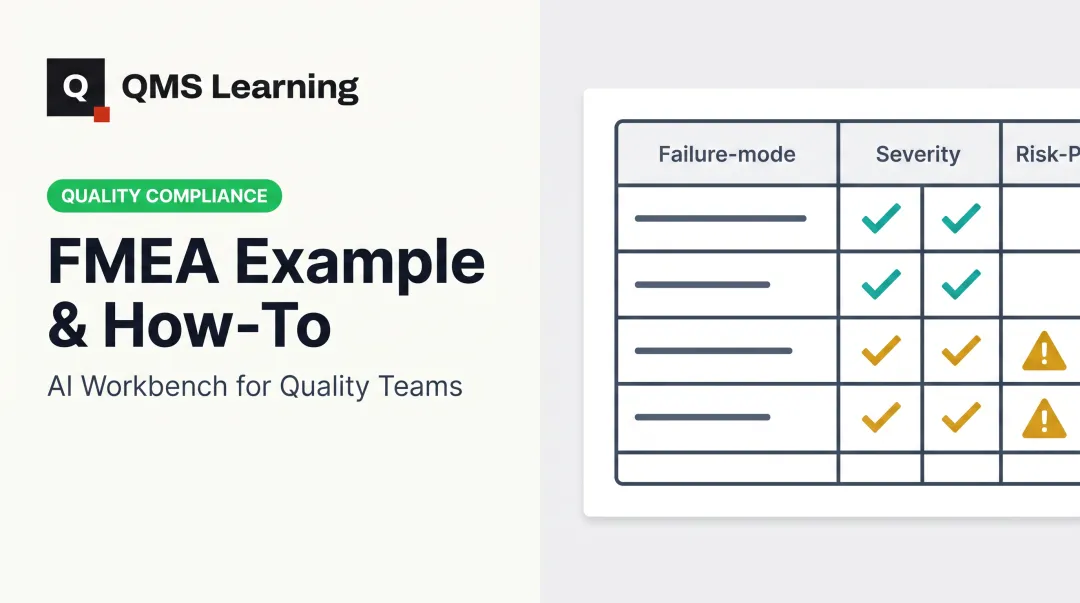
Here's a simplified packaging-line example that shows the structure.
- Function and failure mode: The line's function is to apply the correct product label. Potential failure mode: wrong label applied.
- Effect and severity: Effect is a mislabeled product shipped to a customer (regulatory violation or safety issue). Severity: 8. High-severity items get attention even at a modest RPN—one occurrence could trigger a recall.
- Cause, occurrence, detection, RPN: Root cause is manual label selection with similar-looking SKUs. Occurrence: 5 (moderate frequency). Detection: 6 (visual check only, easy to miss). RPN = 8 × 5 × 6 = 240.
- Common mistake: Teams often assume a "visual check" control works without validating it. If nobody has measured how often the visual check actually catches a wrong label, the Detection score is a guess, not data.
- Corrective action: Add an automated barcode-verification scanner before the label is applied. New scores: Severity 8, Occurrence 3, Detection 2. New RPN = 48 (an 80% reduction), documented and ready for the next audit.
This pattern shows up in published results. A 2025 healthcare scoping review found one FMEA project cut RPN by 86.99% after preventive controls were put in place.
The same review noted that roughly a quarter of studied cases never clearly documented their corrective actions. The paperwork matters as much as the fix.
How QMS Learning Can Help
Running a compliant FMEA program takes more than a template. It takes the judgment to know when FMEA is the right tool, and the discipline to document it the way an auditor expects.
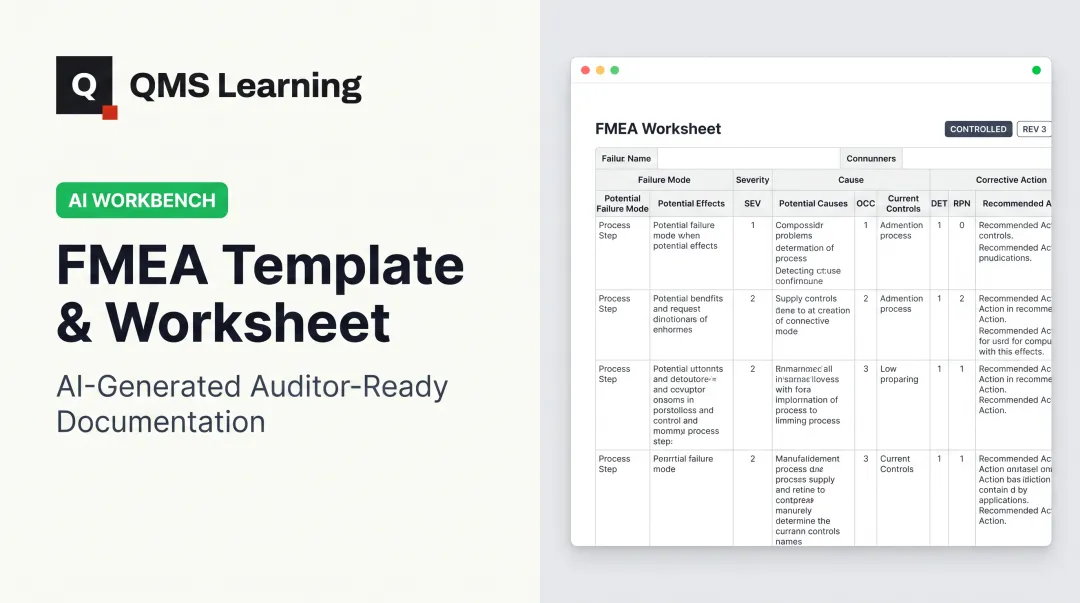
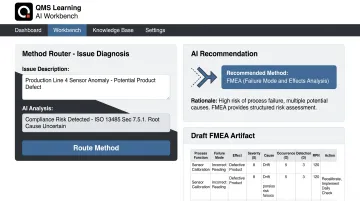
QMS Learning's AI Workbench includes a Method Router that diagnoses a live compliance problem, selects the right methodology from the 10 most common compliance plays (including FMEA), and generates a draft artifact.
If a team describes a new process with potential failure points, the Router points toward FMEA. If the issue is a recurring defect already on the floor, it routes toward 5-Why and CAPA instead. FMEA is a prospective tool, not a fix for existing failures.
FMEA training currently lives inside the Commercial Aviation & Aerospace Operations pathway, alongside AS13000 8D, 5-Why, and CAPA effectiveness verification.
What sets the platform apart:
- Built by Will Trikha, a 20-year quality practitioner who has written over 1,000 audit findings and closed twice as many
- Role-specific courses scoped to the standards teams face (AS9100D, ISO 9001, ISO 13485)
- A single Audit-Evidence Package that compiles worksheets, training records, and time-stamped activity into a registrar-accepted PDF
- Capability spread across the whole team, not bottlenecked in one senior engineer
- Courses updated free as standards evolve
Frequently Asked Questions
What is FMEA and its purpose?
FMEA is a structured, proactive methodology for identifying potential failure modes in a design, process, or system. Its purpose is to analyze causes and effects so teams can prioritize and act before failures occur.
Is FMEA a lean or Six Sigma tool?
No. FMEA originated in reliability engineering and the U.S. military, not Lean or Six Sigma. It's now widely used as an analysis tool within Six Sigma DMAIC projects and lean quality toolkits.
What is a good example of FMEA?
A process FMEA on a packaging line identifying a mislabeling failure mode is a common example. The team rates severity, occurrence, and detection, then adds automated label verification to lower the RPN.
What is the difference between FMEA and root cause analysis?
FMEA is proactive, used before failures occur to anticipate risk. Root cause analysis is reactive, used after a failure to determine why it happened. The two work together in a mature reliability program.
What RPN score should trigger corrective action?
There's no universal RPN threshold. Prioritize by relative ranking within your own analysis, and always address high-Severity failure modes (typically rated 9-10) regardless of the overall RPN.
Who should be part of an FMEA team?
FMEA requires a cross-functional team spanning design, manufacturing, quality, and maintenance, sometimes including suppliers or customers. This ensures the analysis captures technical, operational, and customer-facing risk.