Introduction
A cracked weld that ships. A mounting hole drilled oversize. A mislabeled lot that reaches a hospital. Every one of these failures had a warning sign somewhere in the process — most teams just never wrote it down before it happened.
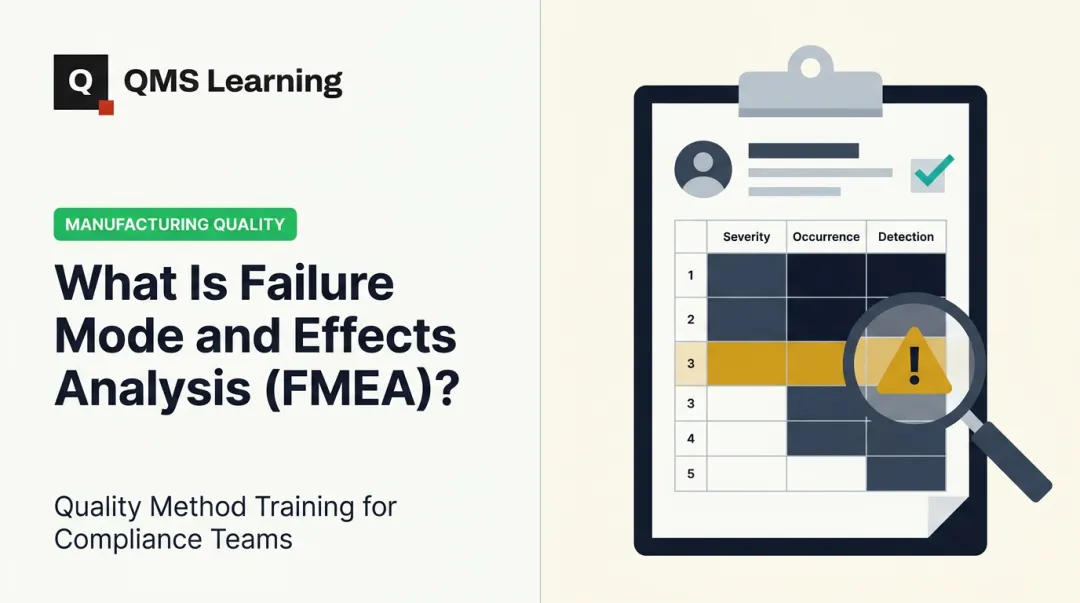
Failure Mode and Effects Analysis (FMEA) is a systematic method for identifying how a product or process could fail, why it would fail, and what happens if it does, before the failure reaches a customer or an auditor.
This guide is written for quality engineers, manufacturing engineers, and compliance leads working under AS9100, IATF 16949, ISO 9001, or ISO 13485. FMEA is one of the most cited but poorly executed tools in the quality toolbox: teams can recite the RPN formula but freeze when handed a blank worksheet.
Below, we walk through the full 7-step process and a complete, filled-out process FMEA example.
Key Takeaways
- FMEA proactively identifies and ranks failure risks before they become defects, recalls, or nonconformities
- Seven structured steps produce a Risk Priority Number (RPN = Severity × Occurrence × Detection)
- Design FMEA (DFMEA) and Process FMEA (PFMEA) apply at different product development stages
- Severity, occurrence, and detection ratings translate directly into a prioritized corrective action plan
- FMEA supports risk-management requirements in AS9100, ISO 13485, IATF 16949, and AS13000
What Is FMEA and Why It Matters in Manufacturing
What Is FMEA?
FMEA is a structured method for identifying how a process or design could fail, the effects of that failure, and how likely it is to occur and go undetected. The American Society for Quality describes it as a systematic, step-by-step approach to identify and prioritize possible failures, starting corrective work with the highest-priority items first.
The goal is simple: surface every plausible risk, rank them, and fix the ones that matter most before production or shipment, not after.
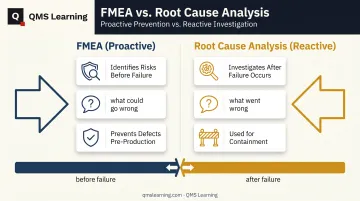
FMEA is not the same as root cause analysis. A 5-Why or Ishikawa diagram is reactive: you run it after a failure has already happened, digging backward to find what caused it. FMEA is preventive. You run it before the failure occurs, asking "what could go wrong" instead of "what went wrong."
Why FMEA Matters in Regulated Manufacturing
Catching a design or process risk on paper is far cheaper than catching it after a part has shipped, a lot has been built, or a recall has been issued. Without an FMEA in place, regulated manufacturers tend to see the same patterns repeat:
- Escaped defects that reach the customer or field
- Repeat nonconformities that keep resurfacing at every internal audit
- Failed registrar audits due to missing risk analysis evidence
- Costly, disruptive recalls or containment actions
FMEA is also a compliance expectation, not just good practice. IATF 16949 embeds DFMEA and PFMEA directly into design and process outputs. AS9100, ISO 9001, and ISO 13485 all require documented risk management. FMEA is one of the most common ways manufacturers satisfy that requirement, even where the standard doesn't name it explicitly.
How to Conduct an FMEA: The 7-Step Process
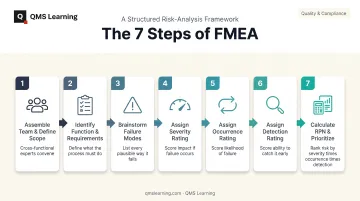
These seven steps take a team from "what could go wrong" to a prioritized, owned corrective action plan.
Step 1: Assemble the Cross-Functional Team and Define Scope
Pull in design, manufacturing, quality, and maintenance, plus suppliers or customers where relevant. A single engineer working alone will miss failure modes that a machine operator or maintenance tech would catch instantly.
Set clear boundaries before you start: a single process step, a subsystem, or a full assembly. Without a defined scope, FMEA sessions sprawl into unrelated processes and never finish.
Step 2: Identify the Function and Requirements
Describe each process step or design element as a function using a verb and a noun: "drill hole," "torque fastener," "apply coating." Then state what the customer or the next downstream process expects that function to deliver, in measurable terms.
Step 3: Brainstorm Potential Failure Modes
For every function, ask: how could this fail to meet its requirement? Failure modes generally fall into a few categories:
- Full failure: the function doesn't happen at all
- Partial or degraded failure: it happens, but below spec
- Intermittent failure: it works sometimes, fails other times
- Unintended function: something happens that shouldn't
Step 4: Identify Effects and Assign a Severity (S) Rating
For each failure mode, describe its consequence on the customer, the next process, or the end system. Then rate severity on a 1-10 scale, where 1 means no discernible effect and 10 means a safety or regulatory hazard.
Step 5: Identify Potential Causes and Assign an Occurrence (O) Rating
Trace each failure mode back to its root cause: tooling wear, operator error, material variation. Rate the likelihood of occurrence from 1 (extremely unlikely) to 10 (near certain), using historical scrap or defect data wherever it exists.
Step 6: Identify Current Controls and Assign a Detection (D) Rating
List the controls already in place to catch each cause before it reaches the customer: inspections, functional tests, poka-yoke devices. Rate detection from 1 (certain to catch it) to 10 (no way to detect it before shipment).
Step 7: Calculate the RPN, Prioritize, and Assign Corrective Actions
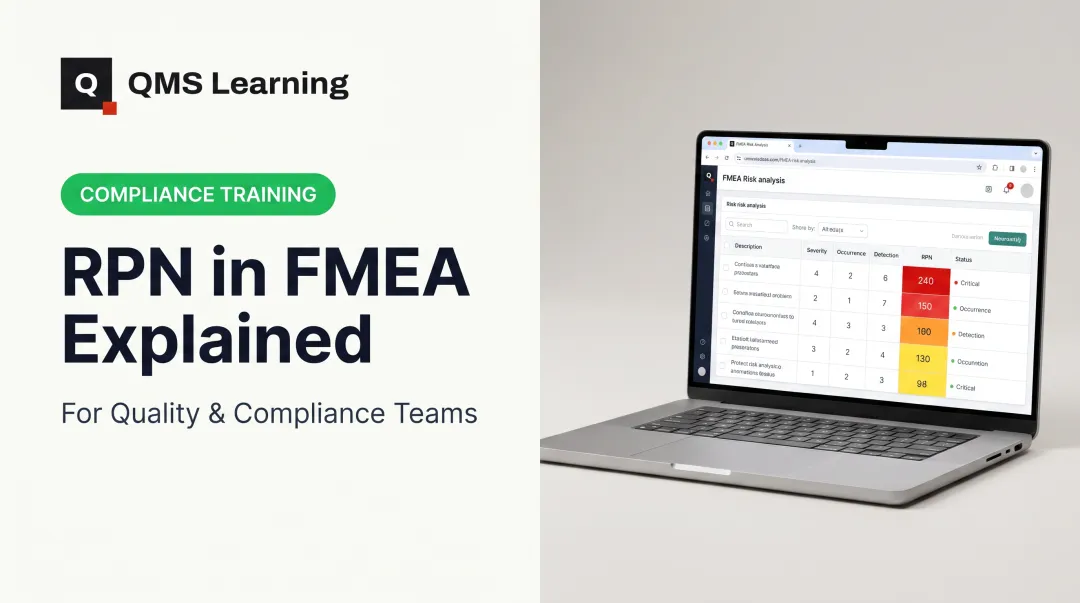
Multiply the three ratings: RPN = Severity × Occurrence × Detection. With three 1-10 scales, RPN can mathematically range from 1 to 1,000, with higher numbers flagging higher-priority risk.
Sort every failure mode by RPN, apply the 80/20 rule to focus limited resources on the highest-impact items, and assign a named owner and target date to each corrective action.
AI-assisted platforms, including QMS Learning's AI Workbench, can auto-calculate RPN, recommend the right corrective method, and generate an audit-ready FMEA artifact—cutting hours of manual worksheet work.
FMEA Example: A Full Process FMEA Walkthrough
Here's a realistic scenario: a CNC drilling operation producing mounting holes on an aerospace bracket.
Process Step, Function, and Failure Mode
- Process step: CNC drilling of mounting holes
- Function: Drill mounting holes to specified diameter and position
- Failure mode: Hole diameter drilled oversize
Effect and Severity Rating
If the hole is oversize, the bracket fastener loses proper clamp load and can loosen in service. On an aerospace component, that threat to structural integrity earns a severity rating of 9, just short of a hazard-without-warning scenario.
Cause and Occurrence Rating
The plausible root cause is a worn drill bit that wasn't replaced on schedule, gradually enlarging hole diameter as it dulls. Historical tool-wear data shows this happens periodically but not frequently, so the team assigns an occurrence rating of 4.
Detection Controls and RPN Calculation
The current control is a sample-based final dimensional inspection, checking a subset of parts rather than every unit. Because sampling can miss an out-of-spec part between checks, the team assigns a detection rating of 5.
| Factor | Rating |
|---|---|
| Severity | 9 |
| Occurrence | 4 |
| Detection | 5 |
| RPN | 180 |
RPN = 9 × 4 × 5 = 180, a high-priority item flagged for immediate corrective action.
Corrective Action and Recalculated RPN
The corrective action is to switch from calendar-based to tool-life-based bit replacement, and to add a 100% dimensional check on this specific feature instead of sampling.
| Factor | Before | After |
|---|---|---|
| Severity | 9 | 9 |
| Occurrence | 4 | 2 |
| Detection | 5 | 2 |
| RPN | 180 | 36 |
Severity stays fixed since the potential consequence of an oversize hole hasn't changed. Occurrence drops because tool-life tracking catches wear before it causes drift. Detection drops because 100% inspection replaces sampling.
The recalculated RPN of 36 documents a measurable drop in risk.
Common FMEA Mistakes and Misconceptions
Confusing FMEA with root cause analysis. FMEA is proactive and runs before a failure occurs. Tools like 5-Why are reactive, applied only after something has already gone wrong. Using one where the other belongs wastes time and produces the wrong artifact for an auditor.
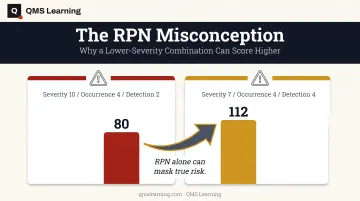
Treating RPN as an absolute threshold. Two failure modes can land at similar RPNs and represent very different risk. One published comparison shows a severity-10, occurrence-4, detection-2 combination scoring an RPN of just 80, while a lower-severity combination of 7-4-4 scores 112 — a higher number despite lower consequence severity.
That gap is why current AIAG-VDA guidance replaced RPN-only prioritization with Action Priority categories that weight severity independently, rather than applying one universal RPN cutoff. Never skip a high-severity item just because its calculated RPN looks moderate.
Treating FMEA as a one-time exercise. An FMEA finished at launch and never revisited stops reflecting reality the moment real production or field data comes in. Some OEMs now require "reverse FMEA," where engineers and operators deliberately try to create bad parts or defeat error-proofing to find gaps the original worksheet missed.
Whether or not your customer requires it, treat FMEA as a living document and update it as your process changes.
Conclusion
FMEA works by systematically listing functions, identifying how each could fail, and ranking those failures by severity, occurrence, and detectability so the team acts on the risks that matter most first.
Knowing the 7 steps in theory is not the same as being able to run one under audit pressure with a customer or registrar watching. The worked drilling example above is meant to close that specific gap.
QMS Learning's practitioner-built courses, including the Commercial Aviation pathway, train teams to select and apply FMEA under real audit conditions. Teams leave with the judgment and audit-ready evidence registrars expect to see.
Frequently Asked Questions
What are the 7 steps of FMEA?
Assemble the team, define scope, and identify functions. Then brainstorm failure modes, rate severity, occurrence, and detection, and calculate RPN so corrective actions are ranked and owned.
Can you provide an example of a process FMEA?
The drilling/bracket example above walks a real process step (drilling mounting holes) through failure mode (oversize hole), effect, root cause, and full RPN calculation, then recalculates RPN after corrective action.
What is FMEA with an example?
FMEA is a structured method for finding how something could fail, what the effects would be, and how likely that failure is before it happens. This article’s oversize drilled hole example shows the full path from failure mode to fastener loosening.
Can you give an example of a failure mode?
Examples include an oversize hole, a cracked weld, or mislabeled packaging. A failure mode is the specific way a function fails to meet its requirement, not the downstream consequence (that’s the effect).
What is the difference between DFMEA and PFMEA?
DFMEA evaluates risks built into a product's design, such as a component failing under load. PFMEA evaluates risks in the manufacturing or assembly process used to build that product, such as a drilling or welding step going out of spec.
How is the Risk Priority Number (RPN) calculated?
RPN = Severity × Occurrence × Detection, with each factor rated on a 1-10 scale. Higher scores signal higher-priority risks that need corrective action first, though severity alone should never be ignored just because RPN looks moderate.