Introduction
The term "Device Master Record" has an expiration date. FDA's Quality Management System Regulation (QMSR) takes effect February 2, 2026, folding 21 CFR Part 820 into ISO 13485:2016 by reference. The name is going away. The obligation is not.
Quality teams still mix up the DMR with the Design History File (DHF), Device History Record (DHR), and Bill of Materials (BOM). That confusion shows up in audits as missing linkages and repeat findings — the paperwork gap that turns a routine inspection into a Form 483.
This guide covers:
- What a DMR is and what it must contain
- How it differs from the DHF, DHR, and BOM
- How to keep manufacturing documentation audit-ready through the 2026 transition
Key Takeaways
- A DMR compiles the specs and procedures needed to manufacture a device the same way every time, per 21 CFR 820.181
- DHF documents design; DMR defines manufacturing; DHR records what actually got built
- The label "Device Master Record" is being retired under QMSR, but the documentation requirement stays intact
- Most teams already have the content — the gap is organization and cross-linking, not missing data
What Is a Device Master Record (DMR)?
A Device Master Record is the compiled set of specifications, drawings, and procedures a manufacturer needs to produce a medical device consistently. Under legacy 21 CFR 820.181, every manufacturer must maintain a DMR for each device type, either containing the information directly or pointing to exactly where it lives.
Think of it as a master blueprint. It doesn't matter which technician runs the line, what shift it is, or whether it's unit #4 or unit #40,000. The DMR keeps the build process identical every time—and that consistency is the point.
The DMR is manufacturing-focused. It's easy to conflate it with other records, but the distinction matters:
- The DHF documents how the device was designed
- The DHR documents what was actually produced for a specific lot or unit
- The DMR sits between them, defining how to build it every single time
A DMR doesn't need to be a single physical binder. It can be a referenced set of documents or a fully electronic record, as long as it satisfies the document control requirements under §820.40 — meaning formal review, approval, and controlled distribution.
Why does this matter beyond paperwork? If a defect surfaces post-market, investigators need to trace whether the device was built to spec. A well-maintained DMR is what lets you prove or disprove that a manufacturing deviation caused the problem, rather than a design flaw.
What Should a DMR Include? Contents and Examples
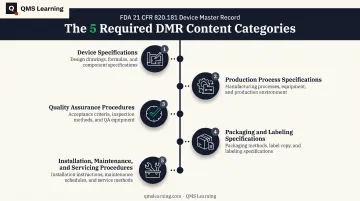
Legacy §820.181 breaks DMR content into five categories. Regardless of what FDA calls them after 2026, these five buckets of information still need to exist somewhere in your controlled documentation.
Device Specifications
Include drawings, composition or formulation, component specs, and software specs. A mechanical drawing with tolerance callouts is a classic example; so is a software build specification for embedded firmware. If your device has physical dimensions or code, this section proves what "correct" looks like.
Production Process Specifications
Document the equipment, methods, procedures, and environmental controls used in manufacturing. For a sterile device, that might mean documented cleanroom classification requirements under ISO 14644-1:2015 for the assembly environment. For a mechanical device, it is more often equipment settings and step-by-step production instructions.
Quality Assurance Procedures
Acceptance criteria and the QA equipment used to verify them belong here. One concrete example is an in-process inspection checklist that references calibrated gauge specs and defines pass/fail thresholds for each characteristic.
Packaging and Labeling Specifications
Capture the methods and processes for packaging and labeling. Two examples worth knowing:
- Sterile barrier packaging validation: FDA recognizes ISO 11607-1 and -2 for materials, sterile-barrier systems, and process validation on terminally sterilized devices
- UDI labeling: 21 CFR 801.20 requires most device labels and packages to carry a Unique Device Identifier
Installation, Maintenance, and Servicing Procedures
This bucket applies when devices need field installation or servicing (capital equipment, not disposables). A typical example is a field-service Instructions for Use written for a technician calibrating an installed imaging system. If your device ships and never gets serviced on-site, this section may be minimal or not applicable.
DMR vs. DHF vs. DHR vs. BOM: Understanding the Differences
These four records get confused constantly, and the confusion is usually what triggers repeat audit findings. Here's the plain-English version.
Design History File (DHF): The record of how the device was designed: user needs, design inputs and outputs, verification, validation, and design reviews. It answers: did we design this correctly and can we prove it?
Device Master Record (DMR): The compiled specs and procedures for building the device consistently. It answers: how do we manufacture this the same way every time?
Device History Record (DHR): The production history for a specific lot, batch, or unit: manufacturing dates, quantities, acceptance records, labeling used, and device identifiers. It answers: what did we actually build, and does it match the DMR?
Bill of Materials (BOM): A comprehensive parts and materials list. FDA training materials list the BOM as an example of DMR device-specification content — not a standalone record. It's typically embedded in or referenced by the DMR.
| Record | Purpose | Key Question | Example Content |
|---|---|---|---|
| DHF | Proves design followed the plan | How was it designed? | Design inputs/outputs, verification data, design reviews |
| DMR | Defines the manufacturing baseline | How do we build it consistently? | Drawings, process specs, QA criteria, labeling specs |
| DHR | Proves this unit matches the DMR | What was actually produced? | Batch dates, acceptance records, device identifiers |
| BOM | Lists parts and materials | What goes into it? | Component list, quantities, part numbers |
The lifecycle connects all four: design outputs from the DHF become the manufacturing specs in the DMR, and every unit built per the DMR generates entries in the DHR. The BOM rides along inside the DMR as one piece of the specification set.
DMR Under QMSR and ISO 13485: What's Changing in 2026
FDA's QMSR final rule was published February 2, 2024, and becomes effective February 2, 2026.
It incorporates ISO 13485:2016 by reference, restructuring Part 820 into just two subparts: General Provisions and Supplemental Provisions. Legacy Subparts C through O, including the section that named the DMR, are removed.
ISO 13485 doesn't use fixed record categories like "DMR." It favors an integrated documentation approach organized around a Medical Device File (MDF) concept. According to AAMI's transition guidance, the mapping looks like this:
| Legacy Term | ISO 13485-Aligned Structure |
|---|---|
| DHF | Design and Development File (Clause 7.3.10) |
| DMR | Medical Device File / MDF (Clause 4.2.3) |
| DHR | Production and Service Provision Records (Clauses 7.5.1, 7.5.8, 7.5.9) |
AAMI describes the Clause 4.2.3 MDF as the authoritative compilation of device specifications and production requirements. That compilation is the DMR's content under a new label.
FDA has been direct about this: the rule "does not fundamentally alter the requirements for a QS that existed previously." The content requirement isn't disappearing. Only the terminology and structural framing are changing.
What this means practically: most existing DMR content can be reorganized and mapped into the MDF structure rather than rewritten from scratch. The specs, drawings, and procedures you already have are still valid. They just need re-labeling and cross-referencing to align with ISO 13485's clause structure.
Building and Maintaining an Audit-Ready DMR
FDA inspection data makes the stakes clear. In one reporting year, Document Controls made up about 10% of all Part 820 Form 483 observations. §820.181 (the DMR clause) accounted for roughly 19–21% of those Document Controls citations, and several cases escalated to Warning Letters.
Common findings tied to DMRs include:
- Outdated specifications that no longer match current production
- Missing linkages between the DHF and the DMR
- Inconsistent labeling documentation across revisions
- No documented method for approving DMR changes before they take effect
Best practices that actually prevent these findings:
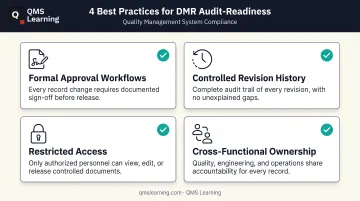
- Formal approval workflows: every DMR document needs review, signature, and date under §820.40, with obsolete versions removed from points of use
- Controlled revision history: one live version; superseded versions retained and clearly marked
- Restricted access: limit who can revise controlled specs so unauthorized edits cannot slip in
- Cross-functional ownership: engineering, quality, and manufacturing work from the same current specification
That last point is where most organizations struggle. Engineering updates a drawing, but manufacturing keeps running the old process instruction because nobody flagged the change. This is exactly the kind of gap FDA investigators are trained to look for when they sample DHRs against the DMR.
Closing that gap takes more than a binder check before inspection day. It means controlled documents, revision history, and exportable audit evidence are part of how the team works every week—especially with the 2026 QMSR transition ahead.
QMS Learning’s Medical Device & Life Sciences pathway covers ISO 13485, FDA 21 CFR Part 820, and ISO 14971 with that same evidence-management model built in. A pilot cohort for design-control and CAPA teams opens in Q3 2026.
Frequently Asked Questions
What is the difference between a Device Master Record (DMR), a Design History File (DHF), and a Device History Record (DHR)?
The DHF documents how the device was designed. The DMR defines how it's manufactured. The DHR records what was actually produced for specific units or lots.
What is a Device Master Record (DMR) in engineering?
The DMR is the master reference compiling specifications, drawings, and procedures needed to build a device consistently, regardless of who's operating the line.
Can you provide some examples of device master records?
Examples include component drawings with tolerances, production process instructions, QA acceptance criteria with gauge specs, and labeling specifications like UDI requirements. See the Contents section above for full detail.
Is a Device Master Record still required under the new FDA QMSR?
The term is being phased out, but the underlying documentation requirement remains. It's now organized under ISO 13485-aligned structures like the Medical Device File.
What is the difference between a DMR and a Bill of Materials (BOM)?
A BOM is a parts and materials list. It's typically referenced or embedded within the broader DMR rather than existing as its own standalone record.
How often should a Device Master Record be updated?
Update it whenever a design, process, or specification change occurs, following formal document control and approval procedures under §820.40, not on a fixed calendar schedule.