Before 2016, EPA's authority to act on existing chemicals was largely constrained. That changed. The amended law introduced mandatory risk evaluations with enforceable deadlines, removed the old "least burdensome" restriction standard, and significantly expanded reporting requirements. Civil penalties now reach $49,772 per violation per day under current federal penalty schedules.
This article breaks down what TSCA covers, who it applies to, the core compliance requirements across Sections 5, 6, and 8, how the TSCA Inventory works in practice, what enforcement looks like, and how to structure a compliance program that holds up under scrutiny.
Key Takeaways
- TSCA applies to manufacturers, importers, processors, and some downstream users — not just chemical producers
- Every chemical substance must be verified against the TSCA Inventory before manufacture or import begins
- Unlisted substances require a Pre-Manufacture Notice (PMN) filed at least 90 days in advance
- Section 8(a)(7) PFAS reporting covers manufacture or import of PFAS from 2011 through 2022 — reporting opens January 31, 2027
- Civil penalties can exceed $49,772 per day, per violation — with criminal sanctions possible for knowing violations
- Compliance is a structured, repeatable program — not a one-time filing
What Is TSCA and Why Does It Matter?
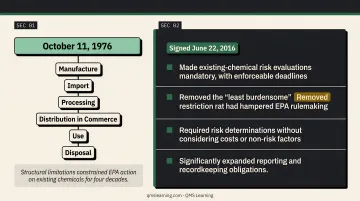
The Toxic Substances Control Act was enacted on October 11, 1976, giving the EPA broad authority to evaluate, regulate, and restrict chemical substances across their entire lifecycle: manufacture, import, processing, distribution, use, and disposal. For its first four decades, that authority was constrained by structural limitations that made it difficult for the EPA to act on existing chemicals in any meaningful way.
The Frank R. Lautenberg Chemical Safety for the 21st Century Act, signed June 22, 2016, fundamentally changed that. The amendment:
- Made existing-chemical risk evaluations mandatory, with enforceable deadlines
- Removed the "least burdensome" restriction standard that had hampered EPA rulemaking
- Required risk determinations without considering costs or non-risk factors
- Significantly expanded reporting and recordkeeping obligations
Six Chemicals Under Special Attention
EPA specifically targets six substances under TSCA based on their historical industrial use, environmental persistence, and public health impact:
- Polychlorinated biphenyls (PCBs)
- Asbestos
- Radon
- Lead
- Mercury
- Formaldehyde
What TSCA Does NOT Cover
Eight categories of materials are generally exempt from TSCA regulatory authority, each regulated under separate federal programs:
- Pesticides
- Tobacco
- Nuclear materials
- Firearms and ammunition
- Food and food additives
- Drugs
- Cosmetics
These exemptions are not automatic. Product identity and intended use both factor into whether an exclusion actually applies — a substance that qualifies as a cosmetic ingredient in one context may fall under TSCA scrutiny in another. When in doubt, the EPA's specific use-case guidance governs.
Who Must Comply with TSCA?
TSCA's reach extends well beyond dedicated chemical manufacturers. The law applies across the supply chain to any entity that:
- Manufactures chemical substances domestically (TSCA's definition of manufacture includes import)
- Imports chemicals, mixtures, or articles containing regulated substances
- Processes chemical substances for commercial distribution
- Distributes or uses substances subject to Section 6 restrictions or SNURs
The Finished Goods Misconception
One of the most common compliance gaps involves companies that sell finished products rather than raw chemicals. If an article contains a substance subject to TSCA reporting, SNURs, or Section 6 restrictions, the company selling that article may still carry TSCA obligations — regardless of whether they consider themselves a "chemical company."
This is especially relevant for manufacturers sourcing components globally. PFAS in upstream materials, PBT chemicals in electronic components, and PCBs in legacy products may trigger obligations the brand owner never identified — often discovered only when a customer audit or EPA inquiry arrives.
Who Owns Compliance Inside the Organization?
Responsibility typically falls to:
- Environmental compliance officers and regulatory affairs specialists
- EHS managers
- Corporate legal and import compliance teams
Most organizations discover that gap when an enforcement action or customer audit exposes it. Building a functional program before that moment — not after — is what separates companies that respond confidently from those that scramble to reconstruct records under pressure.
Key TSCA Requirements: Core Sections Explained
Three sections define the practical compliance burden for most manufacturers, importers, and compliance teams.
Section 5 — Pre-Manufacture Notices (PMN) for New Chemicals
Any chemical substance not listed on the TSCA Inventory is classified as "new." Before manufacturing or importing it for commercial purposes, companies must file a Pre-Manufacture Notice with EPA at least 90 calendar days before activity begins.
During the review period, EPA assesses health and environmental risk. The agency may:
- Approve the substance for commercial use
- Impose use conditions or require additional testing
- Restrict or prohibit market entry
The 90-day window is a filing deadline — not a guarantee of review completion. EPA receives roughly 500 Section 5 notices and applications annually, and GAO has reported that EPA made determinations within the statutory period less than 10% of the time in recent years.
Significant New Use Notices (SNUNs): When EPA issues a Significant New Use Rule (SNUR) for an existing substance, any company intending to begin that designated use must submit a SNUN at least 90 days beforehand. This makes ongoing SNUR monitoring essential — particularly as product designs evolve or sourcing shifts to new suppliers.
Section 6 — Risk Evaluation and Chemical Restrictions
Under Section 6, EPA can restrict, phase out, or ban substances that present an unreasonable risk to human health or the environment — regardless of production volume. Once a Section 6 rule applies to a substance, companies must either comply with the specific use conditions or discontinue use entirely.
Five persistent, bioaccumulative, and toxic (PBT) chemicals are subject to finalized Section 6(h) rules:
| Chemical | Current Status |
|---|---|
| DecaBDE | Most manufacture, processing, and distribution prohibited; 2024 revision added workplace protections |
| PIP (3:1) | Most processing and distribution prohibited, with exclusions and extended compliance dates |
| 2,4,6-TTBP | Distribution limits apply based on volume and concentration |
| HCBD | Manufacture, processing, and distribution prohibited with limited exclusions |
| PCTP | Prohibited above the rule's concentration threshold |
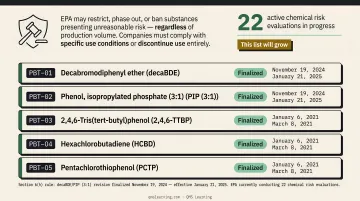
The decaBDE/PIP (3:1) revision was finalized November 19, 2024, and became effective January 21, 2025. EPA is currently conducting 22 chemical risk evaluations — meaning this list will grow.
Section 8 — Reporting, Recordkeeping, and PFAS Disclosures
Section 8 supplies EPA's information base. Depending on which sub-sections apply, companies may need to report:
Section 8 supplies EPA's information base. Depending on which sub-sections apply, companies may need to report:
- Chemical production volumes and processing data
- Distribution information and downstream use data
- Health and safety studies
- Records of adverse effect allegations
Retention requirements:
- Records of significant adverse health reactions involving employees: 30 years
- Environmental-effect records and most other records: 5 years
Section 8(a)(7) PFAS Reporting: This rule has expanded TSCA reporting obligations further than any other recent rulemaking. Manufacturers and importers must report detailed information on any PFAS manufactured or imported between January 1, 2011 and December 31, 2022. Required data includes chemical identity, uses, volumes, byproducts, and exposure information.
EPA's economic analysis identified at least 1,462 PFAS potentially covered and modeled approximately 131,410 potential respondents, with estimated industry compliance costs around $843 million. The reporting window now opens January 31, 2027, following multiple deadline extensions.
Why PFAS compliance is particularly difficult:
- The 12-year lookback period requires reconstructing historical procurement and sourcing data
- PFAS appear in upstream components and legacy materials where direct visibility is limited
- Companies must conduct structured supplier outreach to build a complete, supportable submission before the window opens
The TSCA Chemical Substance Inventory: Your Starting Point
The TSCA Inventory is EPA's official reference list of chemical substances legally allowed in U.S. commerce. As of EPA's January 17, 2025 update, the Inventory contained 86,847 substances, of which 42,495 were classified as active.
An "active" substance has been manufactured, imported, or processed in U.S. commerce during the statutory lookback period, or has since been notified as such. By contrast, the remaining ~44,352 substances are classified as inactive — not banned, but requiring a Notice of Activity before reintroduction.
Practical Compliance Steps
Before manufacturing or importing any chemical substance, teams must:
- Verify Inventory status — active, inactive, or unlisted
- For active substances — assess whether Section 6 restrictions or SNURs apply
- For inactive substances — submit a Notice of Activity before reintroduction
- For unlisted substances — file a PMN at least 90 days before commercial activity begins
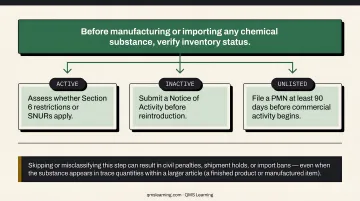
Skipping or misclassifying this step can result in civil penalties, shipment holds, or import bans — even when the substance appears in trace quantities within a larger article (a finished product or manufactured item).
TSCA Import Certification
At the port of entry, importers must file a TSCA certification statement with U.S. Customs — either:
- Positive certification: The shipment's chemicals comply with TSCA
- Negative certification: TSCA does not apply to this shipment
This is a self-declaration, not a third-party certificate. That distinction matters operationally — your logistics team needs to confirm the correct declaration is filed before the shipment reaches port. Failure to file can result in refusal of entry, regardless of whether the substance itself is compliant.
TSCA Enforcement: Consequences of Non-Compliance
EPA's enforcement authority under TSCA Section 16 carries real consequences. The current maximum civil penalty under 40 CFR 19.4 is $49,772 per violation per day, effective January 8, 2025. For knowing or willful violations, criminal sanctions include up to $50,000 per day and/or one year in prison.
Beyond penalties, enforcement actions can include:
- Corrective orders
- Product recalls
- Shipment bans at the border
- Import certification revocations
Documented Enforcement Cases
These recent settlements illustrate the recurring violation categories EPA targets:
| Company | Violation | Penalty |
|---|---|---|
| Haifa North America (2024) | CDR data omitted for 32 imported substances (2016–2019) | $664,267 |
| Western Reserve Chemical (2021) | CDR data omitted for 18 substances (2012–2015) | $357,000 |
| Lighting Resources (2022) | PCB marking, dating, storage, and manifesting violations | $68,290 |
| 3M (2025) | PMN/LVE site notification and import certification allegations | $39,583 |
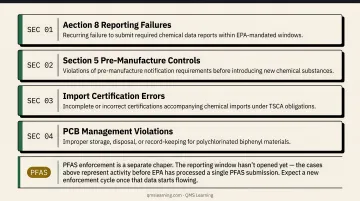
The pattern across these settlements is consistent: Section 8 reporting failures, Section 5 pre-manufacture controls, import certification errors, and PCB management violations. PFAS enforcement is a separate chapter. The reporting window hasn't opened yet, so the cases above represent activity before EPA has processed a single PFAS submission — expect a new enforcement cycle once that data starts flowing.
Building a TSCA Compliance Program That Holds Up
A defensible compliance program comes down to structure and documentation. Intention doesn't hold up in an inspection.
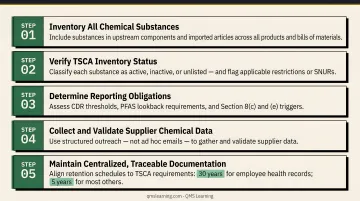
The Foundational Steps
- Inventory all chemical substances in your products and bills of materials — including substances present in upstream components and imported articles
- Verify TSCA Inventory status for each substance — active, inactive, or unlisted — and flag applicable restrictions or SNURs
- Determine reporting obligations — CDR thresholds, PFAS lookback requirements, Section 8(c) and (e) triggers
- Collect and validate supplier chemical data through structured outreach — not ad hoc emails
- Maintain centralized, traceable documentation with retention schedules aligned to TSCA requirements (30 years for employee health records; 5 years for most others)
Supplier Data Is the Persistent Weak Point
Complex supply chains make it difficult to confirm what's in upstream components. Teams relying on informal supplier outreach — scattered emails, inconsistent SDS requests, unorganized spreadsheets — consistently struggle when an inspection or customer audit arrives. Standardized supplier engagement workflows and centralized documentation sharply reduce that exposure.
Regulatory Monitoring Can't Be a One-Time Exercise
TSCA obligations shift continuously. EPA publishes new SNURs, completes risk evaluations, and issues Section 6 rules on an ongoing basis. With 22 chemicals currently under active risk evaluation, new restrictions are coming. Compliance programs need a defined process for:
- Tracking EPA regulatory actions
- Assessing impacts on current products and sourcing decisions
- Updating internal records when obligations change
The Connection to Broader EHS Management
For EHS managers already operating under ISO 14001 or OSHA frameworks, TSCA fits within a larger environmental management system rather than standing apart from it. Teams that have built structured documentation practices, defined roles, and evidence management capability are better positioned to absorb new regulatory requirements without rebuilding from scratch.
QMS Learning's Environmental & Safety Compliance pathway — covering ISO 14001:2026, ISO 45001, OSHA general industry, and EPA reporting — builds the documentation discipline and evidence management capability that regulatory compliance programs like TSCA demand. EHS teams that complete the pathway carry structured audit-readiness skills that transfer directly to managing recordkeeping obligations, supplier data control, and inspection-ready records.
Frequently Asked Questions
What does TSCA compliant mean?
TSCA compliance means continuously meeting EPA requirements for manufacturing, importing, processing, and reporting chemical substances under the Toxic Substances Control Act. It includes inventory verification, required notifications (PMNs, SNUNs), Section 8 reporting, and maintaining records on the timelines EPA mandates — not a one-time filing.
How do I know if my product is subject to TSCA?
Determine whether your product contains chemical substances — as standalone chemicals, in mixtures, or within articles. Verify those substances against the TSCA Inventory and check whether any Section 6 restrictions or SNURs apply. Finished goods are not automatically exempt; if they contain regulated substances, TSCA obligations may follow.
How do I comply with TSCA regulations?
- Verify each substance on the TSCA Inventory before manufacturing or importing
- File PMNs for new chemicals at least 90 days before commercialization
- Meet Section 8 reporting and recordkeeping requirements
- Monitor Section 6 rules and SNURs for applicable restrictions
- Maintain audit-ready documentation across your supply chain
What chemicals are exempt from TSCA requirements?
Eight categories are generally exempt: pesticides, tobacco, nuclear materials, firearms and ammunition, food, food additives, drugs, and cosmetics — each regulated under separate federal programs. Limited exemptions may also apply to research and development activities if quantities are small and not for commercial use.
What are the penalties for TSCA non-compliance?
Civil penalties reach $49,772 per violation per day under current federal schedules. Enforcement actions can also include corrective orders, product recalls, and import bans. Knowing or willful violations carry criminal sanctions of up to $50,000 per day and/or one year in prison.
What is a TSCA Certificate of Compliance?
It's a self-declared statement filed by importers with U.S. Customs — either confirming the shipment complies with TSCA or that TSCA does not apply. It is not a third-party certificate; failure to file can result in the shipment being refused entry.