Introduction
Most EHS programs look functional on paper. Training is scheduled, forms get filed, and someone updates the binder before an audit. But when an inspector actually walks in, or a certification auditor asks to see evidence of competency rather than completion, the gap between documentation and genuine capability becomes hard to hide.
The BLS recorded 5,070 fatal work injuries in 2024 — a rate of 3.3 per 100,000 full-time-equivalent workers. Those numbers reflect what happens when EHS programs exist as checkbox exercises rather than operational systems. Penalties, shutdowns, workers' compensation exposure, and criminal liability in willful cases follow.
This guide covers what EHS compliance actually requires — which regulations apply, what the five functional areas look like in practice, and how to build a program that holds up under real audit scrutiny. It's written for EHS managers, plant managers, quality directors, and operations leads carrying OSHA, ISO 14001, and ISO 45001 obligations.
Key Takeaways:
- EHS compliance is a legal mandate, a moral obligation, and a business risk management function
- Five functional areas create the structure: environment, occupational safety, training, incident reporting, and documentation
- Absent records are treated as absent compliance by auditors and regulators
- OSHA's 2025 penalties reach $165,514 per willful or repeated violation
- ISO 14001:2026 published April 15, 2026 — the May 2029 transition deadline is already approaching
What Is EHS Compliance?
EHS compliance is the full body of laws, regulations, standards, internal policies, and documented practices an organization must satisfy to protect worker health and safety, prevent environmental harm, and remain legally operational.
It's a legal mandate, a moral obligation, and a business risk function — and treating it as only one of those three is where programs start to break down.
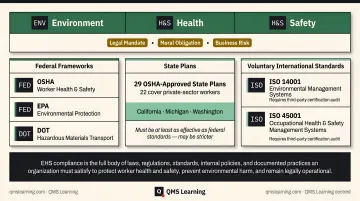
EHS stands for Environment, Health, and Safety. These three pillars are enforced through overlapping frameworks:
- Federal level: OSHA (worker safety), EPA (environmental protection), DOT (hazardous materials transport)
- State level: 29 OSHA-approved State Plans, 22 of which cover private-sector workers — California, Michigan, and Washington among them — and state requirements must be at least as effective as federal standards, and may be stricter
- Voluntary international standards: ISO 14001 (Environmental Management Systems) and ISO 45001 (Occupational Health and Safety Management Systems), which require third-party certification audits
Compliance vs. Capability
Compliance means meeting the minimum legal threshold. EHS capability is something different — the organizational readiness to identify hazards, respond to incidents, pass audits, and prevent recurrence. Passing a training class does not automatically produce that capability.
Regulators and auditors are not looking for certificates. They want evidence your team can actually perform the work: hazards assessed, corrective actions followed through, records current and accessible.
Who Bears Legal Responsibility
Under OSHA's General Duty Clause (Section 5(a)(1) of the OSH Act), every employer must furnish employment and a workplace free from recognized hazards that are causing or are likely to cause death or serious physical harm. This obligation cannot be delegated. It sits with the organization regardless of size, industry, or how many layers of supervision exist between leadership and the shop floor.
That means when an auditor or inspector arrives, the question isn't whether a policy exists — it's whether your team can demonstrate they understand it, apply it, and have the records to prove it.
The 5 Key Areas of EHS Compliance
Gaps in any single area create audit exposure and operational risk. A strong environmental program means little if incident reporting is informal, or if training records cannot be produced on demand.
Environmental Compliance
Environmental compliance covers an organization's obligations to prevent pollution, manage hazardous materials and waste, control air and water emissions, and report to agencies such as the EPA. The governing frameworks include:
- Clean Air Act — regulates air emissions and air-quality programs
- Clean Water Act — controls pollutant discharges to surface waters; direct discharges generally require permits
- RCRA — controls hazardous waste from generation through disposal
- EPCRA — Section 312 (Tier II) requires annual chemical inventory reporting by March 1, generally triggered at 10,000 lbs for hazardous chemicals; reports go to the SERC, LEPC, and local fire department
The EPA's FY2024 enforcement results included 1,851 civil cases and more than $1.7 billion in penalties — including a $1.1M RCRA settlement and a $1.4M Clean Air Act settlement against individual manufacturers. Those numbers reflect enforcement against facilities that assumed their programs were close enough.
Occupational Health and Safety
This area covers all workplace hazards — physical, chemical, biological, radiological, and ergonomic — and the employer's obligation to assess, control, and document those hazards. Practically, this means:
- OSHA 300 log: Record each case within 7 calendar days; post the 300A summary from February 1 through April 30
- Job Hazard Analyses: OSHA's JHA publication is guidance, but specific standards impose documentation requirements — PPE standard 1910.132(d)(2), for example, requires written certification of the workplace hazard assessment
- Incident reporting: Fatalities must be reported to OSHA within 8 hours; inpatient hospitalizations, amputations, and eye losses within 24 hours — including by employers otherwise exempt from routine recordkeeping
The FY2025 OSHA Top 10 most-cited standards included Hazard Communication (1910.1200), Lockout/Tagout (1910.147), and Respiratory Protection (1910.134). These repeat annually for the same reason: organizations acknowledge the standards without consistently documenting compliance.
Regulatory Training and Competency
OSHA and ISO standards both require documented, role-specific training — not generic awareness sessions. What auditors actually look for:
- Training is tied to specific hazards relevant to each employee's tasks
- Employees can demonstrate understanding, not just attendance
- Records exist for initial training and any updates when new hazards are introduced
ISO 14001:2015 and ISO 45001:2018 Clause 7.2 explicitly require organizations to evaluate actions taken to ensure competence — training attendance alone is not the stated endpoint.
DOT hazardous materials training (49 CFR 172.704) adds its own layer: initial training within 90 days, recurrence at least every 3 years, and records retained for employment plus 90 days.
Incident Reporting and CAPA
Organizations need a documented process for reporting near-misses, injuries, illnesses, and environmental releases — and regulators expect evidence of follow-through. That means:
- Initial reporting — OSHA's timing requirements (8 hours for fatalities, 24 hours for hospitalizations/amputations/eye loss)
- Root cause analysis — identifying why the incident occurred, not just what happened
- Corrective action — documented measures to address the cause
- Effectiveness verification — confirmation the corrective action worked
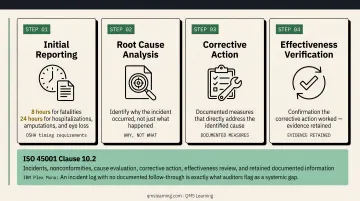
ISO 45001 Clause 10.2 covers this entire cycle — incidents, nonconformities, cause evaluation, corrective action, effectiveness review, and retained documented information. An incident log with no documented follow-through is exactly what auditors flag as a systemic gap.
Documentation and Records Management
EHS compliance is only provable through records. Auditors and regulators treat absent records as absent compliance — regardless of what the organization actually did.
| Record Type | Retention Requirement |
|---|---|
| OSHA 300, 300A, 301 logs | 5 years after the calendar year |
| Employee exposure records | At least 30 years |
| Employee medical records | Employment plus 30 years |
| Training records | Standard-specific; no universal OSHA period |
Training records, inspection reports, audit findings, hazard assessments, CAPA records, and permit documentation all need to be organized, current, and retrievable on demand — not assembled in the week before an audit.
Consequences of EHS Non-Compliance
Financial and Criminal Penalties
OSHA's 2025 penalty structure leaves little room for casual compliance:
| Violation Type | Maximum Penalty |
|---|---|
| Serious | $16,550 per violation |
| Willful | $165,514 per violation |
| Repeated | $165,514 per violation |
| Failure to abate | $16,550 per day |
EPA penalties run higher for environmental violations: Clean Air Act violations can reach $124,426 per day per violation, and RCRA violations carry the same ceiling. Criminal charges are possible in cases of willful violations that result in serious harm.
Operational and Reputational Damage
Beyond penalties, non-compliance produces:
- Work stoppages and production losses
- Elevated workers' compensation costs
- Loss of customer contracts — aerospace, defense, and regulated industries routinely require EHS compliance as a supplier qualification criterion
- Hiring and investor confidence damage once enforcement actions become public
What Scale Looks Like
These consequences aren't hypothetical. Real incidents trace directly to the same gaps — missing documentation, untrained workers, ignored hazards — that compliance programs exist to close.
The West Fertilizer explosion (April 17, 2013) killed 15 people and injured more than 260. The CSB identified limited oversight, inadequate hazard awareness, and emergency planning failures. OSHA issued 24 serious citations; the final settlement penalty was $112,000 — a fraction of the human and community cost.
Deepwater Horizon (April 20, 2010) killed 11 workers. BP's criminal and civil resolution totaled more than $24 billion, including a $5.5 billion Clean Water Act penalty.
The same failure patterns appear in smaller, less visible incidents every week: ignored hazards, missing documentation, untrained workers. The scale changes the headline — the root cause is the same, and it's preventable.
How to Build an EHS Compliance Program That Holds Up Under Audit
Step 1 — Identify All Applicable Regulations
Map every federal, state, and local requirement that applies to your specific operations, industry, and geography. This inventory is a living document. OSHA issued a final rule updating the Hazard Communication Standard in May 2024. ISO 14001:2026 published April 15, 2026, with a May 2029 certification deadline. Regulations change. The obligation to track them does not change with them.
Step 2 — Conduct a Gap Assessment
Measure your current state against each applicable requirement. Use internal audits, walkthroughs, and document reviews to identify where programs, training, records, or controls are missing or insufficient. A gap assessment is not a one-time exercise — it feeds the correction cycle and should be updated whenever regulations change or operations expand.
Step 3 — Build Role-Specific Training With Verified Competency
Effective EHS training maps to the actual hazards and responsibilities of specific roles. An environmental compliance officer needs different training than a maintenance supervisor, and the documentation must show not just completion but demonstrated understanding.
Any training program worth deploying should address both of those requirements: role-specific content and verifiable competency. QMS Learning's Environmental & Safety Compliance pathway is structured around exactly that. It includes:
- EHS Fundamentals — 12 modules, 50 lessons covering ISO 14001, ISO 45001, OSHA general industry, and EPA reporting
- ISO 14001:2026 Transition — 8 modules, 14 lessons covering every clause change, including Clause 6.3 change management procedures and the gap analysis process before the May 2029 deadline
- ISO 45001 Internal Auditor — coming Q3 2026
- OSHA 30-Hour General Industry — coming, earning the OSHA 30-Hour completion card upon completion
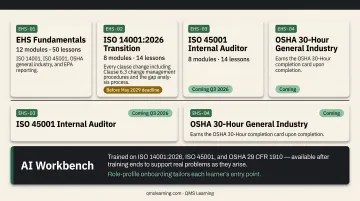
Role-profile onboarding tailors each learner's entry point, and the AI Workbench — trained on ISO 14001:2026, ISO 45001, and OSHA 29 CFR 1910 — remains available after training ends to support real problems as they arise.
Step 4 — Establish Inspection, Audit, and CAPA Cycles
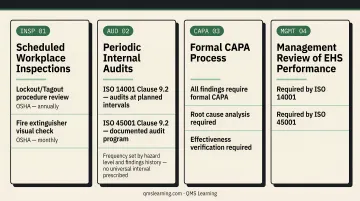
A functioning EHS program requires regular inspection, audit, and corrective action cycles. That includes:
- Scheduled workplace inspections — OSHA requires lockout/tagout procedure reviews annually; fire extinguisher visual inspections monthly
- Periodic internal audits — ISO 14001 and ISO 45001 Clause 9.2 require audits at planned intervals with a documented audit program (neither standard prescribes a universal frequency — set it based on hazard level and findings history)
- Formal CAPA process for any findings, including root cause analysis and effectiveness verification
- Management review of EHS performance data — required by both ISO 14001 and ISO 45001
Step 5 — Maintain Audit-Ready Documentation
Regulators and third-party auditors will ask for records, not verbal assurances. Training records, inspection logs, CAPA evidence, hazard assessments, and permits must be organized, current, and retrievable on demand.
QMS Learning's Manager Dashboard addresses this directly. It exports a single indexed PDF — the Audit-Evidence Package — containing training records by employee, completed scenario logs, AI-generated artifacts (hazard analyses, environmental aspects registers, CAPA records), and time-stamped Workbench interactions.
For ISO 14001 and ISO 45001 certification audits, that package covers four critical clauses in one submission:
- Clause 7.2 — Competence
- Clause 7.3 — Awareness
- Clause 7.5 — Documented information
- Clause 10.2 — Corrective action
The package can be submitted directly to the registrar.
Frequently Asked Questions
What is EHS compliance?
EHS compliance is the body of laws, regulations, standards, and internal practices organizations must satisfy to protect worker health and safety and prevent environmental harm. In the US, it is enforced primarily by OSHA (worker safety) and the EPA (environmental protection), with DOT covering hazardous materials transport.
What are the 5 key areas of EHS compliance?
The five areas are: environmental compliance, occupational health and safety, regulatory training and competency, incident reporting and CAPA, and documentation and records management.
What agencies enforce EHS compliance in the United States?
OSHA, the EPA, and DOT are the primary federal agencies. Additionally, 29 OSHA-approved State Plans give states independent enforcement authority — and many, like Cal/OSHA, impose requirements stricter than federal minimums.
What happens if a company fails to comply with EHS regulations?
Consequences include financial penalties up to $165,514 per willful OSHA violation, EPA enforcement actions, operational shutdowns, criminal liability in willful cases, increased workers' compensation costs, and reputational damage. Regulators treat absent documentation as absent compliance.
What is the difference between ISO 14001 and ISO 45001?
ISO 14001 governs Environmental Management Systems (the 2026 revision published April 15, 2026, with a May 2029 certification transition deadline), while ISO 45001 governs Occupational Health and Safety Management Systems. Both are voluntary standards audited by third-party registrars, separate from but complementary to OSHA and EPA regulatory requirements.
How often should EHS audits and inspections be conducted?
No single universal frequency applies. OSHA mandates specific intervals for certain equipment — lockout/tagout annually, fire extinguishers monthly. ISO 14001 and ISO 45001 require internal audits at planned intervals without a prescribed cadence, so organizations should calibrate frequency to hazard level, regulatory requirements, and findings history.