Introduction
A SOC 2 readiness assessment is a pre-audit evaluation that measures your existing controls against the Trust Services Criteria before the formal examination even starts. Think of it as a dress rehearsal before the real audit performance.
This guide serves two audiences. The first: SaaS and tech companies chasing their first SOC 2 report. The second: defense contractors and DIB vendors layering SOC 2 onto existing CMMC, NIST 800-171, or ISO 27001 programs. Both groups face the same problem from different angles.
Readiness assessments get mentioned constantly in sales cycles and RFPs, yet most teams don't actually understand what one produces or how it differs from the audit itself. We'll cover what a readiness assessment is, why companies use one, how the process actually unfolds, and when skipping it might be the smarter call.
Key Takeaways
- A readiness assessment delivers a gap analysis and remediation roadmap, not an audit opinion
- Costs vary by delivery method: self-assessments are cheaper but less reliable than third-party reviews
- Third-party readiness assessments typically cost $10,000-$17,000, depending on scope and size
- Most first-time failures trace back to inconsistent evidence, not missing controls
- AICPA independence rules typically bar one firm from handling both your readiness assessment and official audit
What Is a SOC 2 Readiness Assessment?
A SOC 2 readiness assessment is a diagnostic gap analysis. It measures your existing controls, policies, and evidence against the applicable Trust Services Criteria (TSC) before the formal examination period begins. Nothing about it is pass/fail.
The output is a prioritized list of gaps, usually delivered as a management letter or remediation plan. No opinion is issued. That's the core distinction most teams miss.
Readiness vs. Type 1 vs. Type 2
These three terms get used interchangeably, and shouldn't be:
| Engagement | What it evaluates | Opinion issued? |
|---|---|---|
| Readiness Assessment | Proposed scope, control design, evidence maturity | No |
| Type 1 Report | Control design as of a specific date | Yes |
| Type 2 Report | Design and operating effectiveness over 3-12 months | Yes |
As Schellman explains in its readiness assessment overview, the engagement identifies gaps and produces an internal deliverable, stopping short of anything resembling an auditor's sign-off.
Self-Assessment vs. Formal Readiness Assessment
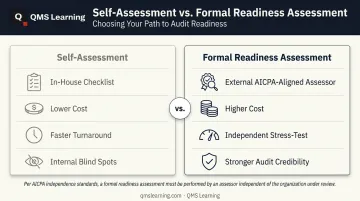
You have two paths here, and they're not equivalent:
- Self-assessment: Done in-house, using checklists or internal audit staff. Cheaper, faster, but carries obvious blind spots: you're grading your own homework.
- Formal readiness assessment: Performed by an external, AICPA-aligned assessor. Costs more, but the findings hold more weight because an outside party is stress-testing your controls the way an examiner would.
One rule matters more than most teams realize: the firm that performs your readiness assessment typically cannot also issue your SOC 2 opinion. AICPA independence guidance (ET 1.295) permits advisory-style readiness work, but requires your organization's management to retain ownership of every control decision. If the same firm designs your controls and then audits them, that's a self-review problem.
This independence boundary affects who performs the assessment, not which criteria apply. Every SOC 2 examination requires the Security criterion at minimum. Availability, Confidentiality, Processing Integrity, and Privacy get added only if your actual customer commitments call for them, not by default.
Why a Readiness Assessment Matters Before Your SOC 2 Audit
SOC 2 isn't legally mandated anywhere. But for SaaS companies selling into enterprise accounts, it's become table stakes. Large buyers use it as proof that a vendor takes data protection seriously, and procurement teams increasingly won't move forward without it.
Coalfire's guide for executives notes that organizations selling to banks, insurers, and large enterprises may simply get blocked in procurement without a SOC 2 report. No law requires it — the market simply won't wait for vendors who skip it.
What Goes Wrong Without One
Skip the readiness step and you're rolling the dice on:
- Unclear scope: nobody agreed in advance which systems and services actually fall under the examination
- Incomplete System Descriptions: the narrative document auditors rely on has gaps that surface mid-audit
- Surprise testing exceptions: controls that looked fine on paper fail when the examiner actually samples evidence
Any of these can lead to a qualified opinion or a delayed report, precisely the outcome you're trying to avoid when a customer contract is waiting on that report.
The DIB Complication
For defense-adjacent technology vendors, SOC 2 rarely stands alone anymore. It sits next to CMMC, NIST 800-171, and ISO 27001 as part of one combined cybersecurity compliance stack. A team juggling all four frameworks without early gap visibility across each one tends to duplicate work, or worse, misses a control that one framework requires but another doesn't flag. QMS Learning's Defense Cybersecurity pathway, currently in pilot, is built to track these overlapping requirements together instead of one framework at a time.
How a SOC 2 Readiness Assessment Works: The Process
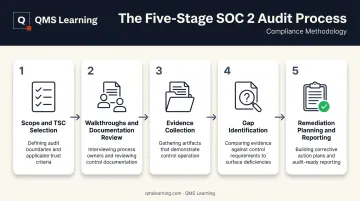
At a high level, the process follows five moves: define scope, walk through processes, collect evidence, identify gaps, and receive a remediation-focused deliverable. Nothing about it happens overnight, but nothing about it should drag on for months, either.
What feeds into the process:
- Existing policies and procedures
- System architecture documentation
- Access logs and system-generated records
- Prior audit history, if any exists
The core of the engagement is mapping each existing control to the relevant TSC and its underlying points of focus. The assessor evaluates whether your control, as it actually operates, satisfies the intent behind each criterion rather than whether the paperwork alone checks a box.
Timelines are typically governed by a project plan agreed during kickoff, ranging from a few days to a few weeks depending on scope.
Step 1: Scope and Trust Services Criteria Selection
Before anything else happens, your organization and the assessor jointly define which systems and services are in scope. You'll also confirm which TSCs apply beyond the mandatory Security criterion. This decision alone shapes the cost, timeline, and depth of everything that follows: adding Availability or Confidentiality, for example, means additional controls to test and document.
Step 2: Walkthroughs and Documentation Review
The assessor reviews your policies, then holds walkthrough meetings with control owners. This is where paper meets reality: does the access review policy match what your IT team actually does every quarter?
Common mismatches surface here, such as a policy stating quarterly access reviews when the team actually runs them monthly. Walkthroughs typically take about a week, according to Schellman's published methodology.
Step 3: Evidence Collection and Gap Identification
For every control, the assessor requests supporting evidence: tickets, logs, approval records, whatever proves the control ran as described. Gaps get flagged wherever documentation is missing, inconsistent, or simply not standardized across the team.
A common gap: one location logs access approvals in a ticketing system while another relies on email threads no one archives.
Step 4: Remediation Planning and Reporting
The engagement wraps with a management letter or gap report. From that point forward, fixing the identified issues is entirely on you. The assessor doesn't remediate, since that would blur the independence line discussed earlier.
Most organizations budget 30 to 90 days to close priority gaps before the formal SOC 2 audit begins.
Key Factors, Evidence Pitfalls, and Common Misconceptions
Three variables determine how heavy a readiness assessment feels:
- TSC selection: adding Availability or Confidentiality on top of Security multiplies the testing scope and cost
- Organization size and complexity: more systems mean deeper walkthroughs and larger evidence samples
- Existing tooling: mature ticketing and access management platforms make evidence easy to pull; ad hoc spreadsheets mean it has to be recreated by hand
The Classic Pitfall: Activity Without Standardization
Here's the scenario that trips up nearly every first-time SOC 2 candidate. A quality or IT manager performs quarterly user access reviews faithfully. The control genuinely exists. But when the assessor asks for proof, what they find is a mess: half the sign-offs live in email threads, some reviews have no dated record at all, and nobody can confirm which policy version governed which review.
Performing a control isn't enough on its own. It also needs a consistent process, documentation format, and approval trail behind it. This is exactly the kind of finding that turns into a reported deviation during the real Type 2 examination. The control itself didn't fail; nobody could prove it ran the same way twice.
Passing a readiness assessment reduces risk. It doesn't guarantee a clean SOC 2 opinion. New gaps can still surface once formal testing begins, especially over a Type 2 observation period spanning several months.
Many teams also treat SOC 2 prep as a one-time compliance project rather than an ongoing habit. That mindset is why evidence gaps reappear at every renewal cycle: the underlying discipline never became part of daily operations.
Building the Standardization Layer
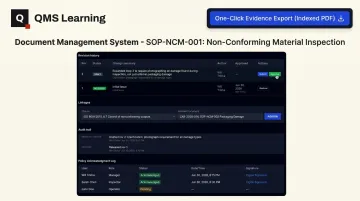
This is precisely the gap QMS Learning's Document Management System was built to close. Its append-only audit trails mean revision histories can't be quietly edited or reconstructed after the fact, so the history itself becomes the evidence. Timestamped, per-person acknowledgment logging replaces scattered email sign-offs with a record showing exactly who acknowledged which policy revision, and when.
Beyond that, clause-mapped linkages tie each controlled document to the specific requirement it satisfies, so coverage gaps surface internally before an auditor finds them. When it's time to prove any of this happened, one-click evidence export compiles it all into a single indexed PDF instead of requiring someone to assemble evidence by hand the night before the audit.
For teams juggling CMMC, NIST 800-171, ISO 27001, and SOC 2 simultaneously, QMS Learning's Defense Cybersecurity Readiness pathway (currently in pilot, opening Q3 2026) applies this same evidence discipline across all four frameworks at once. It's built by a founder who spent 20 years writing and closing audit findings on aerospace and defense floors, rather than building it once per framework and repeating the work four times over.
When a Readiness Assessment Is (and Isn't) the Right Move
A readiness assessment earns its cost in a few specific situations:
- First-time SOC 2 candidates who have never been through an examination and don't know where their blind spots are
- Organizations with complex, multi-system scope where control ownership is spread across several teams
- Teams facing a hard customer-driven deadline where a failed or delayed audit isn't an option
It's less necessary, sometimes redundant, for mature organizations already running continuous compliance monitoring with real-time control mapping. If your evidence collection is already automated and reviewed regularly, a separate formal readiness engagement may just confirm what you already know.
A readiness assessment functions as a rehearsal for the real audit. Its value comes directly from the rigor you bring to scoping and evidence discipline beforehand. Skip that rigor, and the assessment becomes a checkbox exercise rather than a genuine dry run.
Frequently Asked Questions
What is the SOC 2 compliance assessment?
It's an evaluation of an organization's controls against the AICPA's Trust Services Criteria, typically performed before or during a formal SOC 2 examination. The goal is confirming controls are suitably designed and operating effectively.
What is a SOC 2 Type 2 assessment?
A Type 2 assessment is a formal examination testing whether controls operated effectively over a defined period, usually 3-12 months. It results in an auditor's opinion — unlike a readiness assessment, which carries no opinion at all.
How much does a SOC 2 readiness assessment cost?
Third-party readiness assessments commonly cost $10,000 to $17,000, based on published benchmarks from CPA firms like The Pun Group. Actual pricing depends on your organization's size, scope, and how many Trust Services Criteria you select.
How long does a SOC 2 readiness assessment take?
Most engagements move through planning, walkthroughs, evidence collection, and reporting in a matter of weeks. Planning alone often takes several business days, and walkthroughs add roughly another week. Total duration depends heavily on how organized your evidence already is.
Can the same firm perform both my readiness assessment and my SOC 2 audit?
Generally, no. AICPA independence rules restrict a firm from taking on both roles for the same engagement, since designing or advising on controls and then auditing them creates a self-review conflict. Using separate firms is the lowest-risk approach.
Do I need a readiness assessment before every SOC 2 audit, including renewals?
It's most valuable for first-time examinations or environments that changed significantly since the last audit. Mature, continuously-monitored programs often don't need a separate formal readiness step every single cycle.