Introduction
Most teams treat ISO 27001 certification like a single event: pass the audit, get the certificate, done. That's not how it works.
The real process moves through gap analysis, risk assessment, control implementation, internal audit, and a two-stage external audit. Teams that skip steps almost always pay for it later with stalled timelines or failed audits.
This roadmap matters most for IT directors, CISOs, compliance officers, and quality/security leads at defense contractors, government contractors, and regulated enterprises. Certification here supports contract eligibility, CMMC/DFARS alignment, or customer trust.
More than 70,000 ISO/IEC 27001 certificates now exist across 150 countries, according to ISO's own certification data. That volume signals buyers now treat certification as a baseline requirement, not a competitive edge.
This article breaks the roadmap into its four working phases, explains what drives timeline and cost, and flags when a generic template stops being enough.
Key Takeaways
- ISO 27001 has four phases: scope and governance, risk assessment and SoA, implementation and audit, and certification with surveillance
- Preparation timelines typically run 3 months to 1 year, depending on organization size and existing security maturity
- The Risk Treatment Plan and Statement of Applicability receive the heaviest scrutiny in both audit stages
- Certification runs a 3-year cycle — annual surveillance audits, then recertification
- A part-time ISMS owner and a vague risk methodology are the two most common reasons roadmaps stall
What Is the ISO 27001 Certification Project Roadmap (and Why Organizations Need One)
The roadmap is a phase-based project plan that sequences governance setup, risk assessment, control implementation, and audit activities to achieve ISO/IEC 27001:2022 certification. It's the operational bridge between "we want to be certified" and an actual, working Information Security Management System (ISMS).
The end goal is a functioning, evidence-backed ISMS that an accredited certification body can validate through hands-on review of your documentation, controls, and staff behavior. A folder of policies alone won't pass that review.
Every task on the roadmap must map back to ISO 27001's Clauses 4–10 and the 93 Annex A controls, with defensible justification for every inclusion or exclusion decision. This isn't a generic IT project plan, and there's no room for "we'll figure that out later."
Why the sudden urgency? Enterprise buyers and government contracts increasingly require proof of an ISMS before they'll sign.
For defense suppliers, this often overlaps with (but doesn't replace) CMMC and DFARS obligations. The Department of Defense's own CMMC model is built on FAR 52.204-21, NIST SP 800-171, and DFARS 252.204-7012, and ISO 27001 certification isn't recognized as a substitute for those requirements.
Without a structured roadmap, three things tend to go wrong:
- Scope creep: the ISMS boundary expands mid-project because nobody locked it down early
- Skipped risk steps: teams jump to controls before finishing a proper risk assessment
- Undocumented evidence: work happens, but nobody retains proof, and it surfaces as a nonconformity at Stage 1
The roadmap's aggressiveness depends on what's driving it:
- Regulatory-driven: defense and DIB contractors facing mandatory compliance deadlines
- Buyer-driven: enterprise SaaS companies responding to customer security questionnaires
- Best-practice-driven: organizations building an ISMS proactively, without an external deadline
Regardless of the driver, the four roadmap phases stay the same.
The Phase-by-Phase ISO 27001 Roadmap
The four phases connect end-to-end: an executive mandate kicks things off, risk decisions shape what gets built, implementation produces evidence, and the certification audit validates all of it. Skip a phase's output and the next one has nothing solid to build on.
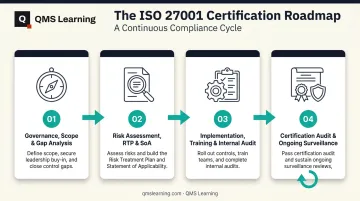
Phase 1: Governance, Scope, and Gap Analysis
Before any technical work starts, someone needs authority to run the project. That means:
- Executive sponsorship: top management assigns responsibilities, provides resources, and integrates ISMS requirements into business processes (a direct Clause 5 requirement)
- An ISMS manager or project lead with cross-departmental pull. This role can't sit with someone who also owns three other full-time jobs
- A clause-by-clause gap analysis comparing existing controls against ISO/IEC 27001:2022 to surface what's missing
- A locked ISMS scope (departments, locations, assets, and interested parties), documented per Clause 4 and retained as evidence
Get the scope wrong here and you'll be renegotiating it three months in, right when momentum matters most.
Phase 2: Risk Assessment, Risk Treatment, and the Statement of Applicability
This is where the project either builds a real foundation or produces paperwork nobody can defend.
Clause 6.1.2 requires a repeatable risk assessment methodology: asset inventory, threat and vulnerability identification, risk scoring, and named risk owners.
From there, teams build the Risk Treatment Plan (RTP), deciding whether to modify, share, avoid, or retain each risk, then getting risk-owner sign-off on residual risk.
The RTP feeds directly into the Statement of Applicability (SoA), which maps all 93 Annex A controls with documented justification for each inclusion or exclusion. Per Clause 6.1.3(d), the SoA must state:
- Which controls are necessary
- Why they're included
- Whether they're implemented
- Why any Annex A control was excluded
Auditors don't accept generic justifications. "Industry best practice" isn't a reason: they want to see it tied to your actual risk assessment.
This deliverable gets scrutinized at both Stage 1 (documentation readiness) and Stage 2 (operational proof), so decisions made here need to hold up under direct questioning.
Phase 3: Implementation, Training, and Internal Audit
Now the RTP becomes real. Technical, physical, and organizational controls get rolled out based on what Phase 2 identified as necessary.
Two training tracks run in parallel: organization-wide security awareness training, so everyone understands the policy and their role in it, and role-specific competence training, since Clause 7 requires evidence that people with security responsibilities actually have the skills for them.
Keep training records: they're objective evidence, and auditors ask for them. QMS Learning's manager dashboard, for example, tracks course completion and competency gaps automatically, so that evidence is ready before an auditor asks.
Before the external audit, run a formal, independent internal audit (Clause 9.2). This has to genuinely surface nonconformities, not rubber-stamp what you already believe.
Follow it with a management review (Clause 9.3), evaluating whether the ISMS is still suitable, adequate, and effective, including audit results, risk outcomes, and improvement opportunities.
Phase 4: Certification Audit and Ongoing Compliance
Select an accredited certification body and schedule both audit stages. Stage 1 reviews your documentation, including scope, policies, and the SoA, to confirm you're ready for Stage 2. Stage 2 then tests operational evidence: logs, staff interviews, and whether the controls defined in the SoA actually function.
If nonconformities come up (they usually do, even minor ones), you'll need to correct the root cause and submit evidence within the auditor's defined window.
Certification isn't a one-time achievement. It runs a 3-year cycle:
| Year | Activity |
|---|---|
| Year 1 | Annual surveillance audit |
| Year 2 | Annual surveillance audit |
| Year 3 | Recertification audit before expiry |
Where the Roadmap Applies and What Affects Your Timeline
This roadmap shows up most often at:
- SaaS vendors responding to enterprise security questionnaires
- Defense contractors and DIB suppliers navigating CMMC and DFARS alongside ISO 27001
- Government contractors under procurement security requirements
- Healthcare and fintech vendors facing customer due-diligence demands
What Speeds Up or Slows Down Certification
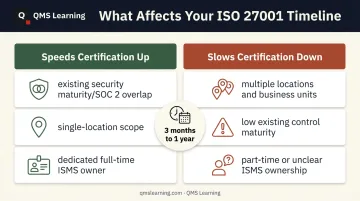
Once you know this roadmap applies to you, timeline is the next planning question. According to Schellman's analysis of certification timelines, organizations generally need 3 months to 1 year to prepare for certification, with remediation work alone sometimes stretching from weeks to months. Key variables include:
- Organization size and number of locations: more sites mean more evidence to collect and verify
- Existing security maturity — a company with an existing SOC 2 report gets a head start; A-LIGN reports 43% evidence overlap between SOC 2 and ISO 27001 requirements
- Dedicated ISMS ownership: a part-time owner juggling other priorities is the single biggest schedule risk
Budget Considerations
Timeline isn't the only variable to plan for. Costs scale with ISMS size and complexity rather than headcount alone. Expect line items across:
- Certification body registration and audit fees
- Lead implementer training for whoever owns the ISMS
- Optional GRC tooling or consultant support for gap analysis and risk assessment
- Internal labor, often the largest hidden cost, especially for smaller teams that struggle to find an internal auditor independent enough to satisfy Clause 9.2
SOC 2 overlap helps, but it doesn't remove ISO-specific requirements like scope definition, the RTP, the SoA, or the two-stage audit itself.
Common Roadmap Mistakes and When You Need More Than a Template
The biggest misconception: treating this as a one-time checklist instead of a living management system that has to demonstrate ongoing effectiveness, every year, through surveillance audits, not just at the initial cert.
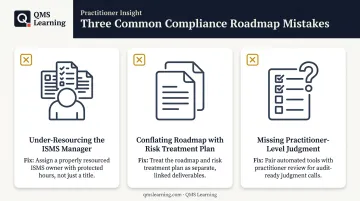
Three mistakes show up repeatedly:
- Under-resourcing the ISMS manager role. Assigning it part-time to someone with a full plate stalls momentum across a multi-month project. This role needs real bandwidth and cross-departmental authority.
- Conflating the project roadmap with the Risk Treatment Plan. The roadmap is your execution timeline. The RTP documents specific risk decisions. Teams that mix these up end up with a schedule that doesn't reflect actual risk priorities.
- Missing practitioner-level judgment. A template tells you what documents to produce. It doesn't tell you how to score a risk defensibly or why a control belongs in your SoA versus being excluded with justification.
That third gap is where generic templates run out of road. When internal teams can't run a risk assessment with confidence or don't know which corrective methodology fits a given finding, that's a capability problem, not a documentation problem.
QMS Learning's upcoming Defense Cybersecurity Readiness pathway (piloting in Q3 2026) covers CMMC, NIST 800-171, ISO 27001, and SOC 2 in one bundle, built around that same distinction.
Rather than handing teams another checklist, the included AI Workbench will be trained on ISO 27001 Annex A to support gap analysis, SoA drafting, and audit-evidence compilation inside the workflow teams already use for CMMC prep.
For organizations facing overlapping federal and international audit obligations at the same time, that integration matters more than another PDF template ever will.
Conclusion
The ISO 27001 roadmap is a four-phase, evidence-driven journey: governance and scope, risk assessment and the SoA, implementation and internal audit, then certification and ongoing surveillance. Skip depth in any one phase and it shows up as a nonconformity later, often at the worst possible moment.
Correctly resourced execution beats blind template adoption every time. Teams juggling CMMC, NIST 800-171, ISO 27001, and SOC 2 simultaneously don't need four separate playbooks. They need one integrated approach. QMS Learning is piloting exactly that with its Defense Cybersecurity Readiness pathway for defense-focused compliance teams starting Q3 2026.
Frequently Asked Questions
How do I prepare for ISO 27001 certification?
Secure leadership buy-in, run a gap analysis against ISO/IEC 27001:2022, define your ISMS scope precisely, and build a phased implementation plan. Only engage a certification auditor once your risk assessment and SoA are solid.
What is a cybersecurity implementation project plan?
It's a structured roadmap sequencing risk assessment, control deployment, staff training, and audit milestones to achieve a security framework such as ISO 27001. The plan governs execution and sequencing, separate from the underlying risk decisions.
How long does ISO 27001 certification take?
Preparation commonly takes 3 months to 1 year, depending on organization size and existing security maturity. Larger, multi-site organizations with lower control maturity sit at the longer end.
What is the Statement of Applicability (SoA)?
The SoA documents all 93 Annex A controls with justification for inclusion or exclusion, tied directly to your risk assessment results. It's one of the most heavily reviewed documents across both audit stages.
Do I need a consultant to get ISO 27001 certified?
Internal certification is possible, but consultants, specialized practitioner training, or platforms like QMS Learning's Defense Cybersecurity pathway (covering ISO 27001, currently in pilot for Q3 2026) reduce nonconformity risk and shorten the timeline. The deciding factor is whether your team has real risk-assessment judgment, not just documentation.
How much does ISO 27001 certification cost?
Costs scale with ISMS size and complexity rather than a fixed price point. Budget for certification body audit fees, lead implementer training, optional GRC tooling, and internal labor — often the largest hidden cost for smaller teams.