Introduction
You've seen this before: a corrective action closes out, the auditor signs off, and three months later the exact same nonconformance shows up on the shop floor.
In AS9100D, ISO 9001, and ISO 13485 environments, that's rarely bad luck. It's usually a symptom of a root cause analysis (RCA) template that got filled out instead of investigated.
Many quality teams treat RCA as a form to complete rather than a diagnostic process to run. The result: corrective actions built on assumptions instead of evidence. Auditors catch this fast, reject the finding on the spot, and send the whole investigation back to the start.
This article covers what belongs in an audit-ready RCA template and how to run it:
- A filled-in example from an AS9100D supplier scenario
- The five-step process every investigation should follow
- How to match 5 Whys, Fishbone, FMEA, or 8D to the problem in front of you
Key Takeaways
- A strong RCA template separates root cause from contributing factors and demands evidence, not assumptions
- Match the method to complexity: 5 Whys for linear issues, Fishbone, FMEA, or 8D for multi-factor or safety-critical problems
- Five core steps drive every investigation: define the problem, collect data, identify the root cause, implement corrective action, verify effectiveness
- Your RCA template doubles as audit evidence, so it must be complete, dated, and traceable
- AI-guided method selection removes the guesswork that stalls junior engineers when a real finding lands on their desk
What Is a Root Cause Analysis Template?
Root cause analysis is the investigation. A root cause analysis template is the document that proves you did it properly.
The American Society for Quality defines a root cause as the factor that caused a nonconformance and should be permanently eliminated through process improvement. ASQ describes root cause analysis as the collective term for the tools and techniques used to uncover it, according to ASQ's root cause analysis resource.
RCA is the methodology: the questioning, data-gathering, and testing that gets you from symptom to cause. The RCA template is the artifact, the structured record that captures each step so someone else (a colleague, a manager, an auditor) can follow your reasoning without having sat in the room with you.
In AS9100D, ISO 9001, or ISO 13485 environments, that artifact isn't optional paperwork. It's the objective evidence an auditor pulls during a nonconformance review. So the "best" RCA template isn't the one with the fewest fields or the fastest fill-in time. It's the one that produces a defensible, traceable record, meaning it shows:
- What data you looked at
- Which method you applied
- Why you ruled out other possible causes
- How you know the corrective action actually worked
Anything less, and you're documenting a guess with better formatting.
Essential Components of an Audit-Ready RCA Template
An RCA template earns its "audit-ready" label from a handful of specific components. Miss one, and the whole record becomes easy for an auditor to challenge.
Problem Statement: Specific and Measurable
A vague problem statement guarantees a vague investigation. "Parts are failing inspection" tells an auditor nothing.
Compare that to: "On March 14, incoming inspection rejected 12 of 50 units (Lot #4471) for out-of-tolerance bore diameter, exceeding spec by 0.008 inches, halting the assembly line for 6 hours."
A strong problem statement answers what, when, where, and how much impact. That gives you something measurable to close against later.
Data Collection: Quantitative and Qualitative
Evidence-based root causes need two data types working together:
- Quantitative data: measurements, defect frequencies, timelines, inspection records
- Qualitative data: operator interviews, process observations, supplier communication logs
Numbers tell you what happened. Interviews tell you why it kept happening. Skip either one, and your conclusion is only half-supported.
Root Cause vs. Contributing Factors
Your template needs to show the reasoning trail, not just a conclusion. Auditors want to see the method applied, whether that's the 5-Why chain, the fishbone categories tested, or the FMEA scoring, not a one-line answer that appeared from nowhere.
Contributing factors (a rushed changeover, an outdated work instruction) raise the likelihood or severity of a failure. The root cause is the condition that, if removed, prevents recurrence.
Document both. Corrective action targets the root cause first, but ignoring contributing factors invites a different version of the same problem next quarter.
CAPA Planning and Verification
Every corrective action needs a named owner, a due date, and a clear split across three action types:
- Containment stops the bleeding, such as quarantining a lot or notifying the customer
- Correction fixes the immediate nonconformance
- Corrective action prevents recurrence at the process level
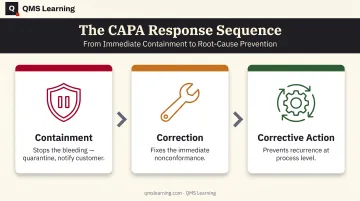
The ISO Auditing Practices Group treats cause analysis, correction, and corrective action as three distinct, separately traceable parts of a nonconformity response, not one blended step.
The template isn't finished until effectiveness is verified and the record is compiled into exportable evidence. QMS Learning's Document Management System auto-compiles training records, generated artifacts, and time-stamped activity into a single indexed audit-evidence PDF that registrars typically accept on first submission.
Root Cause Analysis Template Example
Here's how this looks in practice, based on a representative AS9100D supplier scenario. A manufacturer's incoming inspection catches the same defect from one supplier across three separate jobs in a single quarter—enough to escalate an isolated rejection into a documented nonconformance under AS9100D §8.4.3.
Problem Statement
Incoming inspection identified the same bore-diameter defect on three separate jobs from Supplier X within Q1 (Lots #4471, #4489, #4502). That pattern makes this a recurring nonconformance, not an isolated event.
- Total scrap cost: $8,200
- Production impact: two line stoppages totaling 9 hours
Root Cause
5-Why analysis traced the defect to Supplier X's tooling calibration schedule. The interval had shifted from monthly to quarterly six months earlier, with no matching update to their process control plan.
Inspection records confirmed the drift began the same month the calibration interval changed—the data point that moved this from a guess to a supported conclusion.
Corrective and Preventive Action
- Containment (immediate): Quarantine remaining Lot #4502 stock; 100% inspect open orders — Owner: Receiving Inspection Lead. Due: 48 hours
- Corrective action: Require Supplier X to revert to monthly calibration and submit a revised process control plan — Owner: Supplier Quality Engineer. Due: 30 days
- Preventive action: Add calibration-interval change notification to the Supplier Requalification Procedure — Owner: Quality Manager. Due: 45 days
Verification
Success criterion: zero bore-diameter rejections from Supplier X across the next three incoming lots, reviewed 60 days after implementation. Date the entry and tie it to inspection records—that line is what an auditor checks to confirm the corrective action worked, not only that it was written down.
Steps to Conduct a Root Cause Analysis
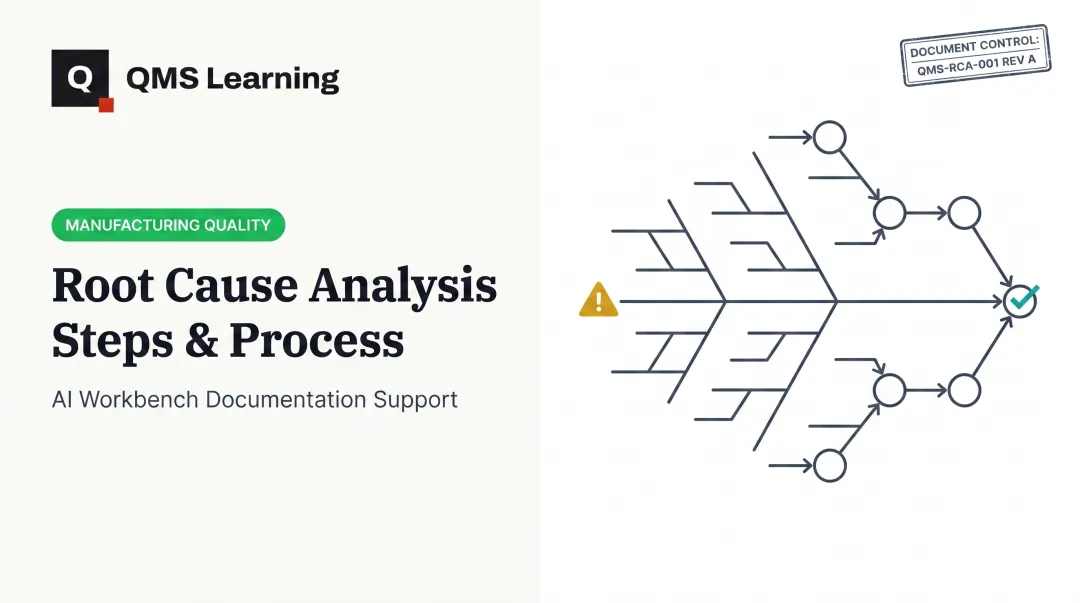
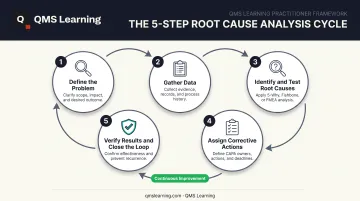
Every RCA method, whether 5 Whys, Fishbone, FMEA, or 8D, runs on the same five-step skeleton. Get these right and the method you pick matters less than you'd think.
- Define the problem precisely. "Parts are failing inspection" isn't a problem statement, it's a symptom. A version with a date, quantity, location, and measurable impact gives you a starting line; the vague version gives you nothing to investigate.
- Gather data while it's fresh. Combine quantitative sources (inspection logs, defect rates, timelines) with qualitative ones (operator interviews, shift-change notes). Memory fades and paper trails go cold fast, so collect within days, not weeks.
- Identify and test possible root causes. Apply your chosen method and push past the first plausible answer. "Operator error" is rarely the root cause; it's usually where the investigation stopped too early.
- Assign corrective actions with named owners and deadlines. Split containment (stop the immediate bleeding) from long-term prevention (fix the system). Actions without owners don't get done. Actions without dates don't get tracked.
- Verify results and close the loop. Schedule a follow-up review, confirm the fix worked against real data, and document the outcome. This is the step teams skip most, and the one auditors check first.
Two shortcuts cause more reopened findings than anything else:
- Stopping at the first symptom instead of the true root cause
- Skipping verification entirely
The FDA's 2024 MDSAP audit approach directs auditors to compare corrective action records against trend data. If the same or a related problem keeps surfacing, that's treated as a sign the original corrective action wasn't effective, per the FDA's MDSAP Audit Approach guidance.
Most reopened findings trace back to a missing verification step that let an ineffective fix slide through unnoticed.
Choosing the Right RCA Method for Your Template
There's no single "best" RCA template. The right structure depends on how complex the problem is, how much data you have, and whether it's safety- or compliance-critical enough to justify a heavier method.
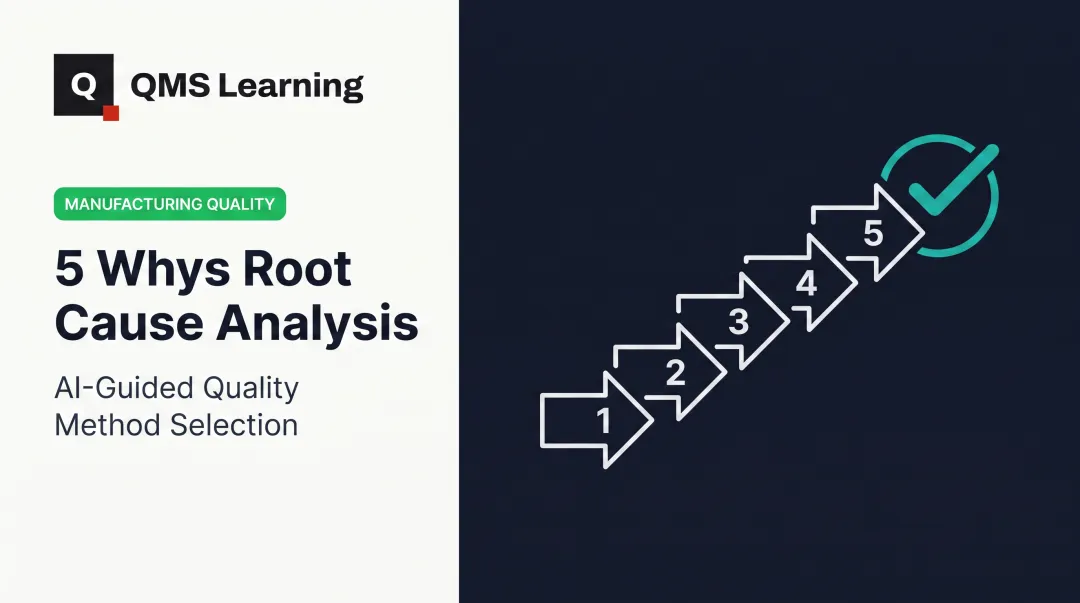
5 Whys
Best for simple, linear problems with a direct cause-and-effect chain. Ask "why" repeatedly, usually five times, until you hit a condition that, if fixed, stops the chain. Fast and easy to document. Weaker for problems with several causes contributing at once.
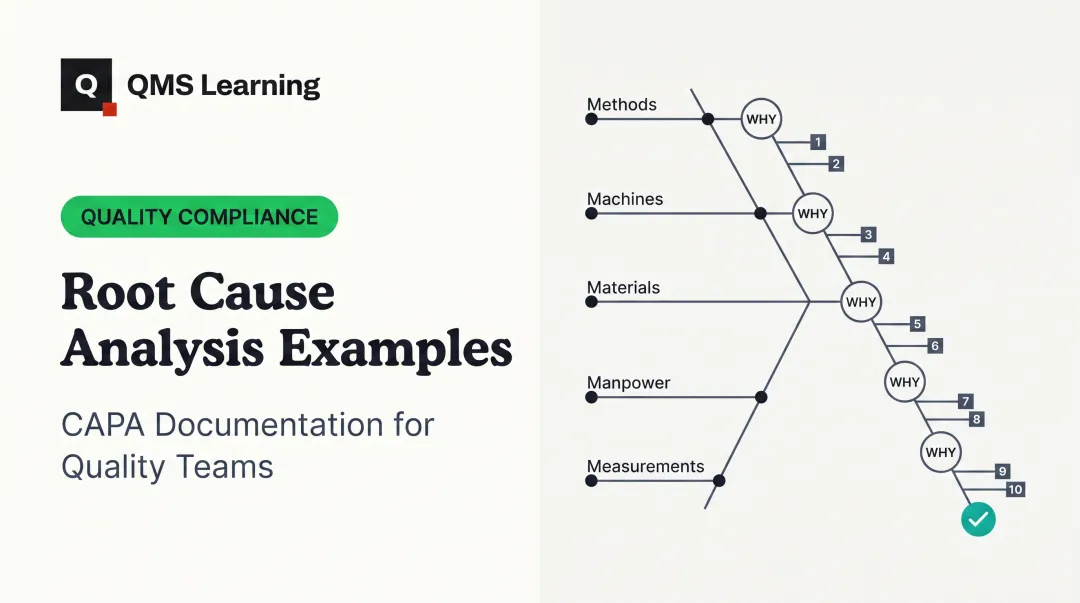
Fishbone (Ishikawa) Diagram
Best for multi-factor problems where causes could sit in several places at once. It sorts candidate causes into categories such as people, process, equipment, materials, environment, and management. It's a brainstorming tool, though; you still need data to confirm which branch actually caused the failure.
FMEA (Failure Mode and Effects Analysis)
Best for proactive risk prevention before a failure happens, especially on high-risk or regulated processes. Rather than investigating what already went wrong, FMEA scores potential failure modes by severity, frequency, and detectability. You fix the highest-risk ones first. It's the wrong tool for closing an existing nonconformance; save it for new processes or design changes.
8D, DMAIC, and CAPA Formats
Best for cross-functional problems or when a customer or registrar demands structured, auditable documentation. These formats layer containment, verified root cause, corrective action, and effectiveness checks into one traceable sequence, which is exactly why aerospace and medical device customers often require them by name.
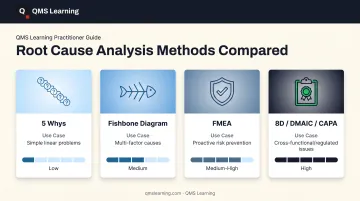
Picking the wrong method wastes time and produces a weaker record. It's also the exact freeze point junior engineers hit when a real finding lands on their desk: do I run a 5 Whys, or does this need FMEA?
QMS Learning's AI Workbench includes a Method Router built to remove that guesswork. It walks a team through 10 common compliance plays, including 5-Why, FMEA, CAPA, gap analysis, and root cause investigation. The Router reads the problem description in plain English, classifies it (isolated incident, systemic supplier issue, process gap, or design issue), and picks the matching method before generating the audit-ready artifact.
When the same defect shows up across three jobs from one supplier, for instance, the Router selects 5-Why plus Supplier CAPA and rules out FMEA. FMEA is built for new processes, not for closing an existing failure.
Frequently Asked Questions
What is the best template for root cause analysis?
The "best" template depends on problem complexity and documentation needs. Simple, linear issues suit a 5 Whys format, while regulated or complex issues need a structured CAPA or 8D-style template with evidence fields for data, root cause, and verification.
What are the steps in a root cause analysis?
The five core steps are: define the problem, collect data, identify the root cause, implement corrective action, and verify results. Skipping verification is the most common reason findings reopen at the next audit.
What's the difference between a root cause and a contributing factor?
A root cause is the fundamental condition that, if eliminated, prevents recurrence. A contributing factor raises the likelihood or severity of a failure without being the underlying cause. Corrective action targets the root cause first, but both should be documented.
How long should a root cause analysis take to complete?
Simple issues can take a few hours using 5 Whys. Complex or regulated investigations, especially ones needing supplier data or lab testing, can take days to weeks depending on how much evidence you need to gather.
Do I need special training to use a root cause analysis template?
Basic templates like 5 Whys require minimal training and most quality staff can apply them right away. Methods like FMEA or 8D benefit from formal instruction, since scoring risk or running cross-functional investigations takes more structured practice.
What must an RCA template include to hold up during an audit?
A specific, measurable problem statement, an evidence-backed root cause showing the reasoning trail, named corrective action owners with due dates, and a verification record. Auditors trace all four before accepting closure.