The confusion is understandable — both standards share management system language, both show up in audits, and both carry real consequences when misapplied. But treating them as interchangeable is one of the most reliable ways to accumulate findings. The standards serve fundamentally different purposes, assessed by different bodies, producing different outcomes.
This article breaks down what each standard actually requires, where they overlap, where they diverge, and how to determine which one — or both — your organization should be running.
Key Takeaways
- ISO 9001 governs organization-wide quality management; ISO 17025 certifies technical laboratory competence specifically
- ISO 17025 requires measurement traceability and documented uncertainty, neither of which ISO 9001 mandates
- Both standards share core management controls: document control, corrective action, internal audits, and management review
- ISO 17025's Option B allows labs to reference an existing ISO 9001 system, yet Clauses 4–7 technical requirements still apply in full
- Manufacturers with in-house labs often need both, not one or the other
What Is ISO 9001?
ISO 9001:2015 is the international standard for Quality Management Systems. Its purpose is straightforward: ensure that an organization can consistently provide products and services that meet customer and regulatory requirements, and demonstrate the ability to improve over time.
The standard applies to any organization in any industry — a machining shop, a software company, a government agency. That breadth is intentional.
Structure and Scope
ISO 9001:2015 uses the High-Level Structure (Annex SL), organized into seven clauses:
| Clause | Area |
|---|---|
| 4 | Context of the Organization |
| 5 | Leadership |
| 6 | Planning |
| 7 | Support |
| 8 | Operation |
| 9 | Performance Evaluation |
| 10 | Improvement |
This structure is deliberately broad. It defines a management framework, not technical requirements for any specific activity. A third-party certification body audits the organization's QMS processes and confirms they are well-managed and documented. Certification does not evaluate whether any specific output — a measurement or test result — is technically accurate.
What ISO 9001 Includes That ISO 17025 Does Not
ISO 9001 contains several management elements absent from ISO 17025:
- Clause 4.1 — Understanding organizational context and external/internal issues
- Clause 4.2 — Identifying interested parties and their requirements
- Clause 6.2 — Setting measurable quality objectives
- Clause 7.1.6 — Documenting and managing organizational knowledge
These clauses give ISO 9001 its strategic breadth — they address how an organization positions and governs itself, not just how it executes specific technical tasks.
Use Cases
ISO 9001 is the baseline requirement for general manufacturers (injection molding, machining, fabrication, assembly), aerospace supply chains, automotive suppliers, and commercial service organizations. Any company that needs to demonstrate consistent process quality to customers or procurement programs belongs here.
For quality managers, ISO 9001 provides the foundation to prevent nonconformities, drive CAPA, manage supplier quality, and build a repeatable, audit-ready system. No specialized laboratory competencies required.
What Is ISO 17025?
ISO/IEC 17025:2017 is the international standard for the competence, impartiality, and consistent operation of testing and calibration laboratories. Where ISO 9001 asks "are your processes well-managed?", ISO 17025 asks something more specific: "are your measurement results technically credible and internationally traceable?"
The standard applies to any organization performing laboratory activities, regardless of size.
Structure and Scope
ISO/IEC 17025:2017 is organized into five clause areas:
| Clause | Area |
|---|---|
| 4 | General Requirements (impartiality, confidentiality) |
| 5 | Structural Requirements |
| 6 | Resource Requirements (personnel, equipment, environment) |
| 7 | Process Requirements (method validation, measurement uncertainty, result reporting) |
| 8 | Management System Requirements |
Clauses 4–7 are where ISO 17025 diverges sharply from ISO 9001. These require demonstrated technical competence — not just documented processes.
What ISO 17025 Requires That ISO 9001 Does Not
- Clause 7.6 requires identifying and evaluating measurement uncertainty contributions for every calibration and testing result
- Clause 6.5 requires an unbroken calibration chain to an appropriate reference — NIST or an equivalent national standard
- Method validation and verification confirm that test methods actually produce reliable results before use
- Impartiality controls create formal obligations to prevent conflicts of interest from affecting results
- Accreditation — not certification — is granted by a national accreditation body assessing technical performance, not management system conformance
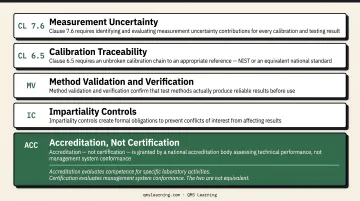
That last distinction matters. NIST draws a clear line between accreditation and certification: accreditation evaluates competence for specific laboratory activities; certification evaluates management system conformance. The two are not equivalent.
Use Cases
ISO 17025 applies to any lab whose results customers or regulators depend on as technically credible. That includes:
- Dedicated testing and calibration labs
- In-house labs within aerospace or manufacturing facilities
- Environmental testing labs
- Medical device testing and verification labs
Accreditation is frequently a contractual or regulatory requirement in these industries:
- Aerospace and defense supplier labs
- Government-contracted testing facilities
- FDA-regulated food testing labs (FDA LAAF program)
- DoD environmental laboratories (DoD ELAP program)
- Medical device testing and verification labs
ISO 17025 vs. ISO 9001: Key Differences and Similarities
Side-by-Side Comparison
| Dimension | ISO 9001:2015 | ISO/IEC 17025:2017 |
|---|---|---|
| Scope | Any organization, any industry | Testing and calibration laboratories only |
| Primary focus | Process quality, customer satisfaction | Technical competence, measurement accuracy |
| Audit outcome | Certification by certification body | Accreditation by accreditation body |
| Traceability | Required conditionally (Clause 7.1.5.2) | Mandatory; unbroken chain to national standard |
| Measurement uncertainty | Not required | Required and documented (Clause 7.6) |
| Quality objectives | Explicitly required (Clause 6.2) | Policies and objectives required (Clause 8.2.1), but less prescriptive |
| Organizational context | Explicit (Clauses 4.1, 4.2) | Not present |
| Organizational knowledge | Required (Clause 7.1.6) | Not specified |
Where They Overlap
Both standards require the same core management controls. ISO 17025 Clause 8 was deliberately structured to harmonize with ISO 9001's management system framework:
- Document control and control of records
- Actions to address risks and opportunities
- Corrective action processes
- Internal audits
- Management reviews
- Commitment to continual improvement
These shared elements are what make ISO 17025's Option B possible.
The Option A vs. Option B Trap
ISO 17025 Clause 8 gives laboratories two implementation paths:
- Option A — Implement Clauses 8.2–8.9 directly (document control, records, internal audit, management review, corrective action, etc.)
- Option B — Reference an existing ISO 9001 system, which "also fulfils at least the intent" of Clauses 8.2–8.9
Option B is where teams routinely generate audit findings. The clause language — "at least the intent" — signals partial equivalence, not complete equivalence.
More critically, Option B does not touch Clauses 4–7 at all. A lab can run the most mature ISO 9001 system in its industry and still have zero coverage of measurement uncertainty, method validation, or metrological traceability.
ISO 9001 certification does not produce ISO 17025 accreditation. Option B aligns management systems — it makes no claim of technical equivalence and covers none of the technical competence requirements in Clauses 4–7.
Which Standard Does Your Organization Need?
The decision is cleaner than it first appears.
Choose ISO 9001 if: Your organization manufactures products, delivers services, or operates any business process where consistent process quality and customer satisfaction are the primary goals. ISO 9001 is the applicable standard for the QMS itself.
Add ISO 17025 if: Your organization operates a testing or calibration laboratory whose results customers or regulators rely on as technically accurate and traceable. ISO 9001 alone will not satisfy that requirement — the technical competence elements in Clauses 4–7 have no equivalent in ISO 9001.
When You Need Both
A manufacturer with an in-house calibration lab or testing function is the most common "both" scenario. The QMS covering production, supplier management, and customer delivery runs under ISO 9001. The lab function that calibrates measurement equipment or produces test data runs under ISO 17025.
If you're operating both frameworks simultaneously, a few practical rules apply:
- Keep internal audits and management reviews separate for each standard — combined reviews routinely produce scope-coverage findings
- Document and record control procedures can be shared, since both standards require them and the controls are compatible
- Don't assume ISO 17025 is fully covered by your QMS documentation — the lab still needs to demonstrate Clauses 4–7 compliance through technical assessment, not just management documentation
Building Real Audit Capability for ISO 9001
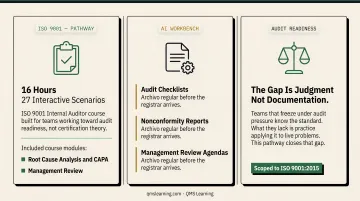
For quality teams running ISO 9001 programs who are working toward audit readiness, the gap that causes most problems isn't documentation — it's judgment. Teams that freeze under audit pressure typically know what the standard says. What they lack is practice applying it to live problems.
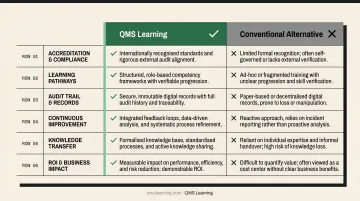
QMS Learning's General Manufacturing Quality pathway is built to close that gap. The pathway includes a 16-hour ISO 9001 Internal Auditor course with 27 interactive scenarios, plus Root Cause Analysis & CAPA and Management Review courses — all scoped to ISO 9001:2015. The AI Workbench generates audit checklists, nonconformity reports, and management review agendas, giving teams hands-on compliance practice before the registrar arrives.
Conclusion
ISO 9001 and ISO 17025 are not competitors — they govern different things. ISO 9001 addresses how an organization manages its processes and quality outcomes broadly. ISO 17025 addresses whether a laboratory's technical results are competent, traceable, and internationally credible. Which one you need comes down to what you produce and what your customers or regulators are actually auditing you against.
The organizations that navigate this correctly are the ones that identify which standard applies to which function, build genuine capability in each, and stop treating compliance as a documentation exercise. Teams that get this right don't just pass audits — they stop accumulating repeat findings. That holds whether you're running one standard, the other, or both in parallel.
Frequently Asked Questions
Do you need ISO 17025 if you have ISO 9001?
Yes, if your organization operates a testing or calibration lab whose results must be technically trusted and traceable. ISO 9001 certification does not cover measurement uncertainty, method validation, or metrological traceability — the core technical requirements ISO 17025 addresses. The two standards serve different purposes and neither substitutes for the other.
Can ISO 9001 replace ISO 17025?
No. ISO 9001 validates that management processes are well-documented and consistently applied, but it does not assess technical competence, measurement accuracy, or calibration traceability. ISO 17025 accreditation requires a technical assessment of the laboratory's specific activities — something no ISO 9001 certification body evaluates.
What are the 4 pillars of ISO 9001?
ISO formally identifies seven quality management principles, not four: customer focus, leadership, engagement of people, process approach, improvement, evidence-based decision making, and relationship management — listed without priority ranking. References to "four pillars" reflect informal conventions, not the standard itself.
What are the 5 requirements of ISO 17025?
ISO/IEC 17025:2017 is organized around five clause areas: general requirements (impartiality, confidentiality), structural requirements, resource requirements (personnel, equipment, environment), process requirements (method validation, measurement uncertainty, reporting), and management system requirements (Clause 8, Option A or B).
Is ISO 9001 changing in 2026?
As of July 2026, ISO lists Edition 6 of ISO 9001 at Stage 60.00 — "International Standard under publication" — with a publication date of September 2026. ISO 9001:2015 remains the current active standard until the new edition is officially released. Quality teams should monitor the ISO 9001 project page for final publication and transition timeline guidance.