Introduction
OHSAS 18001 and ISO 45001 are the two names EHS managers hear most often when someone brings up occupational health and safety certification. Only one of them is still valid. OHSAS 18001’s migration window closed in 2021, but legacy documentation still floats around as if nothing changed. Old audit files, training records, and supplier prequalification packets frequently still reference OHSAS 18001 as if it's current.
This article walks through what each standard actually required, how the transition unfolded, and what your organization needs to check if migration hasn't fully happened yet.
Key Takeaways
- OHSAS 18001 is fully withdrawn; ISO 45001 is the only certifiable OH&S standard today
- ISO 45001 uses Annex SL and shifts from hazard control to risk-and-opportunity management
- Leadership accountability is non-delegable, with stronger worker participation and new organization-context requirements
- OHSAS 18001-only certificates are no longer valid or accredited
ISO 45001 vs OHSAS 18001: Quick Comparison
| Dimension | OHSAS 18001 | ISO 45001 |
|---|---|---|
| Current validity | Replaced; no active migration route remains | The current international OH&S management standard |
| Structure | Four clauses, with requirements concentrated in Clause 4 | Ten clauses (Annex SL), requirements in Clauses 4-10 |
| Approach to risk | Focused on hazard identification and legal compliance | Adds risks and opportunities tied to organizational context |
| Leadership | Could delegate responsibility to a management representative | Top management holds non-delegable accountability |
| Worker/stakeholder scope | Included consultation, narrower internal focus | Strengthens worker participation; adds interested-party analysis |
OHSAS 18001 was never purely reactive. It already required hazard identification and preventive controls. ISO 45001 builds on that base by embedding risk more deeply in leadership, organizational context, and worker involvement.
What is OHSAS 18001?
OHSAS 18001 was developed through the OHSAS Project Group and published as a British Standard because no ISO equivalent existed for occupational health and safety at the time. Organizations needed a recognizable, externally auditable OH&S framework, and OHSAS 18001 filled that gap.
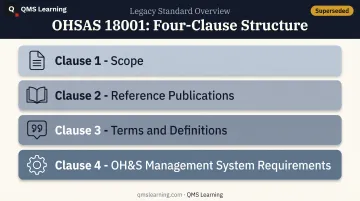
Its structure was simple, with four clauses:
- Clause 1: Scope
- Clause 2: Reference publications
- Clause 3: Terms and definitions
- Clause 4: OH&S management system requirements (where the substantive requirements sat)
The standard's core focus was controlling identified hazards and meeting minimum legal compliance obligations. It required risk assessment and preventive action, but the model centered on managing known risks rather than evaluating broader organizational context or emerging opportunities.
Current status: OHSAS 18001 has been superseded by ISO 45001. It now holds only historical or reference value, useful for teams researching legacy systems or documenting a transition timeline, but it cannot be cited to satisfy any current certification requirement.
What is ISO 45001?
ISO 45001 is the international standard for occupational health and safety management systems, published on March 12, 2018, according to ISO's own announcement. It gives EHS managers and plant leaders a structured way to prevent work-related injury, illness, and fatality while meeting global registrar expectations.
The standard requires organizations to:
- Identify hazards and assess OH&S risk systematically
- Evaluate risks and opportunities within organizational context
- Secure leadership commitment that cannot be delegated
- Build worker participation into every stage, not only after-the-fact consultation
Why It Matters Operationally
Fewer lost-time incidents, steadier insurance and workers' comp costs, and less downtime tend to follow from a well-run OH&S system. Results still vary by organization and should not be treated as guaranteed.
A peer-reviewed Korean analysis found certified workplaces improved leadership integration and worker participation, even though injury and fatality rates did not differ significantly from non-certified sites in that study. Implementation quality matters as much as certification itself.
Structural Advantage
ISO 45001 uses ISO's Annex SL high-level structure — ten clauses covering everything from Context of the Organization through Continual Improvement. That shared skeleton is what lets ISO 45001 slot into a combined management system alongside ISO 9001 and ISO 14001, instead of running as a standalone program.
Use Cases of ISO 45001
ISO 45001 shows up anywhere OH&S risk touches daily operations : plant-floor hazard assessments, supplier prequalification packets, and customer audit checklists all lean on it now.
Where it's applied most often:
- Manufacturing floors : hazard controls tied to machinery, materials handling, and confined spaces
- Construction sites : worker consultation processes and incident reporting workflows
- Aerospace and defense supply chains : OH&S evidence bundled into broader supplier audits
DNV notes the standard applies to organizations of any size and sector, not just heavy industry.
What results can look like:
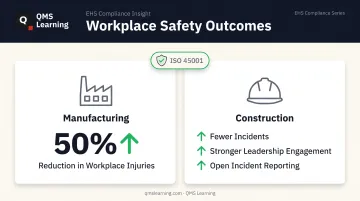
Manufacturing: ASSP reported an aluminum manufacturer implementing ISO 45001 achieved a 50% reduction in workplace injuries, largely through tighter controls on high-risk hazards. One company's result, not a universal benchmark, but it shows what disciplined implementation can produce.
Construction: Beard Construction moved from OHSAS 18001 to ISO 45001 and reported fewer incidents plus stronger leadership engagement and open reporting, per BSI's case study.
The pattern is not a guaranteed percentage. It is a consistent link between engaged leadership, real worker input, and fewer incidents.
Key Differences Between OHSAS 18001 and ISO 45001
Six changes separate the two standards in practice, not just on paper.
Reactive vs. proactive planning. OHSAS 18001 centered on controlling known hazards. ISO 45001 requires evaluating risks and opportunities before incidents occur, not just after a near-miss report.
Leadership accountability. Under OHSAS 18001, a management representative could carry much of the OH&S burden. ISO 45001 keeps that accountability with top management. It cannot be handed off.
Worker participation. ISO 45001 mandates broader involvement from non-managerial workers in hazard identification, incident investigation, and program evaluation, not just periodic consultation.
Context of the organization. New Clauses 4.1 and 4.2 require assessing internal and external issues alongside the needs of interested parties. OHSAS 18001 had no equivalent requirement.
Structural alignment. ISO 45001's Annex SL format mirrors ISO 9001 and ISO 14001. OHSAS 18001's standalone four-clause format didn't integrate as cleanly with other management systems.
Documentation language. "Documented information" replaces the rigid procedures-and-records terminology from OHSAS 18001, giving organizations more flexibility in how they demonstrate compliance, as long as the control requirements are still met.
None of these changes are cosmetic. Each one shows up as a specific line item during a registrar audit.
Which Standard Should Your Organization Follow Today?
There isn't really a choice to make here. ISO 45001 is the only certifiable path forward. The real question is how ready your organization is to meet its heightened requirements.
Practical Transition Steps
- Run a gap analysis against the 10-clause Annex SL structure, not just a line-by-line comparison to your old OHSAS 18001 documentation
- Secure leadership buy-in early, since accountability can't be delegated and top management must understand what they're signing off on
- Rebuild your risk register to cover opportunities alongside hazards, not hazards alone
- Revise worker consultation processes to include non-managerial staff in hazard ID, investigations, and reviews — not just annual surveys
The most common friction point organizations report isn't technical. It's insufficient leadership engagement early in the process, which cascades into documentation gaps discovered too late for a smooth audit.
This is where teams often stall without structured support. QMS Learning's Environmental & Safety Compliance pathway helps EHS managers and plant teams close these gaps in-house:
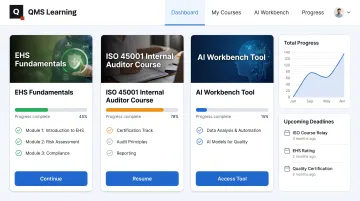
- EHS Fundamentals (12 modules, 50 lessons) covers ISO 45001, ISO 14001, and OSHA general industry requirements
- ISO 45001 Internal Auditor course on hazard ID, OH&S risk assessment, incident investigation, and management review opens pilot cohorts in Q3 2026
- AI Workbench trained on ISO 45001, OSHA 29 CFR 1910, and two decades of real audit findings generates facility-specific SOPs, gap analyses, and audit checklists
The payoff for full alignment is straightforward: fewer incidents, cleaner audit outcomes, and continued eligibility for supplier and customer prequalification lists that increasingly require current ISO 45001 status.
Frequently Asked Questions
What are the 7 elements of ISO 45001?
ISO 45001's Annex SL high-level structure covers seven core clause groups: context of the organization, leadership, planning, support, operation, performance evaluation, and improvement. These map to Clauses 4 through 10 of the standard.
What is the difference between ISO 9001, ISO 14001, and OHSAS 18001?
ISO 9001 covers quality management, ISO 14001 covers environmental management, and OHSAS 18001 covered occupational health and safety before ISO 45001 replaced it. ISO 9001, ISO 14001, and ISO 45001 now share the Annex SL high-level structure, which simplifies integrated audits.
Is OHSAS 18001 still valid?
No. OHSAS 18001 has been fully replaced, with the accredited-certification migration window closing on September 11, 2021, after a COVID-related extension. Organizations need ISO 45001 certification for a recognized, accredited OH&S system today.
When did ISO 45001 replace OHSAS 18001?
ISO 45001 was published on March 12, 2018, with an original three-year migration window. That deadline was extended six months due to COVID-19, closing the accredited migration path in September 2021.
Can I still reference OHSAS 18001 in current audits or supplier documentation?
You can reference it historically (for transition records or legacy knowledge transfer), but it cannot satisfy current certification or prequalification requirements. Registrars and most supplier programs require active ISO 45001 status.
What happens if my organization hasn't transitioned to ISO 45001?
Your organization currently lacks an accredited OH&S certification. That gap can affect supplier qualification, insurance terms, and audit standing until migration to ISO 45001 is complete.