Introduction
ISO 13485 is the global quality management standard for medical device manufacturers. For many US shops, certification cost is now a real budget problem—not a nice-to-have.
Why? The FDA's Quality Management System Regulation (QMSR) aligns 21 CFR Part 820 with ISO 13485:2016, effective February 2, 2026. Manufacturers who never needed the standard before are scrambling to fund it.
That spend swings hard by scope and size. A small startup might land near $15,000, while a multi-site manufacturer with design controls in scope can clear $100,000.
This article breaks down real pricing tiers, what pushes costs up or down, and how to build a budget that holds through certification.
Key Takeaways
- Small companies typically spend $15,000-$40,000; mid-size firms $30,000-$75,000; large or multi-site organizations $100,000 or more
- Certification body audit fees make up only 15-30% of total cost: consulting, implementation, and training absorb the rest
- Device risk class, design control scope, and existing QMS maturity drive your budget more than headcount alone
- Plan for recurring costs: surveillance audits and recertification typically add 15-25% of your initial spend every year
How Much Does ISO 13485 Certification Cost? (Pricing Overview)
There's no fixed price tag for ISO 13485. Certification bodies like TÜV SÜD and SGS price projects individually based on company size, device complexity, number of sites, and whether design controls fall inside the audit scope.
Three budgeting mistakes trip up first-timers:
- Fixating on the audit fee while ignoring consulting and internal labor costs
- Underestimating staff time pulled away from daily operations for documentation and internal audits
- Ignoring recurring costs — surveillance audits happen every year, not once
Typical Cost Range
Industry-reported project scopes usually fall in these ranges:
| Company Size | Estimated Total Cost | Employee Count |
|---|---|---|
| Small/Startup | $15,000 - $40,000 | Under 30 |
| Mid-Size | $30,000 - $75,000 | 30-100 |
| Large/Multi-Site | $100,000 - $420,000+ | 100+ |
These figures typically include Stage 1/Stage 2 audit fees, consulting, documentation development, and initial training. They generally exclude ongoing maintenance, eQMS software subscriptions, and any re-audit fees if you fail on the first attempt.
Small/Startup Companies
Typical single-site scope covers:
- Stage 1 and Stage 2 audit fees
- Basic QMS documentation support
- Limited internal auditor training
Best for: Startups and Class I–II device makers that don't yet have design controls in scope.
Mid-Size Companies
Growing manufacturers usually need:
- Full QMS implementation
- Design control documentation and ISO 14971 risk files
- Broader audit scope across more processes
Best for: Manufacturers adding design and development or aligning with the FDA QMSR for the first time.
Large/Multi-Site Organizations
Larger programs typically include:
- Multi-site audits
- SaMD/IEC 62304 integration where software is involved
- MDSAP-ready QMS builds and post-market surveillance systems
Best for: Established manufacturers with higher-risk devices and global distribution across multiple jurisdictions.
Key Factors That Affect ISO 13485 Certification Cost
Pricing depends on regulatory, operational, and organizational variables, not just employee count.
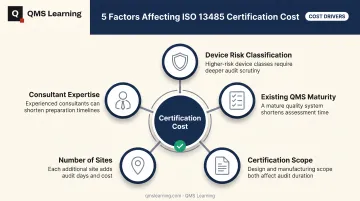
Device Risk Classification and Complexity
Class III and implantable devices demand far more documentation and risk analysis than Class I products. Software as a Medical Device (SaMD) adds another layer, since it requires IEC 62304 integration alongside ISO 13485. More technical areas and higher device complexity both extend audit time and, in turn, your certification body's fees.
Existing QMS Maturity
Starting from zero costs more than adapting an existing system. Companies with an established ISO 9001 QMS have a head start, since much of the document control, management review, and internal audit structure already exists.
SGS reports that firms building from scratch, especially teams under 50 employees, often need 3–6 months. Larger or more intricate operations can take up to a year.
Certification Scope (Manufacturing vs. Design + Manufacturing)
Adding design controls under Clause 7.3, plus a Design History File, costs more than manufacturing-only certification:
- Design control work can represent 20-35% of total implementation effort
- Combined design-and-manufacturing scope commonly runs 30-40% higher than manufacturing alone
- Design and development sites cannot be "sampled" during multi-site audits — every one gets audited
Number of Sites and Geographic Spread
Each additional facility adds audit time and cost. Under IAF audit-time rules, initial audit duration scales with personnel count — from 3 minimum days for very small teams up to 25+ days for organizations above 8,500 employees. Multi-site organizations should expect roughly $15,000-$40,000 in added cost per site, depending on complexity.
Consultant Expertise and Training Requirements
Medical device-experienced consultants cost more per hour than generalists, but they understand design controls and risk files well enough to avoid the rework that generalist consultants tend to cause.
Training is not a one-time expense either. Awareness training, internal auditor certification, and ISO 14971 risk management education all need periodic refreshers.
Role-specific online pathways reduce that recurring classroom spend. QMS Learning’s Medical Device & Life Sciences pathway covers ISO 13485, FDA 21 CFR Part 820, and ISO 14971, and is built to lower repeat training cost versus seated courses (pilot Q3 2026).
Cost Breakdown of ISO 13485 Certification
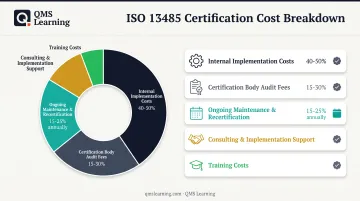
The certification body's invoice is one line item among several. Total investment spans five categories: audits, consulting, internal implementation, training, and ongoing maintenance.
Certification Body Audit Fees
One-time initially, recurring for surveillance and recertification.
Audit fees follow a fixed cadence:
- Stage 1: Document review confirming your QMS is ready for an on-site assessment
- Stage 2: On-site audit testing your system against ISO 13485 and applicable regulations
- After certification: Annual surveillance audits, plus a fuller recertification audit every three years
Consulting and Implementation Support
Mostly one-time, recurring if you keep a retainer.
This typically covers a gap analysis, QMS documentation build-out, design control setup, and mock audit preparation. Costs scale with company size and how far your current documentation is from audit-ready.
Internal Implementation Costs
Mostly one-time, with recurring refreshers.
This is the most underestimated line item: often 40-50% of total investment. It covers:
- Staff hours redirected from daily work to QMS documentation and process mapping
- Internal auditor training for your quality team
- eQMS software subscriptions for document control and CAPA tracking
Training Costs
Recurring.
Awareness training, internal or lead auditor courses, and design/risk management training all carry a per-employee cost.
Traditional classroom training generally runs $1,200–$1,500 per seat plus travel, and annual retraining repeats much of that spend.
Self-paced, role-specific platforms cut this ongoing cost sharply. Teams train around real jobs instead of multi-day classroom blocks, and providers such as QMS Learning report 70–90% lower cost versus classroom alternatives.
Ongoing Maintenance & Recertification
Recurring, on annual and three-year cycles.
Surveillance audits happen annually. QMS updates happen continuously as your product line or regulatory targets shift. Recertification, every three years, is more extensive than a routine surveillance visit. Budget roughly 15-25% of your initial certification cost annually to cover these.
Low-Cost vs High-Cost ISO 13485 Certification — What's the Real Difference?
The price gap between a bargain certification project and a well-funded one reflects real differences in audit readiness and long-term sustainability, not spend for its own sake.
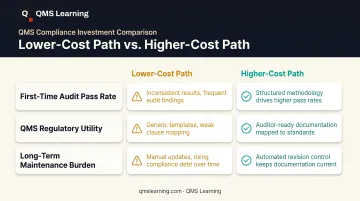
First-Time Audit Pass Rate
How you prepare often decides whether you pass on the first try:
- Lower-cost path: Limited gap analysis raises the risk of findings. A major nonconformity defers certification until you implement and verify corrective action, adding delay and unbudgeted re-audit fees.
- Higher-cost path: Thorough gap analysis and specialist support surface readiness issues before the official audit, not during it.
QMS Regulatory Utility
Passing the audit is not the finish line for device makers who sell in more than one market:
- Bare-minimum QMS: May clear certification but fall short when you need to support an FDA submission or EU MDR technical file.
- Multi-jurisdiction QMS: Built for broader use, it can serve as a regulatory asset across FDA, EU MDR, and MDSAP-participating markets at once.
Long-Term Maintenance Burden
What you build into the QMS now shapes what you pay after the certificate is on the wall:
- Thin documentation: Hard to update and defend in post-market reviews, so costs climb every time a process, product, or regulation changes.
- Structured, audit-ready documentation: Cuts how often you need outside help when something shifts downstream.
How to Estimate the Right Budget for ISO 13485 Certification
The right budget is calibrated to your device risk class, target markets, and organizational complexity, not just the lowest quote you receive.
Before setting a number, work through these factors:
- Target markets — EU MDR, FDA QMSR, Health Canada, and TGA differ, but one solid QMS can often cover several jurisdictions
- Current QMS maturity — run a standalone gap analysis before committing to a full project, so you avoid scope creep mid-audit
- Device risk classification — confirm whether design controls are in scope before pricing anything
- Consultant specialization — choose consultants with actual medical device experience over generalists
- Recurring costs — budget 15–25% of initial certification cost each year; this is not a one-time expense
Building internal competence early matters just as much as the initial audit. Role-specific, self-paced training helps teams sustain compliance after certification instead of calling consultants for every audit cycle.
That is the approach behind QMS Learning’s Medical Device & Life Sciences pathway (pilot Q3 2026): build design-control and CAPA competence in-house and keep training records export-ready for audits.
Frequently Asked Questions
How much does ISO 13485 certification cost?
Small companies typically spend $15,000-$40,000, mid-size firms $30,000-$75,000, and large or multi-site organizations $100,000 or more. Company size and device complexity are the biggest drivers.
How long does ISO 13485 certification take?
Most companies starting from scratch need 3-6 months for smaller teams, with larger or more intricate operations taking up to a year. Firms transitioning from an existing ISO 9001 system generally move faster since much of the documentation structure already exists.
How do I get ISO 13485 certified?
Build a compliant QMS covering all applicable clauses, run internal audits and corrective actions to confirm it works, then undergo a Stage 1 document review and Stage 2 on-site audit from an accredited certification body.
Who needs ISO 13485 certification?
Medical device manufacturers, their suppliers, and life sciences companies targeting the EU, Canadian, or Australian markets need it. US companies increasingly pursue it too, as the FDA QMSR aligns domestic requirements with the standard.
Is ISO 13485 certification mandatory?
It's not legally mandatory everywhere, but it's a practical necessity for CE marking under EU MDR, Health Canada's MDSAP program, and increasingly for FDA QMSR alignment in the US market.
Do I need a consultant to get ISO 13485 certified?
It depends on your team's prior QMS implementation experience. Teams without that background typically benefit from at least a gap analysis and specialized consulting support to avoid costly audit findings.