Introduction
A billing vendor working for a regional clinic network loses an unencrypted laptop containing 3,000 patient records. A patient files a complaint. Within weeks, that vendor faces a federal investigation into the breach.
This is where the HIPAA Enforcement Rule comes in. Codified at 45 CFR Part 160, Subparts C, D, and E, it gives HHS's Office for Civil Rights (OCR) legal authority to investigate complaints and run compliance reviews.
OCR can also impose civil money penalties on covered entities and business associates that violate the Privacy, Security, or Breach Notification Rules.
This guide breaks down how OCR enforcement actually works: the penalty tiers, who's on the hook, the violations that draw the most scrutiny, and the practical steps that keep your organization off OCR's radar.
Key Takeaways
- The Enforcement Rule (45 CFR Part 160, Subparts C-E) lets OCR investigate complaints and fine HIPAA violations
- Current penalties reach $2,190,294 per violation category under the four-tier culpability structure
- Business associates now carry direct liability, not just contractual exposure through their BAAs
- Most complaints close through technical assistance or voluntary correction — formal penalties are the exception
- Documented risk analyses and role-specific training remain OCR's most consistent recommendation for avoiding enforcement
What Is the HIPAA Enforcement Rule?
The Enforcement Rule doesn't create new privacy or security standards. It governs what happens when someone breaks the standards already on the books — the investigation process, civil penalty procedures, and administrative hearings tied to HIPAA's Administrative Simplification provisions.
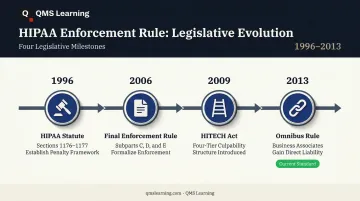
Its authority traces back to Sections 1176 and 1177 of the original 1996 HIPAA statute, which established civil and criminal penalty structures. That framework stayed mostly theoretical until the 2006 Final Enforcement Rule built out the actual procedural mechanics: Subparts C (investigations), D (civil money penalties), and E (hearings).
Two later laws reshaped it substantially. The 2009 HITECH Act introduced the four-tier culpability structure still in use today and raised penalty ceilings, while the 2013 Omnibus Rule made business associates directly liable for specific HIPAA obligations rather than liable only through contract terms.
With that framework in place, enforcement responsibility splits along two tracks. OCR runs the civil side of enforcement, and when facts suggest criminal intent, it refers the matter to the Department of Justice, which handles prosecution under separate statutory authority.
Privacy Rule, Security Rule, and Breach Notification Rule
The three substantive rules each protect something different:
- Privacy Rule: governs how PHI can be used and disclosed
- Security Rule: requires administrative, physical, and technical safeguards for electronic PHI
- Breach Notification Rule: sets obligations for notifying individuals, HHS, and sometimes media after a breach
The Enforcement Rule is the accountability layer sitting on top of all three. Without it, none of these rules would carry real consequences.
HITECH's extension of direct liability to business associates matters here. Billing companies, cloud hosting vendors, consultants, and law firms handling PHI on behalf of a covered entity are no longer shielded by "we just followed our contract." OCR can investigate and penalize them directly.
How the OCR Enforcement Process Works
OCR enforces HIPAA through four channels: investigating complaints, conducting compliance reviews on its own initiative, running education and outreach programs, and referring possible criminal violations to the DOJ.
Complaint Intake and Investigation Criteria
Before OCR accepts a complaint, it checks several conditions:
- Timing: the alleged conduct occurred within the past six years
- Jurisdiction: the complaint names a covered entity or business associate
- Substance: the allegation, if true, would violate HIPAA
- Filing window: the complaint is submitted within 180 days of discovery, though OCR can waive this for good cause
Once a complaint clears intake, OCR notifies both the complainant and the named entity. Both sides are legally required to cooperate with evidence requests. Stonewalling an investigation creates a separate compliance problem.
Resolution Paths and Civil Money Penalties
Most cases don't end in a fine. OCR generally closes complaints one of five ways:
- No investigation needed (outside jurisdiction or untimely)
- Technical assistance provided informally
- Investigation conducted, no violation found
- Corrective action required, no penalty assessed
- Formal resolution agreement or civil money penalty proceeding
If an entity won't resolve noncompliance voluntarily, OCR can pursue a civil money penalty, though the entity retains the right to request a hearing before an HHS administrative law judge before any penalty is finalized.
A common misconception: that penalty money simply disappears into the U.S. Treasury with nothing for affected patients. Under 42 U.S.C. § 1320d-5(c), collections go to OCR for enforcement activity, and the statute requires a methodology for distributing a share to harmed individuals (a mechanism HHS is still developing).
These numbers show the scale of OCR's enforcement work. Through October 31, 2024, OCR reported 374,321 complaints received, 1,193 compliance reviews, and 370,578 resolutions, a 99% resolution rate, with settlements or CMPs in 152 cases totaling $144,878,972.
HIPAA Enforcement Rule Penalty Tiers
Civil penalties fall into four culpability tiers. The 2026 inflation-adjusted table from the Federal Register sets these figures, effective January 28, 2026:
| Culpability Level | Min. per violation | Max. per violation | Annual cap (identical violations) |
|---|---|---|---|
| Did not know, couldn't have known | $145 | $73,011 | $2,190,294 |
| Reasonable cause, not willful neglect | $1,461 | $73,011 | $2,190,294 |
| Willful neglect, corrected | $14,602 | $73,011 | $2,190,294 |
| Willful neglect, not corrected | $73,011 | $2,190,294 | $2,190,294 |
Which tier applies depends on several factors:
- Culpability level demonstrated by the covered entity
- Number of records affected by the violation
- Duration the violation persisted before correction
- Level of cooperation shown during the OCR investigation
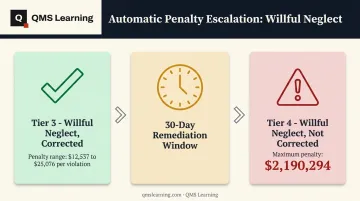
One detail catches organizations off guard: a Tier 3 violation (willful neglect, corrected) automatically escalates to Tier 4 if it isn't remediated within 30 days. There's no grace period beyond that window.
Criminal penalties, handled entirely by DOJ under 42 U.S.C. § 1320d-6, scale with intent:
| Intent | Max. Fine | Max. Imprisonment |
|---|---|---|
| Knowing violation | $50,000 | 1 year |
| False pretenses | $100,000 | 5 years |
| Intent to sell, transfer, or profit | $250,000 | 10 years |
Your compliance history also shapes enforcement outcomes, separate from the criminal penalties above. A clean record works in your favor.
Organizations that document at least 12 months of adherence to a recognized security framework, such as the NIST Cybersecurity Framework, before an incident occurs benefit here. Regulators can treat that history as a mitigating factor in audits, remedies, and penalty determinations.
A poor track record has the opposite effect.
Who Must Comply: Covered Entities & Business Associates
HIPAA regulates three classes of covered entities, plus business associates:
| Regulated Class | Examples |
|---|---|
| Health plans | Insurers, HMOs, employer-sponsored plans, Medicare/Medicaid |
| Healthcare clearinghouses | Entities converting nonstandard health data into standard transactions |
| Covered healthcare providers | Physicians, clinics, dentists, pharmacies, nursing homes conducting electronic transactions |
| Business associates | Billing companies, cloud vendors, consultants, law firms handling PHI on a covered entity's behalf |
HITECH's direct liability extension holds business associates accountable to OCR just like covered entities, covering:
- Security Rule safeguards for protecting electronic PHI
- Breach notification obligations to the covered entity
- Permitted-use limits on how PHI can be accessed or shared
- Subcontractor safeguards extending liability down the vendor chain
Not every organization handling health data falls under HIPAA's umbrella, though. Generally exempt from these rules:
- Life insurers and workers' compensation carriers
- Most employers acting purely in their employer capacity
- Schools and school districts, governed instead by FERPA
- State child protective services agencies
- Most municipal offices
Qualification still matters: an organization can have a covered component tucked inside an otherwise exempt structure, so "we're a school" isn't automatically a get-out-of-jail card.
Top HIPAA Violations That Trigger Enforcement
OCR's own published data points to a consistent set of recurring problems:
- Impermissible uses or disclosures of PHI
- Insufficient safeguards protecting PHI
- Failure to honor patient access requests
- Weak administrative safeguards around ePHI
- Disclosures exceeding the minimum necessary standard
A few recent enforcement actions illustrate what this looks like in practice:
- Solara Medical Supplies paid $3 million after breaches affecting 114,007 and 1,531 individuals, linked to missing risk analyses and delayed notifications. The corrective action plan runs two years.
- BST & Co. became OCR's 15th ransomware-related settlement and 10th action under its Risk Analysis Initiative, with a corrective action plan requiring an enterprise-wide risk analysis and annual workforce training.
- Concentra's December 2025 settlement marked OCR's 54th action under its Right of Access Initiative, confirming that delayed or denied records access remains a top enforcement priority.
The pattern across these cases rarely involves a single catastrophic failure. Instead, it's a missing or stale risk analysis, a training program that existed on paper but not in practice, or a records request that sat too long without a response.
How to Stay Compliant and Avoid Enforcement Action
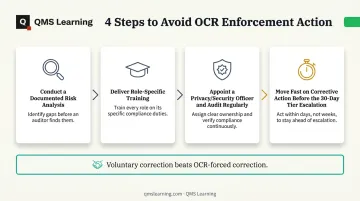
Start with a real risk analysis. HHS guidance outlines the core activities:
- Define your ePHI scope and inventory where it's created and stored
- Identify threats and vulnerabilities to that data
- Assess current safeguards, then estimate likelihood and impact
- Calculate risk levels and document the results
Update this analysis whenever your environment changes; it isn't a one-and-done exercise.
Fix your training model. Generic, one-time training sessions are a recurring theme in OCR corrective action plans. Teams complete a course, then can't demonstrate the judgment to apply it when a real incident hits.
This capability gap isn't unique to healthcare. QMS Learning built its practitioner-based training model to close this exact gap in other regulated industries, pairing role-specific onboarding with an AI Workbench that routes teams to the correct compliance method (5-Why, CAPA, gap analysis) and a Manager Dashboard that tracks who's actually fluent in a given standard. Its Medical Device & Life Sciences pathway, piloting in Q3 2026, will extend that same framework, built around AS9100D and ISO 13485, to HIPAA-adjacent training.
Appoint a dedicated privacy or security officer and run internal audits on a regular cadence. Catching a gap in an internal review beats catching it in an OCR investigation every time.
Move fast on corrective action. Voluntary correction, done early, almost always beats waiting for OCR to force the issue — remember, an uncorrected Tier 3 violation becomes a Tier 4 violation after 30 days.
Frequently Asked Questions
What is the purpose of the HIPAA Enforcement Rule?
It gives HHS/OCR a legal and procedural framework for investigating HIPAA complaints, resolving noncompliance, and imposing penalties when covered entities or business associates fail to protect PHI.
What are the top 5 HIPAA violations?
Impermissible use or disclosure of PHI, inadequate safeguards, failure to honor patient access requests, weak administrative controls over ePHI, and disclosures exceeding the minimum necessary standard.
Who enforces the HIPAA Enforcement Rule?
OCR handles civil enforcement and works with the DOJ when facts suggest criminal conduct, such as knowing violations or PHI theft for personal gain.
What is the largest HIPAA penalty ever imposed?
HHS's $16 million settlement with Anthem in October 2018 was a record at the time, tied to a breach affecting nearly 79 million people. Penalty amounts change as new settlements occur, so this figure may no longer hold the top spot.
Can a HIPAA violation result in criminal charges?
Yes. DOJ handles criminal violations, with penalties scaling by intent — knowing violations, false pretenses, or intent to sell or profit from PHI. Individuals, not just organizations, can be personally prosecuted.
How long does OCR have to investigate a HIPAA complaint?
Complaints must be filed within 180 days of discovery, though OCR can waive that for good cause. OCR also only reviews conduct that occurred within the past six years.