Introduction
Every operational decision in a regulated business rests on a document. A procedure, a drawing, a work instruction, a spec sheet. If that document can't be trusted, the decision built on it is at risk.
Many teams confuse "having documents" with "controlling documents." The gap between the two shows up during audits, in the form of rework, safety incidents, and failed inspections. In fact, a 2025 editorial review by Exemplar Global's The Auditor ranked poor document control as the top common finding across ISO audits, ahead of nine other categories.
This article defines document control, walks through its full lifecycle, clarifies who should own it, and explains why standards like ISO 9001 treat it as a formal, auditable requirement rather than a nice-to-have.
Key Takeaways
- Document control covers the full lifecycle—from creation to obsolescence—so only current, approved versions stay in use
- It's a stricter subset of document management, distinct from records management
- ISO 9001, AS9100D, and ISO 13485 all make it a mandatory, auditable requirement
- Ownership must be clearly assigned—whether to a document controller, quality manager, or trained staff
What Is Document Control?
Document control is the process by which documents are created, reviewed, approved, distributed, accessed, revised, and eventually withdrawn throughout their working life. That process is a chain of custody running from the moment a document is drafted to the moment it's retired.
The purpose is straightforward but hard to execute: make sure the right people can rely on the right, current, approved version of a document at the right time. A technician on the shop floor shouldn't be working from a revision that engineering replaced six months ago. An auditor shouldn't find two versions of the same procedure circulating with conflicting instructions.
Document control rests on trust and traceability. A controlled document carries a demonstrable history: who wrote it, who reviewed it, who approved it, and when it changed. An uncontrolled document has none of that. It might be accurate today and wrong tomorrow, with no way to prove either.
Document control is not:
- A filing system or shared folder structure
- A piece of software you install and forget
- Simply "having" procedures somewhere accessible
It's a governed discipline with defined roles, defined steps, and enforced accountability.
Document Control vs. Document Management vs. Records Management
These three terms get used interchangeably, but they mean different things.
Document management is the broader activity: storing, organizing, and sharing documents so people can find them. Document control is a more rigorous subset focused specifically on approvals, versioning, and regulatory compliance. Every controlled document is managed, but not every managed document is controlled.
Records management covers a different point in the lifecycle. Once a document has served its purpose and generated evidence that a process happened, that evidence becomes a record. Records management governs how that evidence is retained, protected, and eventually disposed of. Document control governs documents still in active use.
Software platforms (DMS or eQMS tools) support all three, but they don't replace them. A system can enforce version numbering. It can't decide who has authority to approve a procedure change, or whether your review workflow actually reflects how your organization operates. Those decisions are people-and-process problems that software alone cannot solve.
The Document Control Lifecycle: What It Covers
A document moves through five distinct stages. Skipping structure at any single stage breaks the chain of trust for the whole document.
- Creation and identification: Documents are drafted using standard templates and assigned unique identifiers, so a specific procedure or drawing can be traced to a specific number, title, and date.
- Review and approval: Before release, the document passes through defined stakeholders whose sign-off is formally recorded. This is where suitability and adequacy get checked, not assumed.
- Version and revision control: Changes are tracked, the current revision status is clearly marked, and superseded copies are prevented from circulating as if they were live.
- Distribution and access management: The correct audiences get the correct, current version, with access scoped appropriately to role and document sensitivity.
- Withdrawal, supersession, and archiving: Obsolete documents are pulled from active use, or clearly labeled if retained for historical reference only.
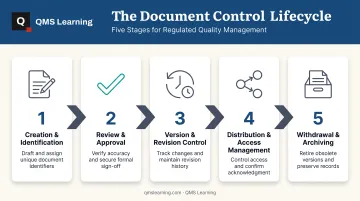
Each stage needs a defined answer to who does what, when, and under what conditions. Informal practice at any one stage undermines everything downstream: an emailed PDF instead of a controlled release, or a verbal "use this version instead."
Those failure modes are exactly what a controlled system is built to block. QMS Learning's Document Management System logs read-and-understand acknowledgments per person and per specific revision, not just per document title. When a document changes, the system flags linked records and training that may need updating, so a revision doesn't leave gaps in who was actually informed.
Who Is Responsible for Document Control?
Responsibility varies by organization size and industry. In smaller operations, a quality manager often absorbs the role alongside other duties. In larger or more heavily regulated environments, a dedicated document controller owns it full-time. Some companies distribute it across trained project or operations staff, with a quality function providing oversight.
There's no single mandated title. What matters is that the responsibility is clearly assigned, not left to whoever happens to notice a document is outdated.
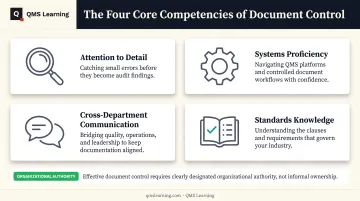
What skills does a document controller need?
- Attention to detail — catching an unapproved change or missing revision date before it becomes a nonconformity
- Systems proficiency — working comfortably in document workflow, database, and office tools
- Cross-department communication — chasing approvals from engineering, quality, and operations without becoming a bottleneck
- Working knowledge of applicable standards — knowing what a clause requires, not just following a checklist
Regardless of title, effective document control needs three things working together: clearly defined responsibilities, consistent application of the procedure, and organizational authority to enforce it.
A document controller with no authority to reject an unapproved revision isn't controlling anything. That setup is an informal side task with a job title—and it is exactly what produces audit findings.
Why Document Control Matters: ISO 9001 and Regulated Industries
ISO 9001:2015 doesn't leave document control to interpretation.
Clause 7.5.2 requires documents to:
- Carry identification (title, date, author, reference number)
- Be reviewed and approved for suitability before release
Clause 7.5.3 governs what happens after release:
- Availability where and when needed
- Protection against loss or misuse
- Control of distribution, access, and changes (version control is the explicit example)
- Retention and disposition of obsolete documents
Other frameworks build on this baseline, and the stakes climb with the sector:
| Framework | What it adds |
|---|---|
| AS9100D (aerospace) | Full ISO 9001 document requirements, plus configuration management under clause 8.1.2 to protect product-configuration accuracy |
| ITAR (22 CFR 122.5) | Mandates records be retained for five years and available for inspection, a recordkeeping rule layered on top of active document control |
| ISO 13485 (medical devices) | Splits document control (4.2.4) and records control (4.2.5) into distinct, separately audited requirements |
Poor document control has real regulatory consequences. In a 2017 FDA Warning Letter, the agency cited TELEMED for noncompliance with 21 CFR 820.40(a) after an obsolete Product Verification document was found on the production floor while a newer revision was supposed to be current.
The company also hadn't followed its own document-change-request procedure. No dramatic recall was needed to trigger federal action. An outdated document on a workbench was enough.
This is exactly the gap a training certificate alone can't close. QMS Learning pairs its AI Workbench, which diagnoses whether a gap is a process issue, a supplier change, or a change-control risk, with a Document Management System that records who reviewed a revision, who acknowledged it, and when.
That combination builds the capability to maintain and prove document control under real audit conditions—not just pass a module and hope the paperwork holds up. Reliable documentation also reduces operational risk, supports traceability, and keeps decisions auditable from the shop floor to the boardroom.
Best Practices for Implementing Document Control
Before evaluating any software, get the fundamentals in place:
- Standardized templates for every document type, so format and required fields don't vary by author
- A clear identification and naming system, so every document has a unique, traceable reference number
- A defined review-approval workflow, specifying exactly who signs off before release
Once those are set, look for a system with genuine version control and a full audit trail. A shared drive with files named "final_v2_ACTUAL_final" isn't document control. It's a liability with a folder icon.
QMS Learning's Document Management System supports this with:
- One clearly identified live revision, with superseded versions preserved but never mistaken for current
- An append-only audit trail covering drafting, review, and release
- Per-person, per-revision acknowledgment logging with timestamps
- One-click Audit-Evidence Package exports for registrar review
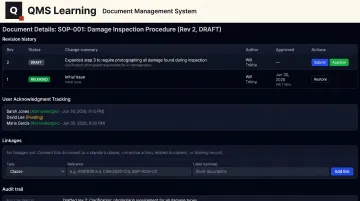
That structure keeps institutional knowledge in-house. When a consultant leaves or an employee moves on, the revision history, approval records, and acknowledgments stay with the organization, not with the person who happened to manage them.
Frequently Asked Questions
What does document control mean?
Document control is the governed process that ensures documents are approved, current, and traceable throughout their lifecycle. It covers creation, review, distribution, revision, and withdrawal, with each step formally recorded.
Who is responsible for document control?
Responsibility varies by organization: a dedicated document controller, a quality manager, or trained operations staff. The role must be clearly assigned and supported by leadership.
What skills do you need to be a document controller?
Attention to detail, familiarity with document management systems, and working knowledge of applicable standards. Strong cross-department communication matters too—approvals often span multiple functions.
Is document control the same as document management?
No. Document management is the broader activity of storing, organizing, and sharing files. Document control is the stricter subset focused on approvals, versioning, and regulatory compliance.
What documents need to be controlled?
Any document affecting product quality, safety, or compliance typically requires control. This includes policies, procedures, work instructions, and specifications used in active operations.
How does document control support ISO 9001 compliance?
ISO 9001 clauses 7.5.2 and 7.5.3 mandate specific practices: approval before issue, clear revision identification, availability at points of use, and preventing accidental use of obsolete documents.