Introduction
Every flight control system, missile guidance computer, and hospital ventilator depends on electronic components doing exactly what their datasheet promises.
When one of those parts is counterfeit, relabeled, blacktopped, or salvaged from scrapped boards, that promise fails, often long after the part has already shipped.
ERAI logged 748 suspect-counterfeit and nonconforming part reports in 2025, and roughly 24% of the suspect-counterfeit parts reported that year passed electrical testing before other evidence flagged them. Electrical testing alone missed one in four.
For aerospace, defense, and medical device programs, the stakes climb fast. A single undetected counterfeit part can trigger an AS9100D nonconformity, complicate a DFARS-regulated contract, or cause a field failure with real safety consequences.
This guide covers the tools you need, four core detection methods, how to interpret ambiguous results, and the safety practices that separate a defensible inspection program from a guess.
Key Takeaways
- Reliable detection starts with the right tools plus a verified golden sample for side-by-side comparison
- No single test (visual, X-ray, decapsulation, or electrical) catches every counterfeit tell
- Misreading a marginal result can send a safety-critical failure downstream
- Suspect parts require quarantine, GIDEP/ERAI reporting, and a documented CAPA, not just disposal
- AS5553 and AS6081 set the minimum detection and reporting bar for OEMs and distributors
What You Need to Detect Counterfeit Electronic Parts in Incoming Inspection
Choosing the right tools, and having a verified reference point, is what separates a reliable inspection from an educated guess. Skip either one, and even a careful inspector will miss the tells that matter.
Tools and Equipment Required
A defensible incoming inspection setup needs:
- Stereo/optical microscope for surface, marking, and lead condition inspection
- X-ray or XRF inspection system to examine internal construction and screen elemental composition against RoHS thresholds
- Decapsulation kit (mechanical or chemical) to expose the die for direct verification
- Curve tracer or parametric tester to compare electrical behavior against datasheet specs
- Manufacturer datasheets and known-good documentation to confirm what "correct" actually looks like
None of these tools mean much without a comparison point. An authenticated golden sample, meaning an original manufacturer part with a verified chain of custody, is what makes most counterfeit tells visible in the first place. A blacktopped surface or a slightly wrong font can look normal in isolation. Next to a genuine part, it's obvious.
Preconditions and Setup
Before any component touches a bench, three preconditions need to be in place:
- ESD-safe workstation and static control: grounded mats, wrist straps, and ESD-safe containers for every part handled
- Consistent lighting and magnification: same angle, same magnification power, every time, so results are comparable across inspectors
- Paperwork and lot traceability review: certificates of conformance, date codes, and chain-of-custody documents should be checked before physical inspection begins, not after
Skipping the paperwork review is a common shortcut. It's also how a lot with a broken chain of custody ends up on a production line before anyone notices.
Methods to Detect Counterfeit Electronic Parts
Method selection depends on part criticality, budget, and what SAE AS5553 or AS6081 requires for the application. Higher-risk parts, especially flight-critical or life-sustaining ones, warrant multiple layered methods rather than a single pass/fail check.
Method 1: Visual and Physical Inspection
This method looks at surface marks, texture, and lead condition, the things a counterfeiter has to physically fake.
Tools needed: stereo microscope, UV light, solvent swab
Steps:
- Compare markings, font, and logo placement against the golden sample
- Inspect leads and pins for re-tinning, bending, or oxidation inconsistent with the claimed age
- Test the surface with a solvent swab to check for blacktopping or over-printing
Pros and cons: Fast and low-cost, but it only catches surface-level counterfeiting. It says nothing about what's happening inside the package.
Method 2: X-ray and Radiographic Inspection
X-ray imaging reveals what's underneath the surface, die size, lead-frame layout, and bond-wire routing, without damaging the part.
Tools needed: X-ray inspection system, XRF spectrometer for RoHS verification
Steps:
- Capture an X-ray image of the suspect part
- Overlay or compare it against the golden sample's internal die and bond-wire layout
- Run an XRF scan to check elemental composition against RoHS thresholds
Pros and cons: Non-destructive and effective for catching die or bond-wire mismatches, but it still requires a genuine reference part. Without one, an unusual internal layout is just unusual, not proof.
Method 3: Decapsulation and Electrical/Parametric Testing
This is the method that confirms what visual inspection and X-ray can only suggest.
Tools needed: decapsulation acid or mechanical tools, curve tracer, functional test bench
Steps:
- Remove the package top, mechanically or chemically, to expose the die
- Verify die markings and etching against the manufacturer's known design
- Run parametric or functional tests and compare readings against datasheet specifications
Pros and cons: Highest confidence, and it confirms actual functional performance. It's also destructive, so it can't be run on an entire lot, only a controlled sample.
Other Advanced Detection Techniques
A few supplementary methods are worth knowing, even if they're not part of every inspection program:
- SEM/EDS for high-magnification surface imaging and blacktopping material analysis
- FTIR to identify organic coatings and compare suspected resurfacing material against expected material
- Scanning Acoustic Microscopy (SAM) for non-destructive detection of internal delamination, voids, or cracks
- DNA marking, used by the DoD on high-risk microcircuits, applying a forensically authenticable botanical-DNA taggant
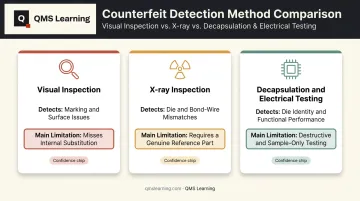
Here's how the core methods stack up:
| Method | Detects | Main Limitation |
|---|---|---|
| Visual inspection | Marking, surface, lead condition | Misses internal or die-level substitution |
| X-ray | Die/bond-wire mismatch | Needs a genuine reference part |
| Decapsulation + electrical | Die identity, functional performance | Destructive; sample-only |
Knowing these methods exist is one thing; knowing which one a given part, risk level, and AS5553/AS6081 requirement actually calls for is the judgment call that trips up junior quality staff during real audits. That's the specific gap QMS Learning's Aerospace & Defense pathway is built to close, through counterfeit parts avoidance scenarios and AI-guided method selection.
How to Interpret the Results
Misreading a result carries real consequences. Accepting a marginal part risks a field failure. Over-rejecting good stock wastes cost and lead time on parts that were fine all along.
FAA guidance on suspected unapproved parts lists tampered identification, abnormal markings, altered surfaces, corrosion, and mismatches between the part and its purchasing documents as indicators, not automatic proof of counterfeiting. That distinction matters for how you disposition a finding. Every result sorts into one of three outcomes:
- Normal/acceptable: Markings, internal structure, and electrical readings match the golden sample within spec. Release the lot to production and log the inspection record.
- Minor/ambiguous findings: Small marking inconsistencies or borderline parametric readings that don't conclusively indicate counterfeiting. Escalate to a second method, such as X-ray after a visual flag, before making a final call.
- Out-of-spec/suspect counterfeit: Blacktopping residue, mismatched date codes, internal die substitution, or a failed parametric test. Quarantine the part immediately, report it through GIDEP or ERAI, and open a formal nonconformance record.
That last step isn't optional in a regulated program. A quarantined part with no report and no CAPA is a finding waiting to happen.
Common Errors and Safety Best Practices
Common Inspection Errors
The same mistakes show up across programs, regardless of size:
- Relying on visual inspection alone for critical or high-risk parts
- Skipping the golden sample comparison, which makes subtle counterfeit tells nearly impossible to catch
- Neglecting chain-of-custody documentation, which undermines the inspection's credibility during an audit
Safety and Best Practices
Catching these errors matters, but the inspection process itself introduces risk. Detection work carries its own hazards, particularly during decapsulation:
- Maintain ESD grounding and PPE whenever handling components or running decapsulation
- Use a ventilated workspace with proper chemical handling protocols for acid decapsulation
- Keep a clean, contamination-free workstation to prevent cross-sample contamination that skews readings
A single mislabeled sample tray can contaminate an otherwise sound inspection. Treat contamination control with the same seriousness as the detection method itself.
Building Audit-Ready Counterfeit Parts Detection Capability
Detection is only half the job. Under AS9100D and AS5553, a suspect or confirmed counterfeit part has to trigger a documented root cause and CAPA, not just a quarantine tag and a shrug.
Teams without structured training often freeze mid-audit when a counterfeit part surfaces, or improvise a response that creates a finding of its own. That's a predictable, avoidable failure.
QMS Learning's Aerospace & Defense Audit-Ready pathway includes a dedicated Counterfeit Parts Avoidance course — six modules and 31 lessons built around SAE AS6174 and AS6081 detection standards. The course covers:
- Supplier control programs and approved source vetting
- Receiving inspection workflows for identifying suspect parts
- Traceability documentation required for audit defense
It's designed to produce counterfeit parts gatekeepers: people who can demonstrate the detection workflow during an audit, not just recall it from a slide deck.
Paired with the course is an AI Workbench that diagnoses the nature of a finding before selecting a method. For a counterfeit-related nonconformity, the process runs in three steps:
- Diagnose the finding to determine whether it's isolated or systemic (same supplier, repeated flags)
- Route to 5-Why plus Supplier CAPA for systemic issues, skipping FMEA since that method fits new-process risk, not closing an existing failure
- Draft the CAPA record mapped to the applicable clause, ready for review the moment the part is flagged

Frequently Asked Questions
What is counterfeit electronics?
Counterfeit electronics are components whose origin, age, or quality is deliberately misrepresented. That includes relabeled, recycled, or blacktopped parts sold as new or higher-grade than they actually are.
What are the most counterfeited products?
Programmable logic ICs led ERAI's 2025 reports at over 15% of the total, with analog, microprocessor, and memory ICs also among the largest reported categories.
Is it illegal to sell counterfeit electronics?
Yes. Selling counterfeit electronics violates trademark and IP law, and in regulated sectors like defense it can trigger federal prosecution. One seller of counterfeit military-grade ICs was sentenced to 46 months in federal prison.
What standards govern counterfeit electronic parts detection?
SAE AS5553 applies to OEMs and manufacturers, while AS6081 applies to independent distributors. Both define avoidance, detection, mitigation, and disposition requirements.
Can visual inspection alone catch all counterfeit parts?
No. Sophisticated counterfeiters now defeat basic visual checks, which makes X-ray, decapsulation, or electrical testing necessary for high-risk or flight-critical parts.
What should you do if you discover a counterfeit part in your inventory?
Quarantine the part immediately, report it via GIDEP or ERAI, and open a documented CAPA that identifies the source and the corrective action taken.