That distinction isn't academic. It determines whether you're eligible to bid, how much an audit costs, and how much evidence your team must produce on demand.
The DoD's shift from self-attestation to certified verification is already underway. Its 2024 final rule estimates 221,286 unique entities will fall under CMMC at full rollout — a mix of self-assessors and companies requiring third-party certification. Here's exactly where NIST 800-171 ends and CMMC begins.
Key Takeaways
- NIST 800-171 defines the 110 security requirements needed to protect CUI; CMMC verifies whether contractors actually implemented them
- CMMC Level 2 is built directly on NIST 800-171's 110 requirements, making 800-171 compliance the foundation for CMMC readiness
- Self-assessment covers basic NIST obligations; most CUI handlers under CMMC need documented evidence and C3PAO validation
- Contract awards increasingly require CMMC status up front, not after you win the bid
- Passing either framework demands audit-ready evidence on demand, not just controls checked off a spreadsheet
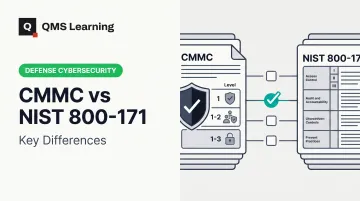
CMMC vs NIST 800-171: Quick Comparison
Here's how NIST SP 800-171 and CMMC 2.0 compare at a glance:
| Dimension | NIST SP 800-171 | CMMC 2.0 |
|---|---|---|
| Nature & Purpose | NIST publication of security requirements for protecting CUI on nonfederal systems | DoD program that requires contractors to prove those safeguards via formal assessment |
| Verification Method | Self-assessment (Basic Assessment) under DFARS 252.204-7019/7020; Low confidence default | Level 1: annual self-assessment. Level 2: self-assessment or C3PAO certification. Level 3: triennial DCMA DIBCAC assessment |
| Structure & Levels | 110 requirements across 14 control families (Rev. 2 — the version CMMC codifies) | Three tiers: Level 1 (Foundational), Level 2 (Advanced), Level 3 (Expert) |
| Scope of Coverage | Any system component that processes, stores, or transmits CUI, plus components protecting it | Contractors and subcontractors handling FCI or CUI under an applicable DoD solicitation |
| Cost & Enforcement | No certification fee; costs are implementation-specific | DoD estimates ~$5,977 per Level 1 self-assessment; ~$104,670 over three years for a small entity's Level 2 C3PAO certification |
What is NIST 800-171?
NIST SP 800-171 is the standard published by the National Institute of Standards and Technology for protecting Controlled Unclassified Information (CUI) on nonfederal systems. It underpins nearly every DoD contractor's cybersecurity obligations, largely because DFARS clause 252.204-7012 requires covered contractor systems to meet it.
Its real value is structure. Instead of vague guidance, contractors get 110 security requirements grouped into 14 families: access control, incident response, audit and accountability, and more. That structure gives teams a concrete roadmap they can score and remediate against.
Here's how self-assessment actually works:
- Start with a baseline score of 110 points
- Subtract 5, 3, or 1 point for each unmet requirement, weighted by security significance
- Submit the resulting score to the Supplier Performance Risk System (SPRS)
- Document your environment in a System Security Plan (SSP)
- Log unmet requirements in a Plan of Action & Milestones (POA&M)
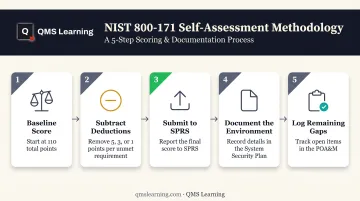
A POA&M records your remediation plan, but it doesn't make an unimplemented requirement count as implemented for scoring purposes, according to DoD's Assessment Methodology.
When Contractors Need NIST 800-171
NIST 800-171 shows up early in the contractor lifecycle, often before you can even bid. DFARS clauses require it for any covered contractor system handling CUI, and that obligation flows down to subcontractors too, including some commercial-item subs.
A typical scenario: a mid-size manufacturer building components for a prime contractor runs a self-assessment, scores itself against the 110 requirements, and submits that score to SPRS. A negative score doesn't automatically disqualify them, but it does invite scrutiny. That score is also the exact baseline CMMC later checks against.
Contractors new to the framework often start with structured training on the 14 control families and CUI-handling requirements. That same foundation is what CMMC preparation builds on, and it is the ground QMS Learning covers in its Defense Cybersecurity pathway.
What is CMMC?
CMMC (Cybersecurity Maturity Model Certification) is the DoD's formal assessment program, built directly on NIST 800-171. It exists because self-attestation alone produced overstated security postures. Companies claimed compliance that assessors later couldn't verify.
The enforcement clause, DFARS 252.204-7021, became effective November 10, 2025. Without the required CMMC status and annual affirmation logged in SPRS, an offeror simply isn't eligible for the award.
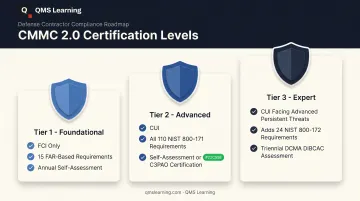
CMMC 2.0 breaks down into three levels:
- Level 1 (Foundational) — Covers FCI only. 15 safeguarding requirements from FAR 52.204-21. Annual self-assessment and affirmation.
- Level 2 (Advanced) — Covers CUI. All 110 NIST 800-171 requirements. Self-assessment or C3PAO certification, depending on what the contract specifies.
- Level 3 (Expert) — Covers CUI facing advanced persistent threats. Adds 24 selected NIST 800-172 requirements on top of Level 2. Requires DCMA DIBCAC assessment every three years.
When CMMC Applies
CMMC applies at contract award, which reverses the old sequence. Compliance is no longer something you patch together after winning the bid. It is a prerequisite for bidding at all.
You'll see CMMC dominate in a few pockets of the defense industrial base:
- Aerospace and defense manufacturers building to DoD specifications
- IT and managed service providers supporting contractor networks
- Subcontractors at every tier of the DIB supply chain
There's no universal readiness timeline, and be wary of anyone who quotes you one. Preparation effort scales with your network's size and complexity. A five-person shop with a single CUI-handling laptop faces a very different lift than a 200-person manufacturer running multiple facilities.
Which Framework Applies to You?
Three questions determine your path: what data you handle, what your specific contract requires, and whether a CMMC level is already named in the contract language.
If You Only Handle FCI
NIST 800-171 likely doesn't fully apply. CMMC Level 1 self-assessment against the 15 FAR-based safeguards is typically sufficient — and it's an annual, contractor-run process.
If You Handle CUI
Full NIST 800-171 implementation is mandatory, and CMMC Level 2 certification will almost certainly follow. Depending on your contract, that means either self-assessment or a full C3PAO review.
The most common pitfall we see: assuming a completed NIST self-assessment automatically satisfies CMMC. It doesn't. C3PAO assessors demand artifacts, system logs, and staff interviews that self-assessments never required. A checked box on SPRS isn't evidence — it's a claim.
That gap is why certification now demands genuine audit-ready capability, not a one-time training session.
QMS Learning's Defense Cybersecurity Readiness pathway (pilot Q3 2026) is built for that gap. It covers:
- All 14 NIST 800-171 control families
- Gap assessment methodology and SSP development against your real environment
- POA&M tracking
- Practice with the questions a C3PAO assessor will actually ask
Conclusion
NIST 800-171 and CMMC are sequential steps, not competing options. NIST defines the controls. CMMC verifies you built them. Clarity comes from your CUI exposure and contract language—not from picking a favorite framework.
Contractors who build real compliance capability early avoid last-minute scrambles, protect contract eligibility, and reduce False Claims Act exposure from overstated compliance. Practitioner-built resources from QMS Learning help teams move from "trained" to audit-ready before an assessor shows up.
Frequently Asked Questions
Is CMMC now required?
CMMC enforcement began through DFARS clause 252.204-7021 on November 10, 2025. Full implementation across all applicable DIB contracts was originally targeted for 2028, so current requirements still depend on your specific contract language.
Is NIST 800-171 the same as CMMC?
No. NIST 800-171 defines the 110 security requirements themselves, while CMMC is the DoD's assessment and certification program that verifies those requirements are actually in place.
Is NIST 800-53 the same as CMMC?
No. NIST 800-53 is a much broader federal control catalog used across all federal agencies. NIST 800-171 draws from a subset of those 800-53 controls, but neither is the same as CMMC.
Do I need to comply with both CMMC and NIST 800-171?
If you handle CUI under a DoD contract, generally yes. NIST 800-171 implementation is the foundation, and CMMC certification is the verification layer on top of it.
What happens if I fall short of full NIST 800-171 compliance?
Each unmet requirement docks your SPRS score by 1, 3, or 5 points, and a POA&M doesn't count as implementation. Unresolved high-weighted requirements can jeopardize both your SPRS score and your contract eligibility.
How long does it take to become CMMC certified?
There's no fixed timeline. It depends on your organization's size, network complexity, and current security maturity. DoD assessors typically book reviews 3–6 months out — that's scheduling lead time, not the remediation work required to get ready.