Introduction
FDA's FY2025 pharmaceutical quality report shows that 28% of reviewed submissions received a Complete Response Letter (CRL), with facility-related issues driving 43% of those CRLs. Manufacturing and quality system failures sit at the center of most non-approval decisions — and the documentation that governs them falls squarely within CMC. These are expensive outcomes. Most are preventable.
CMC regulatory strategy is a lifecycle function — it starts at preclinical and runs through every post-approval manufacturing change a product ever undergoes. Teams that treat it as a submission task (fill Module 3, submit, move on) tend to be the ones receiving CRLs.
This article covers what CMC means in a regulatory context, the core guidelines that govern it globally, how to build a phase-based approach, and the documentation pitfalls that consistently cause delays that cost approvals.
Key Takeaways
- CMC (Chemistry, Manufacturing, and Controls) is the quality documentation framework regulators assess from IND through commercial approval
- ICH Q8–Q12 govern modern CMC strategy across FDA, EMA, and PMDA
- Phase 2 is the last viable window for major process or formulation changes before comparability burden becomes prohibitive
- Process characterization gaps, unjustified specifications, and thin stability data are the leading CRL triggers
- Build post-approval CMC planning into your development strategy — not after launch
What Is CMC in Regulatory Context?
Chemistry, Manufacturing, and Controls is the three-pillar framework governing the technical and quality documentation that proves a drug product is consistently safe, pure, potent, and reproducibly manufactured.
In regulatory affairs, CMC refers specifically to the structured documentation and oversight activities that agencies — FDA, EMA, ICH, WHO — evaluate during IND, NDA, BLA, and ANDA submissions. The ICH M4Q Common Technical Document places this information in CTD Module 3, with the Quality Overall Summary in Module 2.3.
CMC as Science vs. CMC as Regulatory Obligation
Having thorough lab data is not enough. That data must be organized, validated, and presented within the structures regulators expect. A company can possess excellent scientific understanding of its API synthesis and still receive an information request if the data isn't presented in the format reviewers use to evaluate it.
That gap between scientific rigor and regulatory compliance is where submissions stall — and where development teams need to shift their documentation priorities accordingly.
CMC Is a Lifecycle Commitment
CMC compliance doesn't end at approval. Post-approval manufacturing changes, site transfers, formulation updates, and scale-up all require CMC documentation under specific regulatory pathways. Teams that build regulatory flexibility into their original submission avoid the costly Prior Approval Supplements and post-approval delays that follow when CMC is treated as a one-time event.
Core Components of a CMC Compliance Program
Drug Substance (API)
Drug substance CMC covers:
- Synthesis process and flow diagrams
- Structural characterization and identity
- Impurity profiling and qualification thresholds
- Critical process parameter (CPP) identification
- Reference standard establishment
- Container closure for the API
One point teams consistently underestimate: the scale-up rationale. FDA reviewers at NDA stage expect to see how scaling challenges were identified and addressed — not a narrative reconstructed after the fact. That documentation should start during Phase 1 and 2, when the decisions are actually being made.
Drug Product Formulation and Manufacturing
Drug product CMC covers four interconnected elements:
- Formulation design and excipient selection rationale
- Manufacturing process selection (wet granulation, fill-finish, direct compression)
- Critical quality attributes (CQAs) linked to clinical performance
- Container closure system qualification
Formulation decisions carry regulatory weight even when they seem purely scientific.
A change in excipient grade during Phase 2 without documented scientific justification becomes a documentation gap that surfaces during Module 3 review. Teams that log the rationale at the time of the decision rarely have this problem.
Analytical Methods and Validation
The CMC analytical strategy must demonstrate that each method is:
- Suitable for its intended purpose
- Stability-indicating where appropriate
- Validated according to ICH Q2(R2) — the current standard since FDA issued final guidance in March 2024
Method development timelines should align with clinical milestones. Technology transfer to commercial QC labs should begin during Phase 2 — not after process lock — while there's still time to identify interlaboratory variability and resolve it.
Manufacturing Controls and Specifications
Those method decisions feed directly into how manufacturing controls are structured. In CMC practice, "controls" means:
- In-process tests at defined checkpoints
- Critical process parameters with experimentally justified ranges
- Batch records documenting each production run
- QA/QC release protocols
- Change control systems with documented decision trails
Specifications must be statistically derived from actual clinical batch data, not set at round numbers or inherited from similar products. Every acceptance criterion must trace back to a scientific rationale. Reviewers ask for that traceability — teams that can't produce it receive information requests that extend review timelines.
Stability Testing Program
The ICH Q1A–Q1E guidelines govern CMC stability programs. A compliant program must include:
- Long-term and accelerated studies under ICH-specified conditions matched to target market climatic zones
- Stress testing (thermal, humidity, pH)
- Photostability per ICH Q1B
- In-use or post-reconstitution data where applicable
- Minimum 6 months accelerated and 6 months long-term data at ANDA submission
The most common stability failures aren't missing data — they're preventable:
- Container closure on stability batches that differs from commercial packaging
- Stability trends observed but not addressed before submission
- Shelf-life claims unsupported by data from batches representative of commercial scale
Each of these forces either a conservative shelf-life label or a request for additional data post-submission.
Key CMC Regulatory Guidelines to Know
ICH Quality Guidelines Q8–Q12
The Q8–Q12 series forms the backbone of modern CMC regulatory strategy. These guidelines apply across FDA, EMA, PMDA, and Health Canada submissions:
| Guideline | Focus | Key Application |
|---|---|---|
| Q8(R2) | Pharmaceutical Development | QTPP, CQAs, design space in 3.2.P.2 |
| Q9(R1) | Quality Risk Management | Risk-based prioritization of CMC activities |
| Q10 | Pharmaceutical Quality System | QMS expectations across the lifecycle |
| Q11 | Drug Substance Development | Chemical and biotech API manufacture |
| Q12 | Lifecycle Management | Post-approval change-management protocols |
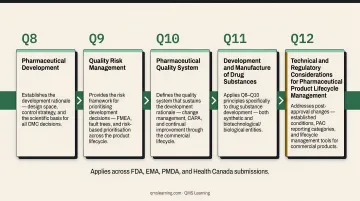
These aren't independent documents; they form a deliberate sequence. Q8 establishes development rationale; Q9 provides the risk framework for prioritizing it; Q10 defines the quality system that sustains it; Q11 and Q12 address substance-specific development and post-approval changes respectively.
FDA CMC Requirements by Submission Type
FDA's expectations scale with development stage:
- IND: Sufficient CMC data to ensure participant safety — not full commercial validation. This covers composition, manufacturing description, controls, stability, and safety-relevant impurities per 21 CFR 312.23(a)(7)
- NDA/BLA: Complete Module 3 documentation demonstrating commercial-scale process control — process validation, analytical method validation, ICH-compliant stability, and final specifications
Section P.2 (Pharmaceutical Development) within Module 3 deserves more attention than most teams give it. Reviewers assess whether development decisions were data-driven and systematic. A thin P.2 that lists choices without demonstrating the rationale behind them draws questions. A strong P.2 that shows the scientific basis for formulation and process decisions shortens review cycles and reduces back-and-forth with the agency.
EMA and Regional Compliance Nuances
EMA-specific CMC requirements include:
- Certificate of Suitability (CEP): EDQM issues these to demonstrate that a substance's quality is controlled by the relevant European Pharmacopoeia monograph
- Active Substance Master File (ASMF): Protects API know-how through an Applicant's Part and Restricted Part — authorities receive the complete file while the applicant retains control of proprietary information
- EU pharmacopeial compliance: Distinct from USP, with different acceptance criteria for some compendial tests
Regional differences persist despite ICH harmonization. China's NMPA has not fully implemented ICH Q4B pharmacopeial interchangeability, meaning full pharmacopeial equivalence cannot be assumed for Chinese submissions. Japan's PMDA often requires additional testing not requested by FDA or EMA. A global CMC strategy that accounts for these divergences from the start avoids costly rework at the point of regional submission.
Good Manufacturing Practice (GMP)
GMP is the operational foundation on which CMC compliance rests, not a standalone manufacturing standard. 21 CFR Part 211 sets minimum CGMP requirements for US finished pharmaceuticals. EudraLex Volume 4 (Parts I and II) governs EU requirements for finished products and active substances.
CMC deficiencies during inspections frequently trace back to GMP system failures:
- Inadequate change control documentation
- Unvalidated manufacturing processes
- Equipment not qualified for the proposed manufacturing steps
The connection between facility inspection status and application outcomes is direct. FDA's FY2025 data shows that more than half of facility withholds in CRLs involved sites with pre-existing OAI or potential-OAI status — meaning compliance problems existed before the application was submitted.
Quality by Design (QbD)
QbD's role in CMC strategy:
- Define the QTPP — the quality target product profile describing what the product must achieve
- Identify CQAs through risk assessment — which attributes directly impact patient safety and efficacy
- Use Design of Experiments (DoE) to characterize process parameters and their impact on CQAs
- Establish a design space — operating ranges within which quality is assured
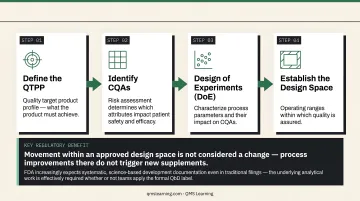
The key regulatory benefit: movement within an approved design space is not considered a change, so process improvements there don't trigger new supplements. Teams locked into a traditional fixed-parameter approach lose that flexibility entirely.
QbD is not mandatory, but FDA increasingly expects systematic, science-based development documentation even in traditional filings. The underlying analytical work is effectively required whether or not teams apply the formal QbD label to it.
Building a Phase-Based CMC Regulatory Strategy
Preclinical and IND Stage
Minimum CMC requirements at IND:
- API characterization with impurity profile
- Drug product composition and manufacturing description
- Analytical methods for release testing (validation not yet required)
- Stability data supporting proposed clinical storage conditions
- GMP compliance documentation
IND CMC sections establish a first impression. Teams that submit disorganized, minimally supported IND CMC packages create reviewer skepticism that persists. That skepticism follows the program through subsequent interactions and makes pre-NDA meetings harder to navigate.
Phase 1 Through Phase 2: The Process Lock Window
Phase 2 is the last practical opportunity to make major process or formulation changes without triggering regulatory justification and comparability data requirements. By end of Phase 2, accomplish the following:
- Formulation locked with documented justification
- CPPs identified with preliminary ranges
- Impurity profile well-characterized against ICH thresholds
- Preliminary scale-up or process characterization data generated
- Stability program expanded to support commercial shelf-life claims
Teams that let formulation decisions drift into Phase 3 pay for it. Comparability studies, delayed timelines, and reviewer questions about late-stage changes are the predictable result.
Phase 3 and NDA/BLA Readiness
Phase 3 CMC deliverables regulators expect in a complete submission:
- Process validation studies at commercial scale
- Analytical method validation reports (per ICH Q2(R2))
- ICH-compliant stability data at commercial-scale packaging
- Final specifications with statistical justification from clinical batches
- Commercial facility qualification
- Comparability studies for any manufacturing changes since Phase 2
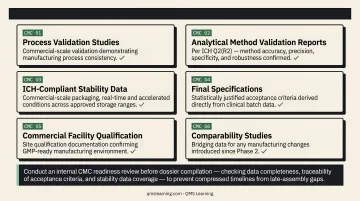
Conduct an internal CMC readiness review before dossier compilation. Many teams discover documentation gaps at this stage that could have been resolved months earlier. A structured pre-submission review — checking for data completeness, traceability of acceptance criteria, and stability data coverage — prevents the compressed timeline that results from finding problems during final assembly.
Post-Approval CMC Lifecycle
Three regulatory pathways govern post-approval manufacturing changes:
| Category | Threshold | Timing |
|---|---|---|
| Annual Report | Minor change, minimal adverse effect potential | Notification only |
| CBE-30 | Moderate change | Distribution 30 days after FDA receipt |
| Prior Approval Supplement | Major change (site transfer, significant process modification) | FDA approval required before distribution |
Design process flexibility into the NDA from the start. Documented design spaces reduce the supplement burden for anticipated improvements, and post-approval CMC planning belongs in the development strategy — not as an afterthought after commercial launch.
Teams that map their improvement roadmap during Phase 3 face fewer supplements, fewer reviewer interactions, and shorter timelines when changes eventually come.
Common CMC Pitfalls That Cause Regulatory Setbacks
Inadequate process characterization. FDA and EMA reviewers distinguish companies that genuinely understand their manufacturing process from those that document steps without demonstrating that understanding. Common red flags include:
- Process parameter ranges without experimental justification
- No data linking parameters to critical quality attributes (CQAs)
- Missing failure mode documentation
The fix is deliberate process characterization studies (including negative results showing which parameters don't impact quality) conducted during development, not assembled retrospectively.
Poorly set specifications. Specifications set too tight produce commercial batch rejection rates that signal a process out of control. Specifications set too loose raise safety concerns. Either way, reviewers ask questions.
Specifications must be derived from statistical analysis of clinical batch data and analytical method capability, with documented traceability from each criterion back to its scientific basis. Unexplained changes between development phases are a consistent reviewer flag.
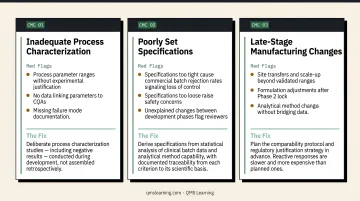
Late-stage manufacturing changes. Site transfers, scale-up beyond validated ranges, formulation adjustments after Phase 2 lock, and analytical method changes without bridging data — each requires comparability studies and regulatory justification that add time and cost. When changes are unavoidable, plan the comparability protocol and the regulatory justification strategy in advance. Reactive responses to late-stage changes are slower and more expensive than planned ones.
How a Strong QMS Supports CMC Compliance
CMC compliance is not a regulatory affairs function in isolation. It requires several operational foundations embedded in daily work:
- Change control systems that document every manufacturing decision
- Document version control with traceable revision histories
- CAPA processes tied to root cause, not just corrective action
- Audit-ready evidence management that travels with the record, not the person
Teams that lack this infrastructure struggle to maintain CMC compliance through manufacturing changes and post-approval obligations — not because they lack scientific knowledge, but because they cannot produce the documented traceability inspectors require. Inspection readiness is a function of how well the quality system operates, not just how well the submission was written.
For life sciences and medical device quality teams building these foundational capabilities, QMS Learning's Medical Device & Life Sciences pathway (ISO 13485 and FDA 21 CFR Part 820, pilot cohort Q3 2026) provides structured training that builds diagnostic judgment alongside evidence management skills.
The platform's Document Management System — with controlled document revision history, clause-mapped linkages, and one-click audit evidence export — gives teams the traceable records inspectors ask for, compiled in minutes rather than days.
Frequently Asked Questions
What is a regulatory CMC strategy?
A regulatory CMC strategy is a phase-based plan for developing, validating, and documenting chemistry, manufacturing, and controls data from IND through commercial approval. It coordinates manufacturing process development with regulatory submission timelines and agency quality expectations across each development phase.
What does CMC stand for in regulatory?
CMC stands for Chemistry, Manufacturing, and Controls — covering the drug substance (API), drug product formulation and manufacturing process, and the analytical and quality controls that demonstrate consistent product identity, purity, strength, and safety throughout the product lifecycle.
What is the difference between GMP and CMC?
GMP (Good Manufacturing Practice) is the operational regulatory standard governing how drugs are physically manufactured. CMC is the broader documentation and compliance framework that encompasses manufacturing (including GMP compliance) plus chemistry characterization and analytical controls.
When should CMC planning begin in drug development?
CMC planning should begin at the preclinical stage. Early planning allows stability programs, analytical methods, and manufacturing process characterization to develop in parallel with clinical activities — avoiding the last-minute data gaps that are a leading source of submission delays.
What are the most common CMC deficiencies that delay drug approval?
The leading categories are inadequate process characterization, poorly justified specifications, incomplete stability programs, and late-stage manufacturing changes that require comparability data. FDA has identified these categories as primary drivers of complete response letters and clinical holds.
How do FDA and EMA CMC requirements differ?
Both agencies use CTD Module 3 and share ICH guideline foundations, but diverge on specifics: EU requirements for CEPs and Active Substance Master Files, stability study design for EU climatic zones, and differing pharmacopeial acceptance standards.