The mix-up isn't rare. Many quality teams build documentation, controls, and evidence around clauses that don't apply to their operation: burning weeks of audit prep on production paperwork a distributor will never need, or missing distributor-specific traceability controls a manufacturer never has to think about. According to IAQG's 2025 Annual Report, the 9100-series family (AS9100, AS9110, and AS9120 combined) saw 12,745 certificates issued globally in a single year, including 1,792 brand-new initial certifications. That's a lot of organizations working through this exact decision right now.
TL;DR
- AS9100 covers design, manufacture, and post-delivery support; AS9120 covers distributors who procure, store, and resell parts unaltered.
- Both build on ISO 9001:2015; AS9120 drops production-only clauses like design controls and process verification.
- AS9120 adds distributor rules: suspected unapproved parts prevention and full manufacturer traceability.
- Choose by supply chain role, not company size—some organizations need both.
- Picking the right standard is step one; passing the audit takes verified capability, not paperwork alone.
AS9100 vs AS9120: Quick Comparison
| Factor | AS9100 (Rev D) | AS9120 (Rev B) |
|---|---|---|
| Applicable organizations | Designers, manufacturers, and post-delivery support providers for aerospace, space, and defense products | Distributors that procure, store, split, and resell parts without altering them |
| Core focus | Design control, production process verification, configuration management, product safety | Traceability to the original manufacturer, unapproved and counterfeit parts prevention, storage and handling |
| Base standard | Full ISO 9001:2015 plus aerospace clauses, including 8.5.1.3 production process verification and 8.3.4.1 design controls | Same ISO 9001:2015 base, with production-only clauses removed and clause 8.1.5 (suspected unapproved parts) added |
Certification Cost and Audit Effort
Neither SAE nor IAQG publishes a standardized fee or man-day table. Actual quotes come from the registrar and depend on headcount, site count, and process complexity. A few patterns hold regardless:
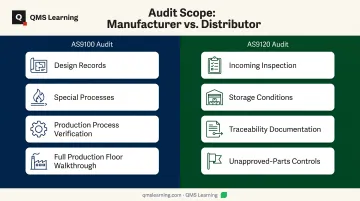
- AS9100 audits tend to run longer, since auditors sample design records, special processes, and production verification across every product line.
- AS9120 audits are typically narrower. Auditors focus on incoming inspection, storage, traceability, and unapproved-parts controls rather than a full production floor walk.
- Multi-site or high-complexity organizations see longer audits either way—registrars size the engagement to the operation, not only the certificate.
Scale of Adoption
IAQG doesn't publish a clean "AS9100-only" versus "AS9120-only" global count. Both are tracked together under the 9100-series family in its OASIS database.
AS9100 still accounts for most of that activity—far more aerospace organizations manufacture than distribute. AS9120's base is smaller but growing as OEMs push traceability further down the supply chain and require certified distributors as a condition of doing business.
What is AS9100?
AS9100 (currently Revision D) is the quality management standard for organizations that design, develop, or manufacture aerospace, space, and defense products and services.
It builds on the full ISO 9001:2015 framework with aerospace-specific requirements: configuration management, product safety, risk management, and production process verification (still called First Article Inspection by many engineers, even though that is no longer the official clause title). It is not a lighter or alternate standard — it is ISO 9001 with more teeth.
Operational benefits:
- Production process verification and configuration management cut down rework and nonconformities before parts ship.
- A documented supplier qualification process reduces the odds of a bad part reaching the customer.
- For most Tier 1 and Tier 2 suppliers, certification isn't optional. It's a contractual gate to bidding on OEM work at all.
AS9100 sits at the top of the 9100-series family. AS9110 (for repair stations) and AS9120 (for distributors) share most of its clause structure but drop or add requirements based on the organization's role. AS9100 functions as the parent standard, with 9110 and 9120 as scoped variants for different roles in the supply chain.
One clause trips up more teams than any other during real audits: 8.1.4, prevention of counterfeit parts. Plenty of organizations have a procedure on paper. Fewer can produce, on the spot, a documented instance of catching a suspect part, tracing its source, and closing the loop. That gap between writing the policy and proving execution is where audit findings live.
Use Cases of AS9100
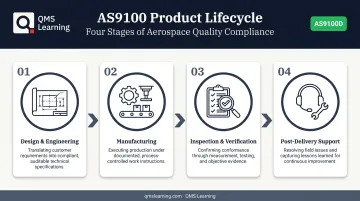
AS9100 covers the full production lifecycle, from initial design and engineering through manufacturing and inspection to post-delivery support once the part is in service. It fits:
- OEMs building complete aircraft, engine, or spacecraft systems
- Tier 1–3 machining and fabrication suppliers making structural or engine components
- Forging and casting houses supplying raw or near-net-shape parts
- Avionics manufacturers producing flight-critical electronics
When Boeing required AS9100 of its suppliers, Bosch Communications used cross-functional lead-auditor and internal-auditor training to earn dual AS9100 and ISO 9001 certification in 11 months and keep its Boeing contract. Certification speed tracks less with the standard's complexity than with whether the team can apply it under real audit pressure.
What is AS9120?
AS9120 (currently Revision B) is the quality management standard for aerospace distributors: companies that procure, store, split, and resell parts without performing any manufacturing or alteration. It runs on the same ISO 9001:2015 foundation as AS9100, but the aerospace-specific additions are scoped to what a distributor actually controls: incoming inspection, storage conditions, and where a part came from.
Why it matters operationally:
- Traceability requirements make it harder for an unapproved or counterfeit part to move through a distributor's shelves undetected.
- Documented storage and handling controls protect part integrity between the manufacturer's dock and the customer's receiving inspection.
- OEMs increasingly require AS9120 certification as a precondition for doing business. An uncertified distributor doesn't get on the approved supplier list.
What AS9120 Leaves Out (and Adds)
Because distributors don't design or manufacture anything, AS9120 removes the clauses that only apply on a shop floor: special process validation, production process verification, and design and development controls. Product safety is folded into general clauses on customer communication, operational planning, and product release rather than kept as a standalone requirement.
In its place, AS9120 adds clause 8.1.5, prevention of suspected unapproved parts, alongside the counterfeit-parts clause both standards share. It also introduces distributor-specific definitions:
- Splitting: dividing product or batch quantity without changing its characteristics or conformity
- Unapproved part: one not produced or maintained to approved data or applicable requirements (a counterfeit part is unapproved by definition)
- Certificate of conformity and test report: documentation distributors must verify and retain at receipt, not just pass along
OEMs buying from distributors need certainty the part is exactly what the paperwork says it is.
Use Cases of AS9120
AS9120 fits organizations working in procurement, warehousing, kitting or splitting, and resale, not design or production. Typical certificate holders include:
- Independent aerospace parts distributors
- Stocking distributors holding inventory against long-lead-time programs
- Brokers supplying fasteners, electronic components, and hardware to OEMs and MRO shops
The stakes are real. ERAI's 2024 annual report logged 1,055 suspect counterfeit and nonconforming parts reports, a 25% jump over 2023 and the highest count since 2015. Independent distributors accounted for nearly a third of those reports.
AS9120 certification is the control system meant to keep a distributor off that list and on OEM approved-supplier lists.
AS9100 vs AS9120: Which Standard Do You Need?
Start with three questions, not the company's size or budget:
- What does the organization actually do? Design and manufacture, or buy and resell without altering the part?
- What do customer contracts require? OEM purchase orders and quality clauses often specify the standard outright.
- Does the product change hands unaltered, or does it get transformed? Splitting a batch isn't manufacturing. Machining, forging, or assembling is.
The answer usually sorts itself out fast:
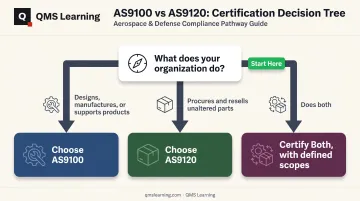
- Choose AS9100 if the organization designs, manufactures, assembles, or provides post-delivery support on aerospace products.
- Choose AS9120 if the organization exclusively procures and resells parts without altering them.
- Consider both if the organization manufactures some lines and distributes others. Each activity needs its own defined scope on the certificate.
Real-World Example: Getting Audit-Ready for the Right Standard
Here's a scenario that plays out more often than most registrars would like. A mid-size aerospace supplier expands into distribution, buying finished parts from an approved manufacturer and reselling them to a second-tier customer.
The quality team, familiar only with AS9100, builds its QMS documentation around production clauses (special process controls, production process verification, design records) for a division that never touches a lathe.
The registrar shows up for the initial audit and asks a simple question: "Show me your process for preventing suspected unapproved parts from entering inventory." Silence.
The team has production verification records for a product line it doesn't even own anymore, but no documented traceability process tied to distribution. The audit generates findings, the certification timeline slips, and sales is explaining to an OEM customer why the "certified" distributor isn't certified yet.
The fix isn't just re-scoping the documentation, although that's step one. It's building a team that can recognize which clauses apply to which activity and produce evidence without a consultant on standby.
That's the gap practitioner-built training closes. Generic classroom sessions teach the standard in the abstract without testing whether someone can apply it under pressure.
Organizations that make this shift typically see two changes:
- Teams reach audit-ready status within a defined rollout window instead of an open-ended prep cycle
- Evidence that used to take days to assemble (training records, procedures, nonconformity logs) compiles in minutes
Picking AS9100 or AS9120 correctly is the easy part. Proving the team can operate under it, on the spot, in front of an auditor, is what actually gets you certified.
If a team needs to build that capability, QMS Learning's Aerospace & Defense Audit-Ready pathway covers AS9100D internal auditing, ITAR compliance, and Counterfeit Parts Avoidance. Those diagnostic skills apply whether a QMS is scoped to AS9100, AS9120, or both.
Organizations carrying AS9100 obligations typically reach audit-ready status within 30 days of rollout. Teams with an AS9120 timeline can discuss a custom-scoped rollout.
Conclusion
The choice between AS9100 and AS9120 comes down to scope fit: design and manufacture, or procure and resell. Match the standard to what the organization actually does in the aerospace supply chain.
Get the scope wrong, and the mismatch shows up where it hurts most: in front of an auditor, during a customer qualification review, or in a bid response that asks for a certificate the company doesn't hold.
Choosing the right standard pays off in faster audits, fewer nonconformities, and stronger OEM relationships built on documented trust. The certificate is only the starting point.
Real audit readiness means the team can produce evidence and close findings live under pressure. That capability has to be built deliberately, not assumed because the paperwork says "certified."
Frequently Asked Questions
What is the difference between AS9120 and AS9100?
AS9100 covers organizations that design, manufacture, or provide post-delivery support for aerospace products. AS9120 covers distributors that procure, store, and resell parts without altering them. It omits production-specific clauses such as production process verification and design controls.
What does AS9120 stand for and what are its requirements?
AS9120 is the SAE aerospace QMS standard for distributors. It includes all ISO 9001:2015 requirements plus distributor-specific rules: traceability to the original manufacturer, prevention of unapproved and suspected unapproved parts, and controlled inventory and documentation handling.
Is AS9100 being replaced?
AS9100D is the current SAE edition. IAQG has confirmed a full 9100 revision is underway and expected around 2027, but no new edition has been published yet.
Can a company be certified to both AS9100 and AS9120?
Yes. Organizations that both manufacture and distribute aerospace parts can hold both certifications, with each activity assigned its own defined scope on the certificate.
Is AS9120 based on ISO 9001?
Yes. AS9120 incorporates all ISO 9001:2015 requirements and adds aerospace distributor-specific clauses on top, the same approach AS9100 takes for manufacturers.
What is the difference between AS9110 and AS9120?
AS9110 applies to aviation repair and maintenance stations, while AS9120 applies to distributors. Both are part of the 9100-series family, built on the same ISO 9001:2015 foundation as AS9100.