If you're weighing certification, the real question isn't "is it worth it." It's "what will this actually cost." The honest answer: it depends. A 20-person office pays a fraction of what a 300-person plant with multiple sites spends. Employee count, site count, industry risk level, and how mature your current safety program is all move that number.
This guide breaks down realistic pricing by business size, walks through every cost component across the standard's 3-year certification cycle, and shows how to control spending without cutting corners on safety.
Key Takeaways
- Small, single-site businesses typically spend $8,000–$18,000 over a 3-year cycle; large multi-site operations can exceed $45,000+
- Employee count, site count, industry risk level, and current safety system maturity drive most cost variation
- Registrar fees cover the audit — documentation, training, and two years of surveillance audits add to the total
- Consultants speed up implementation but aren't mandatory for leaner, lower-risk organizations
- Companies already certified to ISO 9001 or ISO 14001 can integrate audits and cut costs meaningfully
How Much Does ISO 45001 Certification Cost? (Pricing Overview)
ISO 45001 doesn't have a fixed sticker price. What you pay depends on your registrar's day rate, how many employees and sites fall within scope, and how much internal prep work you've already done before the audit clock starts.
Common budgeting mistakes to avoid:
- Treating the registrar's quote as the entire project cost (it usually covers the audit only)
- Underestimating staff hours needed for documentation, training, and internal audits
- Forgetting that Years 2 and 3 bring recurring surveillance audit fees; certification isn't a single payment
Typical Cost Range by Business Size
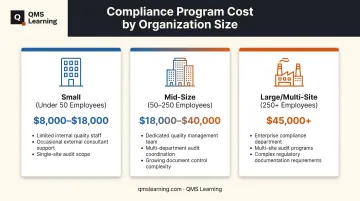
Here's what most US organizations pay across the full 3-year certification cycle:
| Business size | Typical 3-year cost |
|---|---|
| Small (single site, under 50 employees) | $8,000 – $18,000 |
| Mid-size (50–250 employees) | $18,000 – $40,000 |
| Large / multi-site (250+ employees) | $45,000 and up |
These ranges typically include registrar audit fees (Stage 1, Stage 2, plus two years of surveillance) and basic documentation support. They usually exclude consultant fees, equipment or facility upgrades flagged during a gap analysis, and extensive auditor travel for multi-site organizations.
Small, Single-Site Business
For a single location under 50 employees with low-to-medium risk operations, the budget mostly covers an optional gap analysis, Stage 1 and Stage 2 audits, and minor documentation cleanup rather than a full rebuild. This tier works best for businesses that already have some safety practices in place (a written policy, basic hazard logs, an OSHA recordkeeping process), even if nothing is formally mapped to ISO 45001 yet.
Mid-Size, Consultant-Assisted
Between 50 and 250 employees, most companies bring in partial consultant support alongside internal training: formal employee awareness training, internal auditor training, and a full audit cycle with two years of surveillance. This tier suits growing companies without a dedicated EHS or safety manager that need outside structure to move quickly.
Large or Multi-Site, Fully Supported
At 250+ employees or multiple locations, costs climb because of full consultancy engagements, multi-site sampling audits, and integration work with existing ISO 9001 or ISO 14001 systems. This fits complex, higher-hazard organizations such as manufacturing plants, oil and gas operations, and multi-facility logistics networks, where scope and risk both push up audit-day requirements.
Key Factors That Affect the Cost of ISO 45001 Certification
Pricing isn't arbitrary. Accredited certification bodies calculate required audit time using international rules, most notably IAF MD5, which ties audit days to headcount and risk level. Everything else layers on top of that baseline.
Business Size and Number of Locations
More employees and more sites mean more audit days. IAF MD5 sets minimum combined Stage 1 and Stage 2 audit-day requirements based on "effective personnel" (everyone whose work can affect OH&S performance, including contractors and part-timers).
For 26–45 effective personnel, baseline audit time looks roughly like this:
- High-risk category: about 7 audit days
- Low-risk category: about 4 audit days
Add a second or third site, and multi-site sampling rules can add further audit time.
Complexity and Risk Level of Operations
Construction, manufacturing, and oil and gas fall into "high complexity" because of the inherent hazards involved. Office-based organizations typically land in "low complexity." That classification directly affects Stage 2 depth. Auditors spend more time on-site verifying how hazards are actually controlled in high-risk environments, which raises both audit days and fees.
Current Safety System Readiness
This is where internal effort saves real money. A business that already documents hazard assessments, incident investigations, and safety training closes gaps faster than one starting from a blank page. Starting from zero usually means more consultant hours and a longer runway before Stage 1.
Existing ISO Certifications
If you're already certified to ISO 9001 or ISO 14001, you have a head start. Management system structures overlap across ISO standards, so existing documentation and management review cycles can often be adapted rather than rebuilt. Many registrars also allow integrated audits, which reduces total audit days and total fees.
Consultant vs. In-House/Training-Led Implementation
A full ISO 45001 consultant builds your documentation, runs your gap analysis, and preps your team. That convenience is a separate line item, and it often leaves little lasting capability on your payroll.
A training-led approach costs less over time and keeps the knowledge in-house. You avoid paying consultant rates again every time a nonconformity comes up.
Cost Breakdown of ISO 45001 Certification (3-Year Cycle)
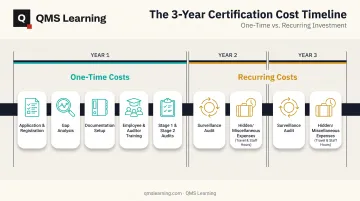
The audit fee is just one line in a much longer bill. Total cost spreads across one-time setup work and recurring costs over the full three years.
| Cost element | Timing | What it covers |
|---|---|---|
| Application & registration | One-time | Opens your file with the certification body and schedules the audit |
| Gap analysis (optional) | One-time | Identifies gaps between current practices and ISO 45001 before you start |
| System setup & documentation | One-time | Policies, procedures, and records — usually the largest single line item |
| Employee & internal auditor training | One-time, recurring with turnover | Awareness training for all staff plus specialized internal auditor training |
| Stage 1 & Stage 2 audits | One-time per cycle | Document review, then an on-site assessment of how the system functions |
| Surveillance audits (Years 2–3) | Recurring | Smaller annual check-ins required to keep the certificate valid |
| Hidden/miscellaneous costs | Recurring | Auditor travel, staff hours pulled from regular duties, unplanned upgrades |
System setup and documentation deserves extra attention. It's often the biggest time sink, not because the writing is hard, but because mapping every policy to the right clause and keeping it audit-ready takes real hours.
A document management system with clause mapping and on-demand audit-evidence export, such as the one in QMS Learning's platform, cuts that manual cross-referencing so your team can close gaps instead of hunting for files.
Hidden costs catch the most people off guard. These items rarely appear in the initial quote, yet they show up on the invoice:
- Auditor travel for multi-site organizations
- Staff hours pulled from regular work during audit weeks
- Equipment or facility upgrades flagged in a gap analysis
How to Reduce ISO 45001 Certification Costs Without Cutting Corners
Cutting costs doesn't mean cutting safety steps. Most savings come from preparation, not shortcuts. The biggest mistake is treating certification as a one-time event instead of a three-year commitment.
- Prepare before Stage 1. Finish documentation and internal audits before the registrar arrives. Fewer Stage 1 gaps means fewer repeat visits.
- Train continuously, not right before the audit. Role-specific, self-paced training (such as QMS Learning's Environmental & Safety Compliance pathway) spreads OH&S competence across the team and cuts recurring classroom costs.
- Combine audits with existing ISO standards. If you already hold ISO 9001 or ISO 14001, ask about integrated audits so shared processes get reviewed once, not twice.
- Get at least three quotes. Registrar fees vary. Request a full cost breakdown, not just a headline number, before you sign.
Conclusion
ISO 45001 certification cost varies enormously by business size, risk level, and how ready your safety program already is. A single-site office with 30 employees and a low-risk profile pays far less than a 400-person operation running three facilities.
The smarter way to plan is in three-year terms, not single invoices. Map these items before you ask for a quote — that prevents mid-project budget surprises:
- Gap analysis and documentation
- Training and internal capability building
- Stage 1 and Stage 2 certification audits
- Two years of surveillance audits
The right number isn't the cheapest one. It's the one that funds real internal capability alongside the audit fee — so the certificate on the wall reflects a safety system that works day to day.
Frequently Asked Questions
How much does it cost to become ISO 45001 certified?
Most US businesses spend $8,000–$18,000 over a 3-year cycle for a small, single-site operation, $18,000–$40,000 for mid-size companies, and $45,000 or more for large or multi-site organizations.
How do I get ISO 45001 certified?
The typical path runs through an optional gap analysis, building documentation and training your team, then completing Stage 1 (document review) and Stage 2 (on-site) audits with an accredited registrar, followed by annual surveillance.
How long does it take to get ISO 45001 certification?
Most organizations take 6–12 months from kickoff to certificate, depending on size and safety maturity. Registrars also expect the system to run at least three months, with a management review and full internal audit done before Stage 1.
How long is ISO 45001 valid?
Certificates run on a 3-year cycle. Years 2 and 3 require annual surveillance audits, and a recertification audit at the end of Year 3 renews the certificate for another three years.
Does the ISO 45001 certification cost include consultant fees?
No. A registrar's quote covers auditing and certification services only. Consultant fees for gap analysis, documentation, or training are separate, whether you hire outside help or handle it in-house.
Can small businesses afford ISO 45001 certification?
Yes. Certification usually costs less than one serious workplace injury. The National Safety Council puts the average medically consulted work injury at $48,000, and OSHA willful penalties now exceed $165,000.