Introduction
ISO 14001:2026 is now the world's most widely adopted environmental management system standard, with more than 670,000 certified organizations worldwide, according to ISO's 2026 announcement citing the latest ISO Survey. Yet ask five certification bodies for a quote, and you'll get five different numbers.
That's because ISO 14001 certification has no fixed price tag. Cost depends on your company size, number of locations, industry risk level, and how much environmental management work you've already done.
This article breaks down realistic 2026 cost ranges, a full line-item breakdown, the factors that push pricing up or down, and practical ways to control spending without cutting corners on your audit.
Key Takeaways
- ISO 14001 certification typically runs $5,000 to $50,000+ across a 3-year certification cycle, depending on size and complexity
- The Stage 2 audit and internal documentation setup usually account for the largest share of total cost
- Existing EMS documentation and trained staff cut costs significantly versus starting from scratch
- Non-accredited "discount" certifiers can create hidden rework costs and credibility problems
- Building internal audit-readiness capability beats relying solely on outside consultants long-term
How Much Does ISO 14001 Certification Cost? (Pricing Overview)
There's no published price list for ISO 14001 certification. Certification bodies calculate cost using IAF MD5 audit-day guidelines, which tie required audit time to your effective employee count, number of sites, and environmental complexity rating.
Businesses commonly misjudge this cost in three ways:
- Underestimating internal prep time before the Stage 1 audit
- Forgetting that surveillance-year fees continue in Years 2 and 3
- Choosing a cut-rate certifier whose findings later require expensive rework
Typical Cost Ranges by Business Size
| Business Profile | Estimated First-Year Cost |
|---|---|
| Small business (single site, low complexity) | $5,000–$15,000 |
| Mid-size business (moderate complexity, multi-department) | $15,000–$35,000 |
| Large/complex or multi-site/high-risk industry | $35,000–$50,000+ |
These ranges cover audit fees and basic documentation support. They exclude consultant fees, extensive retraining, and major process changes needed to close gaps before the audit.
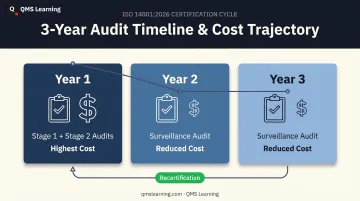
ISO 14001 runs on a 3-year certification cycle, not a one-time payment. The table shows typical first-year costs—setup plus Stage 1 and Stage 2 audits—which are by far the highest. Years 2 and 3 are surveillance audits and cost considerably less.
Key Factors That Affect the Cost of ISO 14001 Certification
Pricing comes down to how many audit days your organization requires and how much internal preparation work sits ahead of the audit. Several variables move that number.
Business Size and Number of Locations
Employee count and site count directly drive auditor day requirements under IAF MD5 guidelines. A company with 5 employees might need just 2.5 audit days; one with over 1,000 could require 20+ days.
Multi-site businesses pay more because:
- Each additional location typically adds audit time
- Travel costs stack up across visits
- Sampling rules (site square-root formulas) still require broader coverage than a single-site audit
Industry and Environmental Risk Level
High-impact sectors like mining, chemical processing, refining, and waste treatment require longer, more specialized audits. Office-based or low-impact service businesses fall into "limited" complexity, meaning fewer audit days and lower cost, even at similar headcounts.
Current EMS Readiness
An organization with existing environmental policies, aspect registers, and training records spends far less on setup than one building an EMS from scratch. Readiness shortens audit time and cuts documentation work billed before the audit starts.
Internal Expertise vs. External Consultants
Many businesses hire consultants to write policies, run gap analyses, and prep staff. Independent consultants typically charge $500 to $1,500 per day, separate from certification body audit fees.
The alternative is building that capability in-house. Train internal EHS staff to handle documentation and gap analysis, or use role-specific EHS training and AI-assisted tools (such as QMS Learning's EHS pathway and Workbench) so your team can produce auditor-ready records without a standing consultant. Upfront training time costs more initially, but it pays off across every recertification cycle. You are not re-buying the same expertise every three years.
Choice of Certification Body
Accredited, IAF-recognized certification bodies operate under independently verified competence standards. Non-accredited "discount" bodies may quote lower fees, but:
- Customers, auditors, and regulators may not recognize the certificate as valid
- You risk needing to re-certify with an accredited body later, paying twice
- Some large contracts specifically require IAF-accredited certification
The cheapest quote isn't always the cheapest outcome.
ISO 14001 Certification Cost Breakdown
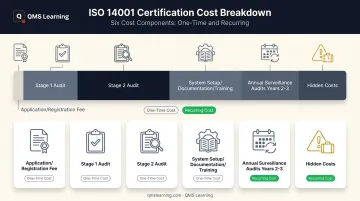
The total cost splits across several distinct line items over the 3-year cycle rather than arriving as one lump-sum invoice.
Application and Registration Fees
One-time. A small upfront fee paid to the certification body to begin the process and schedule your audit dates.
Stage 1 Audit (Documentation Review)
One-time per cycle. This readiness check compares your existing documentation against ISO 14001:2026 requirements. It's typically shorter and less costly than Stage 2, and it flags gaps before the real audit begins.
Stage 2 Audit (Certification Audit)
One-time per cycle. A comprehensive on-site evaluation of how your EMS actually functions day to day. This is usually the single largest line item in your total certification cost.
System Setup, Documentation, and Training
One-time, and the most variable cost. Gap analysis, policy and procedure writing, and staff training fall here. Costs swing dramatically depending on whether you handle this in-house or outsource to consultants at $500–$1,500 per day.
Annual Surveillance Audits (Years 2 and 3)
Recurring. Smaller yearly audits confirm the EMS is still being followed properly. Per IAF MD5 guidance, surveillance audit time runs roughly one-third of the initial Stage 1 plus Stage 2 audit time. These audits are required to keep your certificate valid through the full cycle.
Hidden and Often-Missed Costs
Recurring or variable. Budget for:
- Auditor travel expenses, especially for multi-site operations
- Staff time diverted from core duties during audit prep
- Corrective action rework if nonconformities surface
- Official ISO 14001:2026 standard document (CHF 196, about $220, from ISO)
How to Reduce ISO 14001 Certification Costs
Cost control starts before the auditor ever shows up. A few practical moves make a measurable difference.
Complete a gap analysis first. Organize documentation before scheduling Stage 1. Walking into that audit unprepared often means repeat visits and repeat fees.
Build internal capability instead of leaning entirely on consultants. This is where many organizations overspend year after year. Train EHS and quality staff on ISO 14001 requirements so setup and recertification do not default to outside help.
QMS Learning's Environmental & Safety Compliance pathway supports that shift:
- ISO 14001:2026 training, including clause changes and change-management procedures
- AI Workbench drafts for gap analysis reports and environmental aspects registers
- Manager Dashboard export of a time-stamped Audit-Evidence Package for the auditor
Keep digital, well-organized EMS records. Where you have multiple sites, combine audits when eligible under sampling rules. Well-documented systems mean surveillance audits in Years 2 and 3 run faster and cheaper.
Is ISO 14001 Certification Worth the Cost?
Weigh the upfront investment against real business upside:
- Winning contracts that treat ISO 14001 as a supplier prerequisite
- Lower energy and waste costs from a working environmental management system
- Avoiding regulatory penalties tied to environmental noncompliance
Some large procurement contracts already treat ISO 14001 (or an equivalent) as a pass/fail gate for suppliers bidding above set contract values.
The real return depends on maintaining the EMS through the full 3-year cycle, not treating certification as a one-time checkbox. A certificate earned but not maintained loses its value fast, along with credibility among customers.
That is why cost still has to match how EMS-ready you already are, plus your size and complexity. The right spend balances audit fees against genuine internal capability so the certification holds up well beyond the day the auditor leaves.
Frequently Asked Questions
How much does it cost to get ISO 14001 certified?
Costs typically range from roughly $5,000 for small single-site businesses to $50,000+ for large or complex operations. This spans the full 3-year certification cycle, not just the initial audit.
Is ISO 14001 certification mandatory?
No, ISO 14001 is voluntary in most industries. That said, customers, regulators in certain sectors, and supply chains increasingly require it contractually.
How do I get ISO 14001 certified?
The core steps are: gap analysis, EMS documentation and staff training, then Stage 1 and Stage 2 audits with an accredited certification body. Ongoing surveillance audits follow in Years 2 and 3.
How long does ISO 14001 certification take?
Small, EMS-ready businesses can often complete certification in a few months. Larger or more complex organizations starting from scratch typically need 12 months or more.
Do I need a consultant for ISO 14001 certification?
Consultants are optional and can speed up the process, but they're not free. Expect $500 to $1,500 per day. Many organizations reduce long-term costs by building internal expertise through training instead.
What does it cost to maintain ISO 14001 certification after the first year?
Years 2 and 3 involve smaller annual surveillance audits, which cost less than the initial certification audits. Every three years, a recertification audit is required to keep the certificate active.