Key Takeaways
- FDA's June 2022 EMC guidance applies to all electrically-powered medical devices, including IVDs, with submissions structured under Sections A through K
- IEC 60601-1-2 Edition 4.1 is the primary FDA-recognized standard for non-implantable devices
- AIMDs require ISO 14117 or the ISO 14708 series rather than IEC 60601-1-2
- Immunity pass/fail criteria must be quantitative, device-specific, and observable — not generic "Performance Criterion A" language
- EMC labeling is a regulatory requirement, not optional documentation
- IDE/IND submissions allow alternative mitigations when full conformity testing isn't yet feasible
What Is EMC and How Does It Differ from EMI?
Electromagnetic compatibility (EMC) is a device's ability to function safely and effectively in its intended electromagnetic environment — resisting incoming interference while not generating interference that disrupts other equipment. EMI (electromagnetic interference) is the effect that occurs when EM disturbances exceed a device's immunity threshold. EMC is the design and testing requirement. EMI is what happens when that requirement isn't met.
FDA has documented the consequences. Power-driven wheelchairs moved uncontrollably near certain radio frequencies — FDA testing confirmed that EM-induced brake release posed genuine injury risk. That outcome is EMI in practice — and EMC testing is the mechanism that prevents it from reaching patients.
Two Classes of EM Disturbances
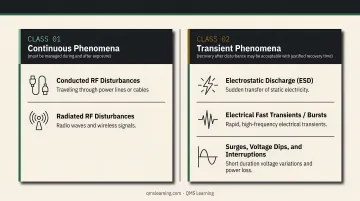
The 2022 FDA guidance categorizes EM disturbances into two broad classes:
Continuous phenomena (must be managed during and after exposure):
- Conducted RF disturbances — traveling through power lines or cables
- Radiated RF disturbances — radio waves and wireless signals
Transient phenomena (recovery after the disturbance may be acceptable with justified recovery time):
- Electrostatic discharge (ESD)
- Electrical fast transients/bursts
- Surges, voltage dips, and interruptions
Why FDA Updated the Guidance in 2022
The 2016 guidance was broad and high-level. The 2022 version added:
- Structured risk assessment requirements aligned with ISO 14971
- Specific direction on submission content organized by section
- Explicit acknowledgment of technology gaps including RFID, NFC, wireless power transfer, and Cellular 5G
- Distinct immunity pass/fail criteria requirements for transient versus continuous phenomena
These updates directly shape what FDA expects in a premarket submission — which is why understanding the 2022 framework is the starting point for any EMC testing program.
Scope: Which Medical Devices Does FDA's EMC Guidance Cover?
The guidance applies to all electrically-powered medical devices and any device with functions or sensors using electrical or electronic circuitry — including IVD products and accessories.
Implementation timeline:
- Non-IVD devices: 60 days after issuance (effective August 5, 2022)
- IVDs: 1 year after issuance (effective June 6, 2023) to allow operational adjustments
The Three Intended Use Environment Categories
FDA classifies devices into one of three environments, and this classification determines which tests and test levels apply:
| Environment | Examples | Key Characteristic |
|---|---|---|
| Professional Healthcare Facility | Hospitals, physician offices, outpatient clinics | Trained personnel continuously available |
| Home Healthcare | Residences, schools, vehicles, outdoor settings | Lay operators; less controlled EM conditions |
| Special Environments | Aircraft, MRI rooms, heavy industrial sites | Unique or extreme EM characteristics |
A device intended for professional healthcare environments faces different test levels than the same device intended for home use — misclassify the environment, and every testing decision downstream is built on the wrong foundation.
What FDA's 2022 EMC Guidance Requires in Premarket Submissions
FDA recommends organizing EMC information in the same order and with the same section headings as the guidance itself — Sections A through K. Where test reports or other submission sections already contain the required information, cross-referencing those locations is acceptable rather than duplicating content.
Three areas drive most of the submission workload: documenting device characteristics and intended use environments, summarizing test results and modifications, and handling IDE/IND submissions during clinical trials.
EMC-Relevant Device Characteristics and Intended Use Environments
Manufacturers must document:
- Device functions and operating modes (with block diagrams and photographs)
- Power supply type — mains, internal, or both, including whether use during charging is possible
- Intended use environments for each device configuration
- Wireless technologies incorporated into the device
- Any intentional RF emitters built in that may produce disturbances
This documentation directly determines the complete scope of required testing.
Testing Results, Allowances, Deviations, and Modifications
Submissions must include a summary of all emissions and immunity test results, identifying which passed and which failed — and how observed degradations were addressed.
Allowances (standard-permitted variations) must include documentation that all conditions of the allowance are satisfied.
Deviations (non-standard approaches) require scientific justification showing no impact on safety or performance.
If a device was modified to pass EMC testing — adding ferrite beads, filters, or shielding, for example — the submission must:
- Describe all modifications made
- Confirm whether test results were captured before or after modification
- Confirm that changes will be incorporated into the finished device per design controls
- Analyze whether modifications affect biocompatibility, sterility, electrical safety, or software
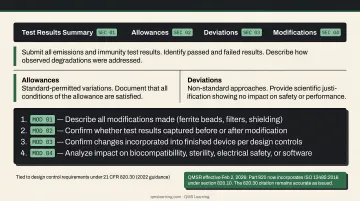
The 2022 guidance ties this documentation to design control requirements under 21 CFR 820.30. One update to note: following the QMSR effective February 2, 2026, Part 820 now incorporates ISO 13485:2016 requirements under section 820.10. The 820.30 citation remains accurate as a reference to what the guidance stated when issued.
IDE and IND Submissions
Full conformity testing to consensus standards may not be feasible during clinical trials, since device designs often iterate. FDA permits alternative mitigations for IDE/IND submissions, including:
- Ad-hoc or limited EMC testing
- Labeling mitigations such as continuous medical oversight requirements
- ESD precautions
Manufacturers must still describe potential emission risks and justify how each is controlled.
Consensus Standards for EMC Testing
The applicable standard depends on device type and intended use environment. The table below summarizes the primary FDA-recognized standards:
| Standard | Scope | FDA Recognition |
|---|---|---|
| IEC 60601-1-2 Ed. 4.1 (2020) | Non-implantable medical devices | Rec# 19-36, partial recognition |
| ISO 14117:2019 | Cardiac pacemakers, ICDs, CRT devices | Rec# 3-161, complete |
| ISO 14708 series | Active implantable medical devices (AIMDs) | Individual part entries |
| IEC 61326-1:2020 | IVD and laboratory equipment | Rec# 19-42, partial recognition |
| IEC 61326-2-6:2020 | Point-of-care IVD devices | Rec# 19-43, partial recognition |
| RTCA DO-160 | Aircraft environments | Recommended for aircraft use |
| ISO/TS 10974:2018 | MRI environment assessment for AIMDs | Listed as complete |
Critical Notes on Partial Recognitions
Before finalizing your testing plan, note these key limitations and transition details:
- IEC 60601-1-2 partial recognition excludes Figure 3's treatment of nursing homes as a home healthcare example, and excludes Table 8 note k's exemption of SIP/SOP cables shorter than 1 m from conducted RF testing
- IEC 61326-2-6:2020 declarations are accepted through July 2, 2028 during transition to the fully recognized 2025 Edition 4.0 (Rec# 19-57)
- IVDs: FDA recommends acceptance criteria specific to device functions and test levels from 60601-1-2 — even though IVDs fall outside 60601-1-2's scope — or levels derived from measured environmental conditions
- IEC 60601-2-X / ISO 80601-2-X series: Check the FDA recognized standards database to confirm each standard is recognized and appropriate for the device's intended use environment before building your testing plan
Essential Performance, Risk Assessment, and Immunity Pass/Fail Criteria
Defining Essential Performance
Essential Performance (from ANSI/AAMI ES 60601-1) is the performance of a clinical function where loss or degradation beyond manufacturer-specified limits results in unacceptable risk.
FDA's three-step determination process:
- Identify the performance of each clinical function
- Specify the limits separating fully functional performance from loss or degradation
- Evaluate the risk of loss, disruption, deviation, or over-delivery — if the risk is unacceptable, that function qualifies as Essential Performance
Structured Risk Assessment Under ISO 14971
The 2022 guidance elevated risk assessment from a background consideration to a formal, structured step. Manufacturers must provide a summary of EMI-caused malfunction risks, categorized into three severity levels:
- Deaths and serious injuries
- Non-serious adverse events
- Events without reported or potential harm
This categorization directly determines the immunity test levels required and what labeling mitigations are necessary. Devices in the "deaths and serious injuries" category face the most demanding testing requirements.
Immunity Pass/Fail Criteria Requirements
That severity classification carries through into how pass/fail criteria are designed. Criteria must be:
- Quantitative — specify measurable values, not categories
- Device- and function-specific — generic "Performance Criterion A" language alone is insufficient
- Observable — the degradation or failure must be detectable during testing
For transient phenomena (ESD, electrical fast transients, voltage dips): recovery after the disturbance may be acceptable, provided a specific recovery time is justified by risk analysis.
For continuous phenomena (conducted and radiated RF): the device must maintain specified performance during the disturbance, not just recover after it.
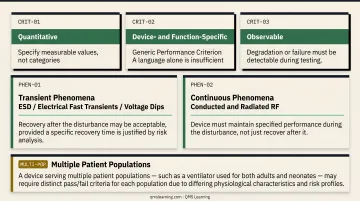
If a device serves multiple patient populations — a ventilator used for both adults and neonates — each population may require distinct pass/fail criteria due to differing physiological characteristics and risk profiles.
EMC Labeling and Common Electromagnetic Emitters
Device labeling — user manuals, instructions for use, technical manuals, and physical markings — must communicate specific EMC information to ensure safe use in the intended environment. Required content includes:
- Intended use environments for which the device is suitable
- Compatible accessories with which EMC was established
- Expected performance degradation during EM disturbances and how to identify it
- Compliance levels for each emissions and immunity test
- Any deviations or allowances from referenced standards
- Precautions, separation distances, or other measures for EM sources exceeding tested levels
- Wireless specifications where applicable
Those labeling obligations become more complex when the device will operate near emitters that existing recognized standards don't fully address.
Common Emitters That Recognized Standards May Not Fully Address
FDA's 2022 guidance explicitly identifies the following emitters as not adequately covered:
- RFID readers and metal detectors/EAS systems
- NFC and wireless power transfer (WPT)
- Cellular 5G
- Electrocautery, MRI systems, electrosurgical units, and diathermy equipment
Devices in the "deaths and serious injuries" risk category require immunity testing to FDA-recognized standards for each foreseeable emitter. Devices in the lowest risk category require, at minimum, a labeling mention.
MR Safety Marking and FCC Language
A device expected to enter the MR environment that has not been demonstrated MR Safe or MR Conditional must be marked MR Unsafe using the ASTM F2503 symbol.
When FCC Part 15 labeling uses the term "harmful interference," FDA recommends adding a clarifying note. The FCC definition — interference that endangers radionavigation or safety services, or seriously degrades radio communication — differs from the risk management definition under ISO 14971. Without that clarification, users may misinterpret the label's intent.
Frequently Asked Questions
What are the EMC standards for medical devices?
IEC 60601-1-2 Edition 4.1 is the primary standard for non-implantable devices. AIMDs require ISO 14117 (cardiac devices) or the ISO 14708 series. IVDs and lab equipment reference IEC 61326-1 and IEC 61326-2-6, and devices intended for aircraft use should reference RTCA DO-160.
What is 21 CFR 820.30 and why does it matter for EMC?
21 CFR 820.30 requires manufacturers to document all design changes in the design history file. For EMC, any modification made to pass testing — shielding, filters, ferrite beads — must be recorded there and confirmed as incorporated into the finished device before marketing.
What is the difference between EMI and EMC?
EMI is the effect — the disruption of device performance caused by electromagnetic disturbances. EMC is the design property and testing standard that ensures a device can operate in its EM environment without being disrupted and without disrupting other equipment.
Does FDA EMC guidance apply to in vitro diagnostic devices?
Yes. IVDs fall within the scope of the June 2022 guidance, but with an extended implementation date of June 6, 2023 — one year after issuance — compared to 60 days for other device types.
What is Essential Performance in EMC testing?
Essential Performance is the clinical function of a device where loss or degradation beyond manufacturer-specified limits creates unacceptable patient risk. Manufacturers must identify, quantify, and build immunity pass/fail criteria around it in any submission referencing the IEC 60601 family of standards.
What should EMC labeling include?
Required elements include intended use environments, compatible accessories, expected performance degradation during EMI, compliance levels for each test performed, deviations or allowances used, precautions for high-EM sources, and wireless specifications if applicable.