The financial stakes are real. IBM's 2025 Cost of a Data Breach Report puts the global average breach cost at $4.44 million. On the privacy enforcement side, DLA Piper's January 2025 GDPR survey reported €5.88 billion in GDPR fines since enforcement began — with an average of 363 breach notifications per day.
Understanding the difference between these two disciplines isn't academic. It's what keeps your compliance program from having a dangerous blind spot.
Key Takeaways
- Data privacy governs who can collect, use, and share personal information — it's rights-driven and regulatory
- Cybersecurity protects systems and data from unauthorized access — it's technical and defensive
- A system can be secure yet still violate privacy law
- A privacy policy means nothing if the underlying data is exposed
- Defense contractors face legal obligations across both domains simultaneously under CMMC, DFARS, and related frameworks
- Treating them as separate silos creates compliance gaps — the two disciplines must coordinate
Data Privacy vs. Cybersecurity: Quick Comparison
| Dimension | Data Privacy | Cybersecurity |
|---|---|---|
| Primary focus | Individual rights over personal data | Protection of systems and data from threats |
| Scope | How data is collected, used, shared, retained | How data is accessed, transmitted, and secured |
| Governing frameworks | GDPR, CCPA/CPRA, HIPAA Privacy Rule, FERPA | CMMC, NIST 800-171, ISO 27001, SOC 2 |
| Organizational owner | Legal, compliance, privacy officers | IT, CISOs, security operations |
| Core tools | Consent management, privacy notices, DSARs | Firewalls, MFA, encryption, incident response |
| Core question | Do we have the right to use this data? | Is this data protected from unauthorized access? |
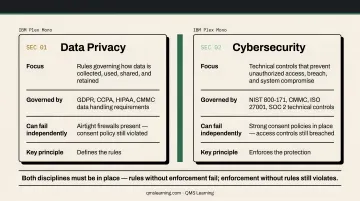
Put simply: data privacy defines the rules; cybersecurity enforces the protection. An organization can have airtight firewalls and still violate privacy law — and strong consent policies won't stop a breach if access controls fail. Both disciplines must be in place.
What Is Data Privacy?
Data privacy is the set of individual rights and organizational obligations that govern how personal information is collected, stored, used, and shared. It is regulatory and rights-driven — not technical in nature.
The core questions data privacy answers:
- Do we have a lawful basis to collect this data?
- Who consented, and how?
- How long can we retain it?
- Who inside (and outside) the organization can access it?
- Can the individual request deletion or correction?
Key Privacy Frameworks
| Framework | Applies To | Core Obligations |
|---|---|---|
| GDPR | EU establishments; non-EU orgs serving EU residents | Lawful basis for processing, data subject rights, breach notification, appropriate security measures |
| CCPA/CPRA | CA businesses over $26.625M revenue or handling 100K+ residents' data | Right to know, delete, opt out; reasonable security requirements |
| HIPAA Privacy Rule | Healthcare covered entities and business associates | Limits PHI use/disclosure; patient access, amendment, and complaint rights |
| FERPA | Schools receiving federal education funding | Parents and eligible students control access to education records |
How Privacy Obligations Show Up in Practice
Privacy compliance shows up in day-to-day operations — not in security tools:
- Consent management banners on websites and apps
- Privacy notices disclosing how and why data is collected
- Data subject access requests (DSARs) — responding when individuals ask what data you hold
- Data minimization policies — collecting only what's necessary
- Retention schedules — deleting data when its purpose is fulfilled
Ownership sits with legal and compliance teams. For organizations that also handle technical data or CUI, that distinction matters — privacy obligations don't disappear because a cybersecurity control is in place.
Defense Contractor Context
For defense contractors, privacy obligations surface through DFARS clauses and CUI handling requirements. The NARA CUI Registry includes a Privacy category — covering Sensitive Personally Identifiable Information and Health Information — so contractors handling those categories face a direct overlap between CUI safeguarding obligations and data privacy law.
What Is Cybersecurity?
Cybersecurity is the technical and operational discipline focused on protecting systems, networks, and data from unauthorized access, cyberattacks, ransomware, and breaches. Where privacy defines the rules, cybersecurity enforces the protection.
The CIA Triad
Every cybersecurity program is built around three pillars:
- Confidentiality — only authorized users can access data
- Integrity — data is accurate, complete, and unaltered
- Availability — data and systems are accessible when needed
All three must hold. A ransomware attack destroys availability. A misconfigured database destroys confidentiality. Unauthorized data modification destroys integrity — and losing any one of them can trigger a reportable incident under frameworks like CMMC or DFARS.
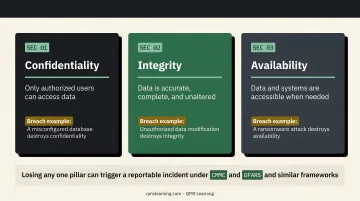
The CIA Triad describes what security must protect. The tools and methods below describe how organizations actually enforce it.
Cybersecurity Tools and Methods
| Tool / Method | Problem It Solves |
|---|---|
| Firewalls | Blocks unauthorized network traffic |
| Encryption | Protects data in transit and at rest |
| Multi-factor authentication (MFA) | Prevents credential-based unauthorized access |
| Identity and access management (IAM) | Controls who can access which systems |
| Endpoint detection and response (EDR) | Identifies and contains threats on devices |
| Incident response planning | Defines the response when a breach occurs |
Cybersecurity in Regulated Industries
Defense contractors face some of the most specific cybersecurity requirements in any industry:
- CMMC Level 2 — 110 NIST SP 800-171 Rev. 2 requirements across 14 control families, with third-party C3PAO assessment required for specified contracts
- DFARS 252.204-7012 — adequate security for covered defense information, NIST 800-171 compliance, and 72-hour incident reporting after discovery
- ISO/IEC 27001:2022 — requires organizations to build and maintain a documented information security management system (ISMS) — covering risk treatment, controls, and ongoing performance review
- SOC 2 — AICPA examination of service-organization controls across five Trust Services Categories, including security and availability
In defense contractor environments, these requirements aren't optional — they're contractual. Cybersecurity ownership sits with IT teams and CISOs, but every step of the incident response lifecycle (detection → containment → eradication → recovery → reporting) must be documented and auditable to satisfy DFARS and CMMC obligations.
Key Differences Between Data Privacy and Cybersecurity
The single most important distinction: cybersecurity can exist without data privacy, but data privacy cannot be effectively delivered without cybersecurity.
A secured system can still collect and misuse personal data unlawfully. But privacy commitments are meaningless if the data is exposed through a breach.
Three Scenarios That Illustrate the Difference
Scenario 1: Privacy violation, not a security failure An organization uses strong encryption and access controls, but collects customer data without a lawful basis and without disclosing its purpose. The systems are secure. The privacy violation is real.
Scenario 2: Security failure, not a privacy failure A company with proper consent processes and privacy notices gets hit by ransomware. The privacy program is sound. The security failure caused a breach notification obligation.
Scenario 3: Both simultaneously A phishing attack results in unauthorized disclosure of personal data. It's a security failure because the attack succeeded. It's also a privacy breach because personal data is now in unauthorized hands — triggering both cybersecurity incident response and regulatory notification obligations.
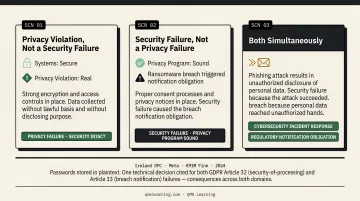
Ireland's DPC fined Meta €91 million in 2024 after passwords were stored in plaintext — an example where the enforcement decision cited both security-of-processing failures (GDPR Article 32) and breach notification failures (Article 33). One technical decision produced consequences across both domains.
Regulatory Consequences Are Different
| Domain | Consequence of Failure |
|---|---|
| Data privacy | Regulatory fines (GDPR, CCPA, HHS), private rights of action, corrective action plans |
| Cybersecurity | Breach notification obligations, contract termination, False Claims Act exposure, CMMC assessment failure |
When both are triggered simultaneously, the response requires legal, compliance, and security teams working from the same playbook — not separate tracks that collide during a live incident.
Organizational Ownership Gap
These disciplines have different owners inside most organizations:
- Data privacy: legal, compliance, and privacy officers
- Cybersecurity: IT and security teams
Both sides must coordinate. Incident response plans require input from each function, and breach notification obligations sit directly at the intersection of the two domains. When they operate in silos, the gaps show up in incomplete breach response plans and audit findings that span both areas simultaneously.
How Data Privacy and Cybersecurity Work Together in Regulated Industries
GDPR Article 32 requires "appropriate technical and organizational measures" to protect personal data. That language directly links legal privacy obligations to cybersecurity controls. For any organization subject to data protection law, the two frameworks are functionally inseparable.
Defense contractors feel this intersection most acutely. CMMC mandates cybersecurity controls for CUI protection. DFARS 252.204-7012 introduces reporting obligations — including a 72-hour incident reporting window — that require both technical response capability and coordinated legal notification. DFARS 252.204-7009 separately limits how cyber incident information can be used and disclosed. Teams that understand only the technical side will miss the compliance implications; teams that understand only the legal side won't be able to execute incident response.
The Silo Problem
The most common organizational mistake: treating privacy and cybersecurity as entirely separate programs with no shared accountability. The practical consequences:
- Incomplete breach response plans — IT responds technically, but notification obligations are missed or delayed
- Audit findings that span both domains — a C3PAO assessor finds an SSP gap; a separate regulator finds a privacy notice gap; neither team knew the other had a problem
- Regulatory fines after technical incidents — a security failure triggers a privacy disclosure obligation that no one planned for
Penn State paid $1.25 million in 2024 to resolve False Claims Act allegations tied to inaccurate cybersecurity assessment scores on DoD and NASA contracts — demonstrating that cybersecurity compliance failures carry legal and financial consequences well beyond the technical domain.
Building Dual Competency
For teams in the defense industrial base, closing both gaps requires verified competency in the controls those frameworks require — not awareness-level training. QMS Learning's Defense Cybersecurity Readiness pathway (pilot cohort opening Q3 2026) bundles the four frameworks defense teams are most commonly audited against:
- CMMC & NIST 800-171
- ISO 27001 ISMS
- SOC 2 Compliance
- Data Privacy (GDPR/CCPA)
The program is designed for CISOs, IT directors, compliance officers, and program managers who need to operate across both disciplines. The AI Workbench generates SSP sections, POA&M entries, and incident response runbooks — all trained on NIST SP 800-171, CMMC assessment guides, and DFARS clause flow-down requirements.
Conclusion
Data privacy and cybersecurity are complementary disciplines with distinct but interdependent purposes. Privacy defines what you're allowed to do with personal data. Cybersecurity ensures that data is protected while you do it. Neither replaces the other.
The practical next step: map which regulatory obligations apply to your organization. Common frameworks to assess include:
- GDPR or CCPA — data handling rights, consent obligations, and breach notification
- CMMC and DFARS — cybersecurity maturity controls for defense contractors
- HIPAA Privacy and Security Rules — applicable to healthcare data across both disciplines
Once mapped, verify that your team has documented competency in the controls those frameworks require — not just completion certificates.
Organizations that staff and train each discipline in isolation will have gaps. Auditors, regulators, and threat actors are counting on that. QMS Learning's Defense Cybersecurity pathway — covering CMMC, NIST 800-171, and data privacy obligations — is built to close that gap with role-specific training and audit-ready evidence your team can produce on demand.
Frequently Asked Questions
What is the difference between data privacy and data security?
Data privacy governs how personal information is collected, used, and shared under legal frameworks — it's about rights and lawful processing. Data security (a component of cybersecurity) focuses on the technical controls that prevent unauthorized access to that information. An organization can have strong security controls and still violate privacy law — the two obligations don't overlap as much as most teams assume.
What are the three pillars of the CIA Triad?
The CIA Triad stands for Confidentiality (only authorized users access data), Integrity (data is accurate and unaltered), and Availability (data is accessible when needed). Cybersecurity programs are built to protect all three at once.
Can you have cybersecurity without data privacy?
Yes. An organization can secure its systems against external threats while still collecting or using personal data in ways that violate privacy laws. Security controls don't create a lawful basis for data processing — which is why security compliance alone does not equal regulatory compliance.
Is CMMC a data privacy or cybersecurity standard?
CMMC is a cybersecurity standard focused on protecting Controlled Unclassified Information (CUI) in the defense supply chain. However, DoD contractors may also face separate data handling and privacy obligations under DFARS clauses — making both domains relevant to any complete compliance program.
What US regulations govern data privacy?
The US has no single federal privacy law. Key sector-specific laws include HIPAA (healthcare), FERPA (education), GLBA (financial services), and COPPA (children's data). At the state level, CCPA and CPRA are the most comprehensive. Which laws apply depends on your industry, the states you operate in, and the type of data you process.
Do defense contractors need to comply with both cybersecurity and data privacy requirements?
Yes. Defense contractors must meet CMMC and NIST 800-171 for cybersecurity, while DFARS clauses add CUI handling and breach notification obligations on the privacy side. Those processing international or commercial data alongside CUI may also face GDPR or CCPA requirements — gaps in either domain can trigger audit findings or contract consequences.