Introduction
A CMMC Level 2 assessment can decide whether your company keeps a six or seven-figure DoD contract, or loses eligibility for future awards entirely. The stakes are that direct.
Most organizations that fail do so because staff couldn't answer assessor questions correctly, or because the System Security Plan didn't match what was actually happening on the floor. Missing firewalls and unpatched servers are rarely the real problem.
The DoD estimates 8,350 medium and large entities will need a Level 2 C3PAO assessment under the finalized rule.
This guide covers what the assessment actually requires, how to prepare, what happens during the on-site review, the mistakes that sink otherwise-solid programs, and what to expect once the assessor leaves.
Key Takeaways
- Level 2 evaluates all 110 NIST SP 800-171 security requirements, typically through third-party C3PAO review
- Documentation gaps and unprepared staff cause more failures than missing technology
- Preparation commonly runs six to nine months, starting with defining your CUI scope
- A score of 88/110 only unlocks Conditional status; Final certification requires every applicable requirement Met
- Eligible gaps get 180 days to close through a Plan of Action & Milestones
What Is a CMMC Level 2 Assessment?
A CMMC Level 2 assessment confirms your organization meets all 110 security requirements in NIST SP 800-171 Rev. 2, the standard built to protect Controlled Unclassified Information (CUI). For most Level 2 contracts, this evaluation comes from an authorized C3PAO, not your own internal team.
Who has to comply? Any prime contractor or subcontractor that processes, stores, or transmits CUI under DFARS 252.204-7012 falls into scope. That clause flows down without alteration to subcontracts, meaning a supplier three tiers removed from the government can still face the same certification bar as the prime.
Level 2 sits in the middle of the CMMC framework:
- Level 1 – Self-assessed, covers Federal Contract Information (FCI) only
- Level 2 – C3PAO or self-assessed by contract terms; covers CUI; all 110 NIST 800-171 practices
- Level 3 – Government-led assessment for the highest-priority CUI, built on top of Level 2
Thousands of medium and large defense contractors will need a formal C3PAO review. That figure excludes smaller subcontractors pursuing Level 2 (Self) where contracts allow it.
CMMC Level 2 Requirements at a Glance
Every Level 2 requirement traces back to the 110 practices in NIST SP 800-171 and the objectives in NIST SP 800-171A. Practitioners often cite roughly 320 individual assessment objectives across those practices.
Key Security Domains Covered
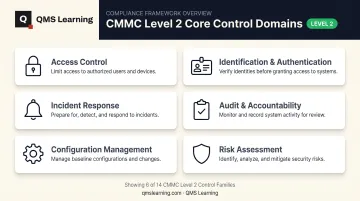
Assessors evaluate 14 control families in total. These carry the most weight in practice:
- Access Control – who can reach CUI and under what conditions
- Identification & Authentication – how users and devices prove who they are
- Incident Response – detection, reporting, and recovery procedures
- Audit & Accountability – logging and traceability of system activity
- Configuration Management – controlling changes to systems handling CUI
- Risk Assessment – ongoing evaluation of threats to CUI
Assessors score each practice with three methods:
- Examine – review documents and system configurations
- Interview – talk with personnel who operate the controls
- Test – verify a control works as described
A practice is marked Met only when every applicable objective is satisfied. One failed objective marks the entire practice Not Met.
No official statistic tracks average first-attempt findings. Practitioners who sit through these assessments see the same pattern: gaps rarely come from exotic technical failures. They show up where documentation and daily practice have drifted apart.
How to Prepare for a CMMC Level 2 Assessment
Realistic preparation timelines vary by organization, but CyberSheath's CEO told National Defense magazine that six to nine months is typical, with one accelerated case completing prep in around four months. Start by defining your CUI boundary and asset categories under 32 CFR 170.19 before anything else.
Schedule your C3PAO scoping call early. Use it to confirm which cloud providers and MSPs fall inside your assessment boundary before evidence collection begins.
Build and Validate Your System Security Plan
Your SSP needs to document implementation status for all 110 practices, and it has to match what assessors actually find on-site. A plan that says one thing while the network does another is one of the fastest routes to a Not Met finding.
Framework-specific tools reduce that mismatch risk. QMS Learning's AI Workbench is trained on NIST SP 800-171, CMMC assessment guides, and DFARS flow-down requirements. It can draft SSP sections that stay aligned with the underlying controls as your environment changes.
Conduct an Internal Gap Analysis and Pre-Assessment Dry Run
Run a mock assessment against the full set of NIST 800-171A objectives before the real C3PAO arrives. This surfaces:
- Weak or missing evidence for specific practices
- Undocumented practices that exist informally but aren't written down
- Gaps between what policy says and what staff actually do
Assemble and Organize Your Evidence Package
C3PAO assessors need proof, not assertions. Core evidence includes:
- Signed, current policies mapped to specific controls
- Network and data flow diagrams showing CUI paths
- Access logs demonstrating enforcement, not just configuration
- Training records tied to relevant personnel and dates
A clause-mapped document management system removes a lot of the scramble here. QMS Learning's Controlled Document Management System maps procedures directly to NIST 800-171 controls and exports an indexed audit-evidence package on demand.
Train Your Team to Handle Assessor Interviews with Confidence
SMEs across IT, security, and management need to answer questions accurately, without volunteering extra scope-expanding details. Documentation-only prep consistently falls short here.
QMS Learning's Defense Cybersecurity Readiness pathway (pilot cohort opens Q3 2026) closes that gap. It covers all 14 control families alongside SSP development and C3PAO preparation.
The CMMC Level 2 Assessment Process and Scoring
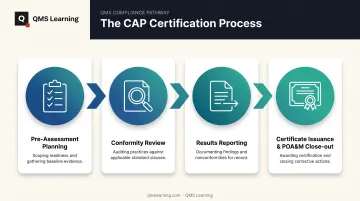
The CMMC Assessment Process (CAP) runs through four phases, as described by A-LIGN:
- Pre-assessment planning – scoping, evidence review, logistics
- Conformity review – the actual on-site or remote evaluation
- Results reporting – documenting findings and scores
- Certificate issuance and POA&M close-out – final status and any remaining remediation
What Happens During the On-Site Assessment
Assessors typically spend multiple days on-site reviewing documentation, interviewing personnel across departments, and testing technical controls directly—not taking your word for it.
Expect daily debriefs on emerging Not Met findings. That window is your chance to surface additional evidence before the report locks in.
How the SPRS Scoring System Works
Scoring starts at 110 and deducts points for unimplemented requirements, with deductions of 1, 3, or 5 points depending on the practice's security value. Two thresholds matter most:
- 88/110 unlocks Conditional Level 2—only if no single POA&M item is worth more than one point
- Final Level 2 requires every applicable requirement Met (a full 110)
Certain controls, like maintaining a System Security Plan and managing physical access, can never move into a POA&M. They must be fully implemented at the time of assessment.
Those scoring outcomes also drive what you should budget for. Based on DoD's own regulatory cost modeling, a small entity's three-year total (initial assessment plus recurring affirmations) is about $104,670. Other-than-small entities can expect closer to $117,768 over the same period.
Common Mistakes That Cause CMMC Level 2 Assessments to Fail
Most failures come from a short list of avoidable errors, not obscure technical gaps.
Misaligned SSP vs. Actual Practices
An SSP claiming multi-factor authentication is enforced everywhere means nothing if testing shows privileged accounts logging in with a password alone. That mismatch gets flagged fast, and it damages credibility on every other claim in the document.
Weak or Incomplete Evidence Documentation
A policy statement isn't evidence. Assessors want proof of execution: training logs, screenshots, ticket histories. Without it, even a genuinely implemented control gets marked Not Met.
Untrained Staff Freezing or Over-Answering During Interviews
An employee who casually mentions a shared drive storing CUI, when that drive was never part of the defined scope, hands the assessor a new system to evaluate. That single remark expands the assessment boundary on the spot. Structured interview practice and role-specific training prevent this before it costs certification.
Incorrect Scoping Leading to Unnecessary Compliance Burden
Over-scoping pulls unrelated systems into the assessment, driving up cost and complexity. Under-scoping leaves real CUI exposure unprotected and unassessed. Neither error is cheap to fix mid-process.
Treating Certification as a One-Time Checkbox
Assessors look for a living program, not a one-time audit performance. Missing continuous monitoring records, stale training logs, and skipped annual affirmations are common Not Met findings. Ongoing compliance requires:
- Continuous monitoring of implemented controls
- Annual affirmations of compliance status
- Refreshed training as staff turn over and regulations shift
What Happens After the Assessment: POA&M, Remediation, and Certification
Your score determines what happens next. Three paths are common:
- 88 or above (minor gaps only): You can receive Conditional Level 2 status and work a Plan of Action & Milestones (POA&M). Every eligible item must be remediated, evidenced, and verified in a closeout assessment within 180 days of the conditional date.
- Below 88: You get neither Conditional nor Final status. Full remediation, a new application, and a full C3PAO reassessment are required—and assessor availability can add months.
- Missed 180-day POA&M window: Conditional status expires. You stay ineligible for new awards that require that status until you earn it again.
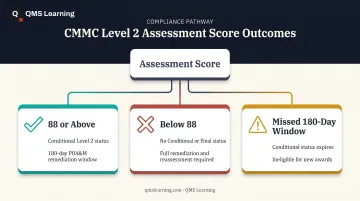
Final Level 2 certification follows only after all required controls are met and any conditional findings are closed on time.
Frequently Asked Questions
What is a CMMC Level 2 assessment?
A CMMC Level 2 assessment is a C3PAO evaluation confirming your organization meets all 110 NIST SP 800-171 security requirements needed to protect Controlled Unclassified Information. Most DoD contracts requiring CUI handling mandate this level.
Who needs to be CMMC Level 2 certified?
Prime contractors and subcontractors that process, store, or transmit CUI under DFARS 252.204-7012 need Level 2 certification. The requirement flows down through the contract chain unaltered.
What is the minimum score needed to pass a CMMC Level 2 assessment?
A score of 88/110 unlocks Conditional status, provided no single POA&M item exceeds one point. Final Level 2 status requires every applicable requirement to score as Met.
What happens if my organization fails the CMMC assessment?
Remediate the gaps, update your evidence, and schedule a full reassessment with a C3PAO. Rescheduling and completing that process can take several months.
How long does it take to get CMMC Level 2 certified?
Most organizations spend six to nine months preparing, depending on existing security maturity and how well-organized their evidence already is. Some accelerated cases complete prep closer to four months.
Can our organization conduct its own CMMC Level 2 assessment?
Usually not. Most Level 2 contracts require certification from an authorized C3PAO. Self-assessment applies only to Level 2 (Self) scenarios specified in the contract, unlike Level 1.