Introduction
Counterfeit parts aren't a theoretical risk in aerospace and defense electronics. ERAI's 2025 Annual Report logged 748 suspect-counterfeit and nonconforming parts across its reporting database (ERAI, 2025 Annual Report).
That figure is down from 1,055 in 2024, but bad material still enters the supply chain at a steady rate.
Most quality teams treat AS6081 as a box to check during registration. The real challenge shows up later: knowing exactly which tests apply to a given lot, when they're triggered, and how much documented evidence satisfies a customer or registrar auditor.
This article breaks down the risk-based test selection framework behind AS6081, the specific test methods it references, the documentation auditors actually request, and how the standard fits alongside AS5553 and AS6171.
Key Takeaways
- AS6081 requires risk-based test selection, not a single universal checklist
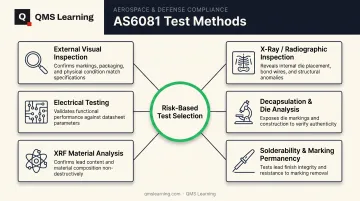
- Core methods cover visual, X-ray, electrical, decapsulation, XRF, and solderability checks
- Sample size, acceptance criteria, and disposition records create objective test evidence
- AS6081 works alongside AS5553 (OEM programs) and AS6171 (test methods) — it doesn't replace either
- Evaluating supplier test-report adequacy matters as much as running the tests
What Is AS6081 and How It Relates to AS5553 and AS6171
AS6081A is SAE's current standard for counterfeit avoidance, detection, mitigation, and disposition. Published April 21, 2023, it applies to independent distributors and brokers that procure electrical, electronic, and electromechanical (EEE) parts in the open market (SAE International, AS6081A). It replaced the original 2012 edition.
Testing sits at the center of this standard because suspect counterfeit parts require objective, testable proof. A part that "looks right" isn't evidence — a documented test result is.
Where Each Standard Fits
| Standard | Governs | Applies To |
|---|---|---|
| AS5553 | Organization-level counterfeit avoidance program | OEMs and integrators sourcing parts |
| AS6081A | Sourcing, risk assessment, and testing controls | Independent distributors and brokers |
| AS6171A | Detailed test procedures and equipment thresholds | Labs performing the actual testing |
AS6171A is the companion "test methods standard." When AS6081 says a part needs X-ray inspection, AS6171's slash sheets (like AS6171/5 for radiological methods) define how that inspection is actually performed and evaluated.
DLA ties this together directly. Under its Qualified Testing Suppliers List (QTSL) program, independent distributors supplying certain semiconductor and microcircuit categories without approved-manufacturer traceability must run a counterfeit-mitigation program that conforms to the latest AS6081. They must also test using AS6171 methods (DLA QTSL Booklet). That is a defined qualification requirement, not a blanket rule for every DLA supplier.
The Risk-Based Framework for Selecting AS6081 Test Methods
Here's the part most teams miss: AS6081 doesn't hand you one fixed test suite to run on every lot. It requires a documented risk assessment that determines which methods apply.
Key risk factors driving that assessment include:
- Part obsolescence status (active production vs. end-of-life)
- Source reliability tier — OCM-authorized channel vs. gray-market broker
- Criticality of the part's end application (flight-critical vs. non-critical)
- Prior history of counterfeit incidents for that part number or manufacturer
Flow-Down and Risk Mitigation Levels
Customer or contract flow-down requirements often push testing rigor beyond the standard's baseline. A prime contractor's purchase order might mandate decapsulation on a part that would otherwise only need visual and electrical screening.
This creates tiered risk mitigation levels:
- Low-risk, traceable sources — basic screening (visual, documentation review)
- Moderate risk — added electrical and X-ray testing
- High-risk or obsolete-part sources — full test suite, potentially including decapsulation and XRF
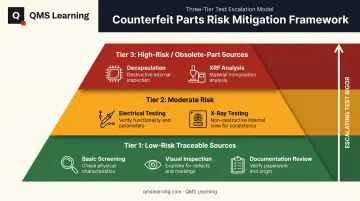
A documented Counterfeit Parts Control Plan ties these tiers together. It specifies exactly which test method applies for each risk scenario, so testing decisions aren't made ad hoc on the receiving dock.
That same risk logic is sharper under AS6081A-2023, which expanded expectations around risk assessment, reporting, and traceability compared with the 2012 release. The public SAE record confirms the title and scope changed to match this broader focus; for exact clause-level wording, use the licensed standard text.
Test selection also decides whether in-house testing is enough or whether you need an accredited third-party lab that meets AS6171 requirements. Part criticality and in-house equipment capability usually drive that call.
The Required AS6081 Test Methods Explained
External Visual Inspection and Documentation Review
External visual inspection is the first-line screen. Inspectors check markings, packaging, date codes, logos, and lot paperwork against known OCM reference data.
It is fast and low-cost, and it flags many obvious counterfeits: mismatched fonts, inconsistent lot codes, or packaging that does not match the manufacturer's known standard.
X-Ray/Radiographic Inspection
X-ray shows what visual inspection cannot: internal die attach, bond wire routing, and package construction. Inspectors use it to catch reworked or resurfaced packages where the outside looks legitimate but the internals do not match the exemplar part.
Electrical Testing (Parametric and Functional)
Electrical testing confirms the part performs to datasheet specification, not merely that it looks correct.
For high-reliability applications, testing often includes temperature cycling and environmental stress screening. That step catches parts that pass at room temperature but fail under operational conditions.
Decapsulation and Internal Die Analysis
Decapsulation is destructive and sample-based, reserved for high-risk or high-value lots. Technicians open the package and compare die markings to verified OCM die photos.
It is the most conclusive test available, but you cannot run it on every unit without destroying inventory.
XRF (X-Ray Fluorescence) Material Analysis
XRF verifies lead-free and RoHS plating composition. It catches remarked, re-tinned, or refurbished parts that claim RoHS compliance they do not have, or that have been dressed to look newer than they are.
Solderability and Marking Permanency Testing
Solderability testing confirms leads properly accept solder, a practical functional check that is easy to skip. Marking permanency testing checks whether markings rub off under light abrasion, a common sign of a hastily remarked counterfeit.
Labs rarely rely on one method alone. AS6081 test plans combine these screens based on supplier risk, part criticality, and lot value so you apply destructive analysis only where the risk justifies it.
Documentation, Sample Size, and Acceptance/Rejection Criteria
Running the right test means nothing without the paperwork behind it. AS6081 requires a documented test plan for each lot specifying:
- The method(s) used
- The sample size pulled from the lot
- Defined pass/fail criteria applied to the results
Disposition tracking is equally non-negotiable. Parts must be traceable from initial testing through final disposition — release, quarantine, or destruction — with a complete audit trail connecting each decision back to test data.
Confirmed counterfeit parts must be reported to GIDEP, and affected supply chain stakeholders need notification so the same suspect lot doesn't quietly resurface at another buyer.
Auditors and OEM customers treat this package as objective evidence during supplier qualification and registrar audits:
- Documented test plan (methods and pass/fail criteria)
- Sample size record for the lot
- Disposition trail (release, quarantine, or destruction)
- GIDEP filing and stakeholder notifications
A distributor who can produce these records on request is audit-ready; one who can only describe the process verbally is not.
Who Must Comply and How to Build Audit-Ready Testing Capability In-House
AS6081 compliance touches two distinct groups:
- Independent distributors and brokers required by DLA qualification programs or OEM contracts to test and document
- OEM and procurement quality teams who must qualify those distributors and audit their testing programs on an ongoing basis
Judgment is the common failure point, not knowledge. Quality teams can usually recite the required test list from memory. What trips them up is standing in front of a distributor's test report and deciding whether the sample size, acceptance criteria, and documentation are adequate for that specific risk scenario. That skill is different from memorizing a checklist.
QMS Learning's Aerospace & Defense Audit-Ready pathway targets that gap. It bundles three courses:
- AS9100D Internal Auditor
- ITAR Compliance
- Counterfeit Parts Avoidance — 6 modules and 31 lessons on SAE AS6174 and AS6081 detection methods, supplier control programs, receiving-inspection workflows, and traceability documentation
The pathway's AI Workbench Method Router guides teams through supplier qualification, gap analysis, and nonconformity reporting, and generates audit checklists tailored to the applicable standard.
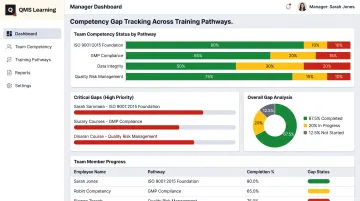
The Manager Dashboard shows quality directors where competency gaps sit across the pathway, so a distributor audit does not rest on one senior engineer's memory.
Frequently Asked Questions
What is the difference between AS6081 and AS5553?
AS5553 applies to OEMs and integrators building counterfeit avoidance programs upstream in their own procurement. AS6081 applies specifically to independent distributors testing and detecting counterfeits mid-chain.
Is AS6081 certification mandatory for electronic component distributors?
AS6081 is required by the DLA for independent distributors supplying certain military electronics categories. OEM customers often require it contractually even outside DLA programs. There is no blanket, industry-wide legal mandate beyond those contexts.
What test methods are required under AS6081?
Common methods include external visual inspection, X-ray/radiographic analysis, electrical testing, decapsulation, XRF material analysis, and solderability/marking permanency testing. Which ones apply depends on the lot's documented risk assessment.
How does AS6171 relate to AS6081 testing requirements?
AS6171 is the companion test methods standard. It defines the detailed procedures, equipment requirements, and pass/fail thresholds referenced whenever AS6081 requires a specific test to be performed.
What happens if a counterfeit part is found during AS6081 testing?
The part is quarantined and dispositioned under the organization's documented control plan. Confirmed counterfeits must be reported to GIDEP, and affected supply chain stakeholders notified.
Who is required to comply with AS6081?
Independent distributors, brokers, and stocking distributors that sell EEE parts into aerospace, defense, and other high-reliability supply chains. That includes organizations qualified under DLA programs or bound by OEM customer contracts.